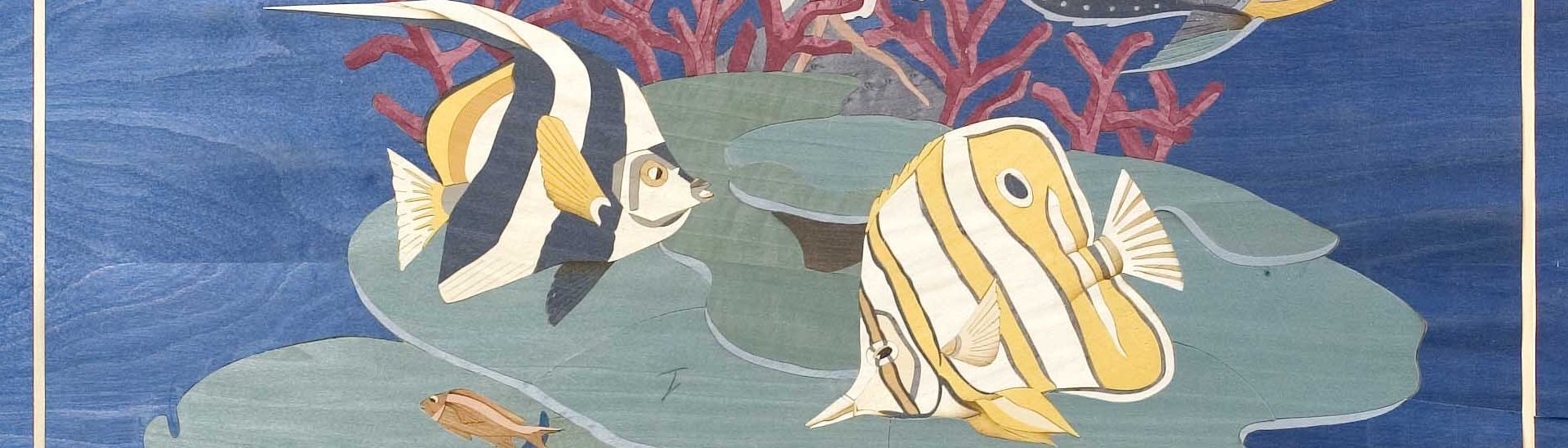
Baby Beds — Sorrento Marquetry
Japan — early 2000s — wood marquetry on furniture
The strangest project. A commission that began with a Glasgow cafe window made in 1984, passed through a hotel in Rome, a mediocre pizza, a bottle of Sassicaia, and a workshop in Sorrento — and ended with two baby beds in two houses in Japan, each one a different underwater world.
My position in things is that if I understand how something is made, I can design for it. That position was tested here more unusually than almost anywhere else in the practice.

Two Beds — Two Worlds
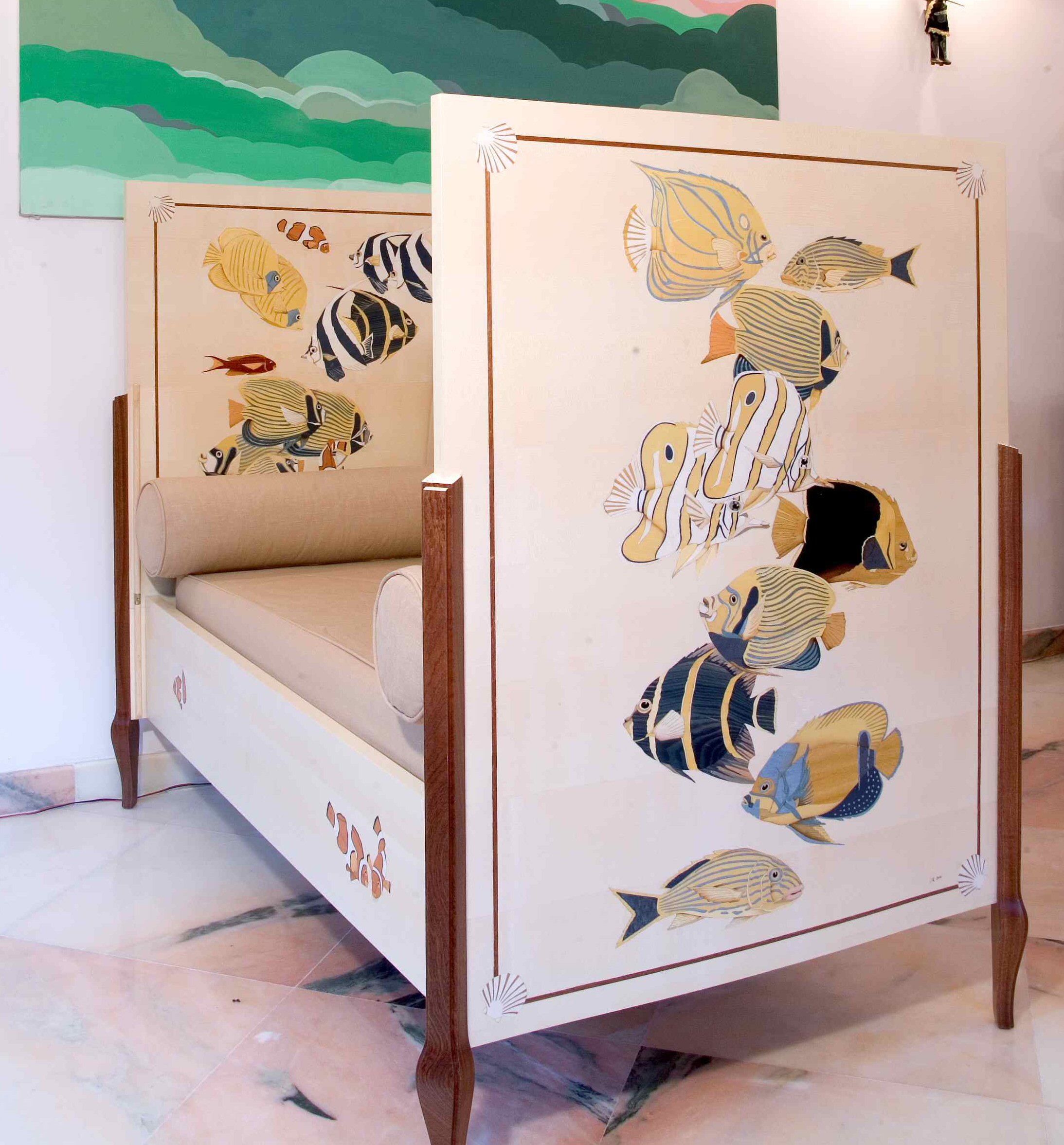
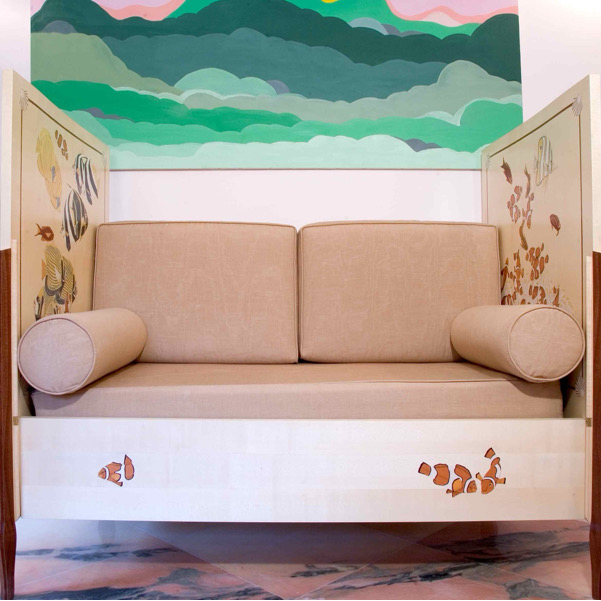
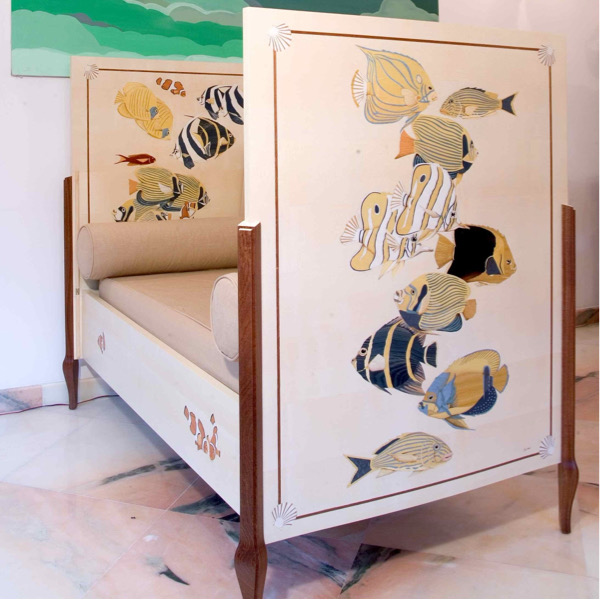
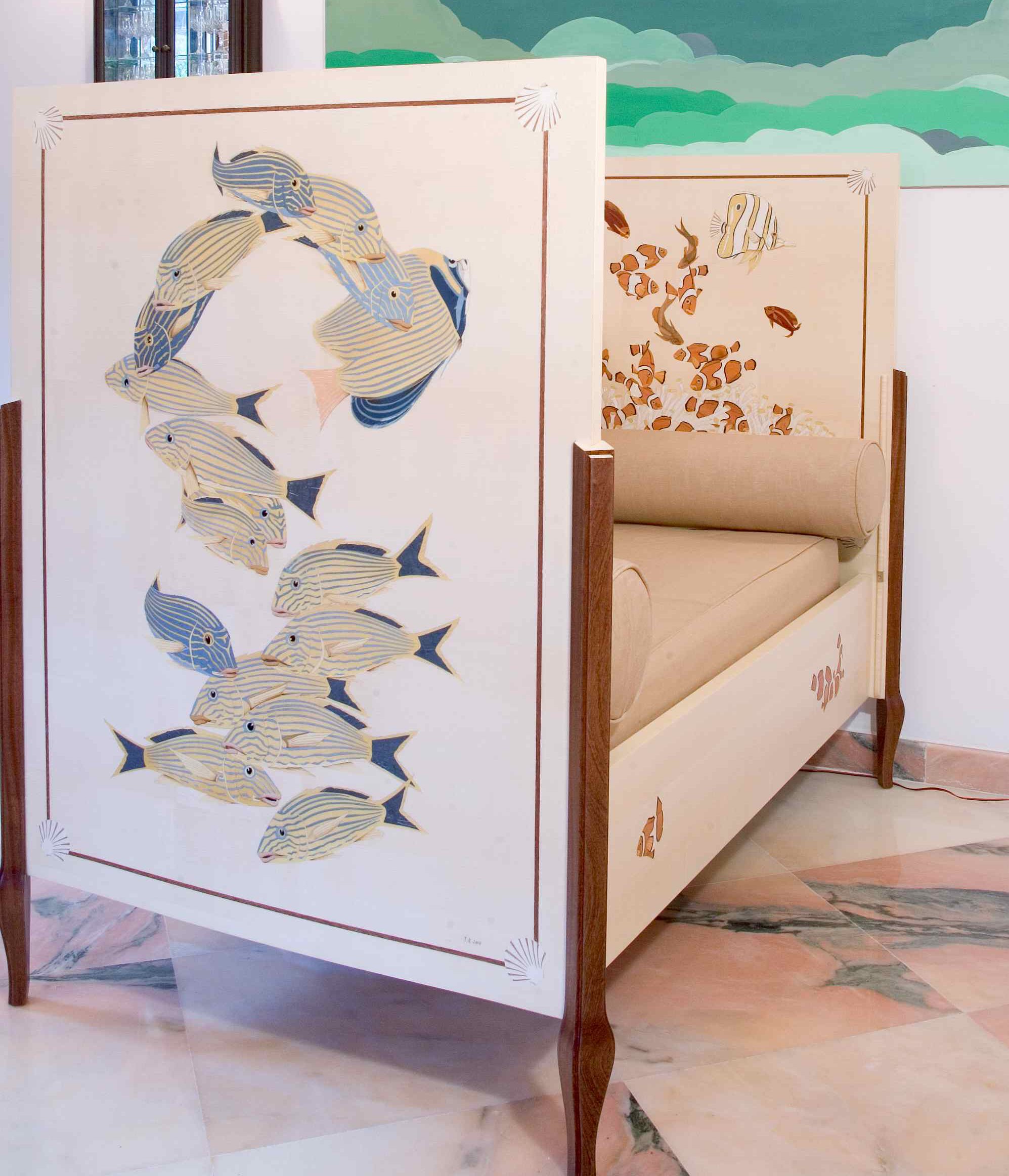
The cream bed — natural wood veneer colours only, the sunlit surface reef
The Cream Bed
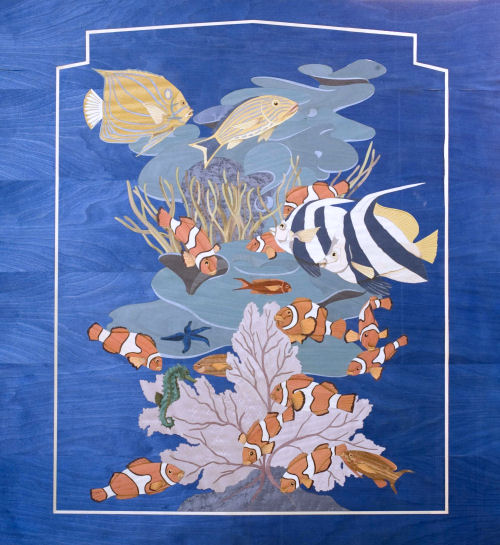
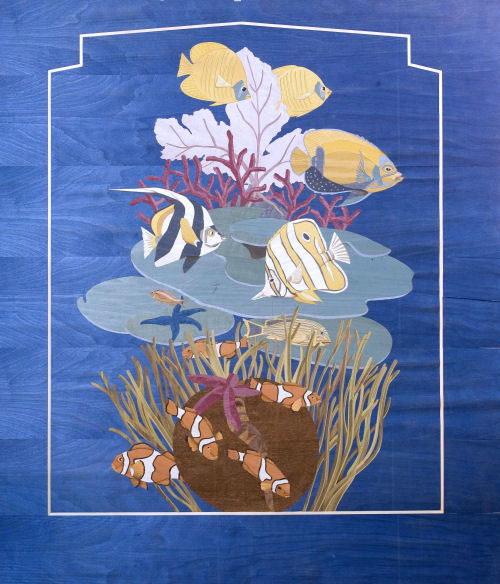
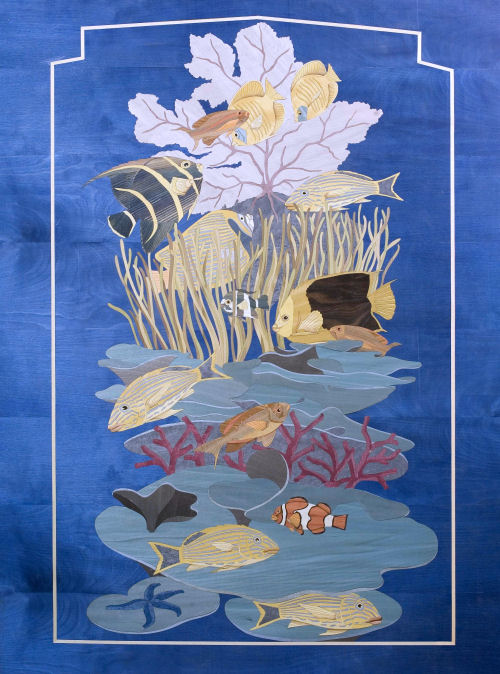
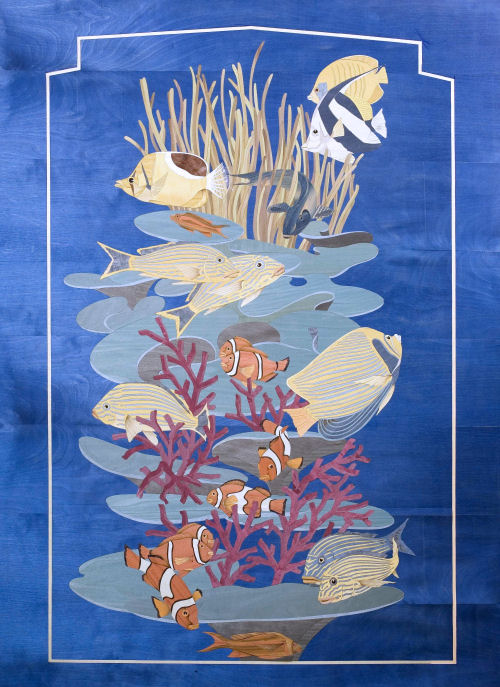
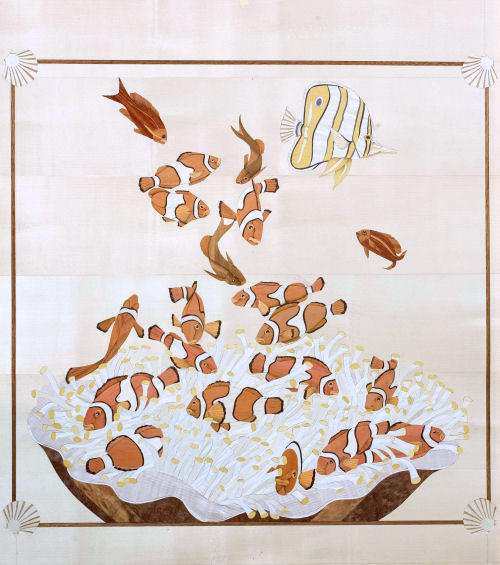
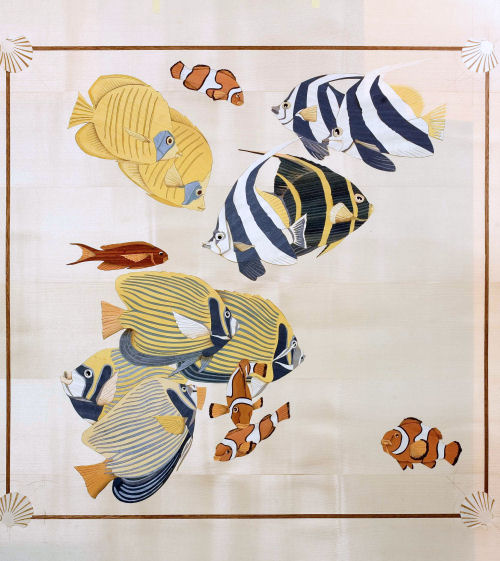
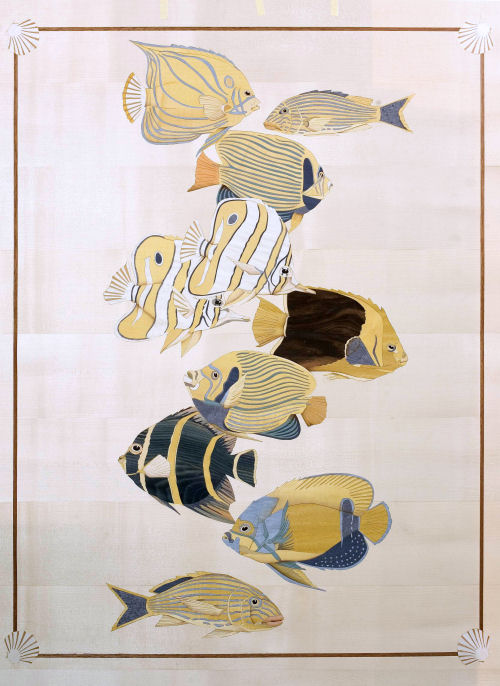
Made entirely from natural wood veneer colours — no dyes. The warm honey tones, the pale creams, the mid-browns and darker woods of different species create the full tonal range of the shallow reef world. Surgeonfish, emperor angelfish, moorish idols, butterfly fish and clownfish move through a marine landscape of coral, seagrass and anemone — all rendered in the natural colour of the wood itself.
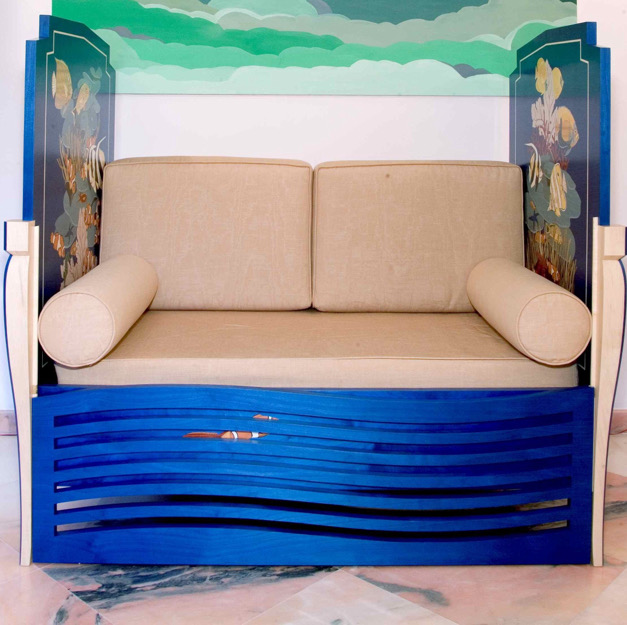
Designed from the outset to convert into a sofa as the child grew older — the wavy slatted rail becoming the back support, the upholstered seat and bolster cushions already part of the design. A piece of furniture conceived for a child's whole childhood, not just the infant years.
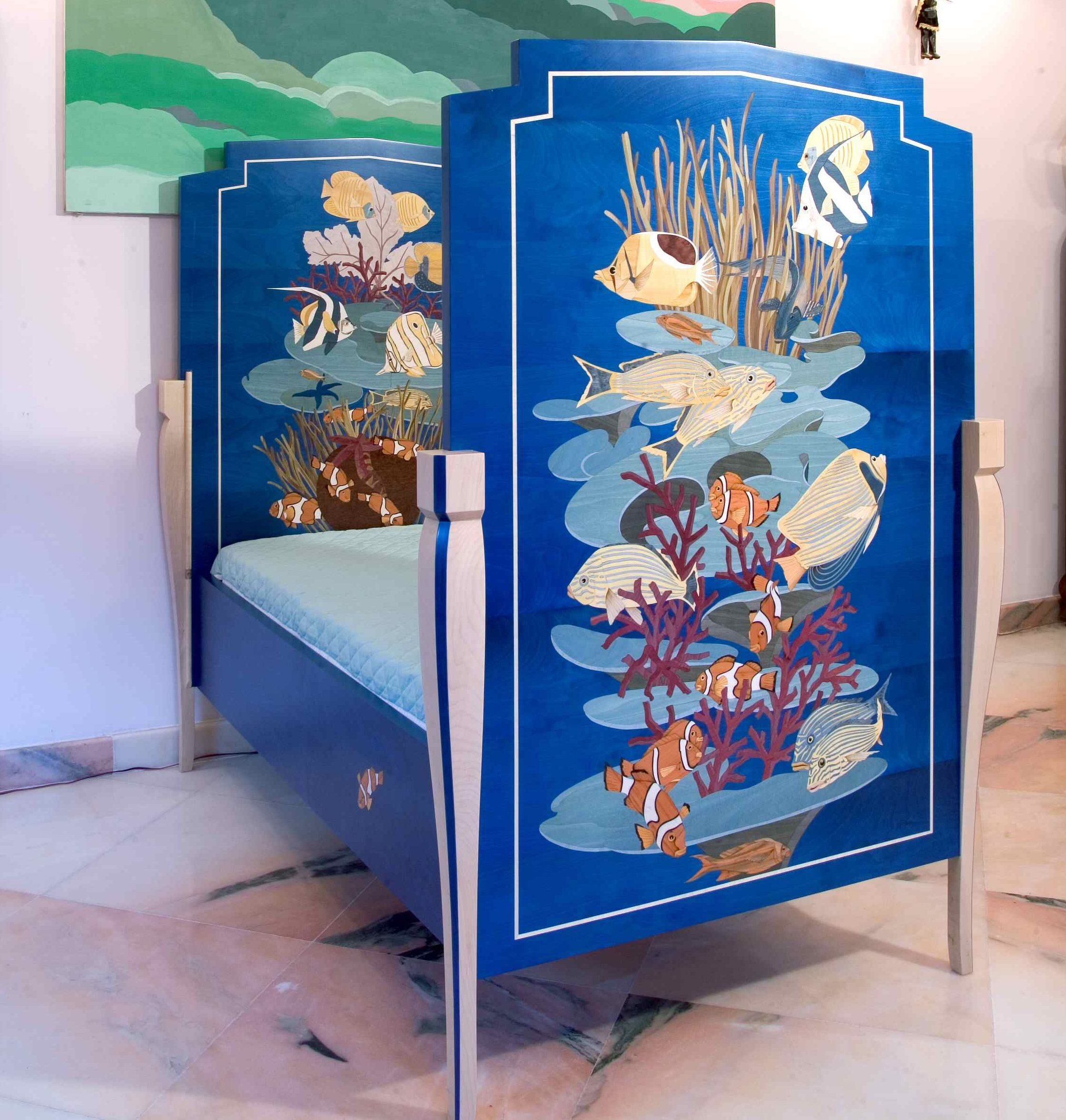
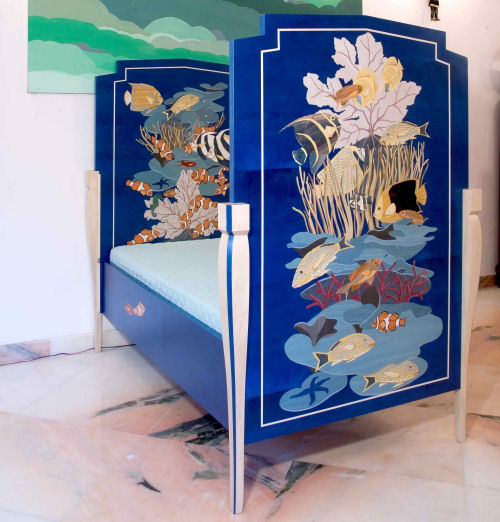
The cobalt blue bed — dyed veneers, the deep ocean world
The Blue Bed
Made with dyed veneers — the palette extended into the deeper, more saturated colours of the ocean world below the surface. The same species as the cream bed, now reading as creatures of depth rather than light. The cobalt blue ground, the richer oranges of the clownfish, the more intense greens of the seagrass — the same fish in a different world.
A single clownfish runs along the base rail — connecting this bed to its companion across the two houses in Japan. The same fish, different colour, different house, different world. A child moving between two homes finds a different ocean in each one.
Rome — Hotel Eden
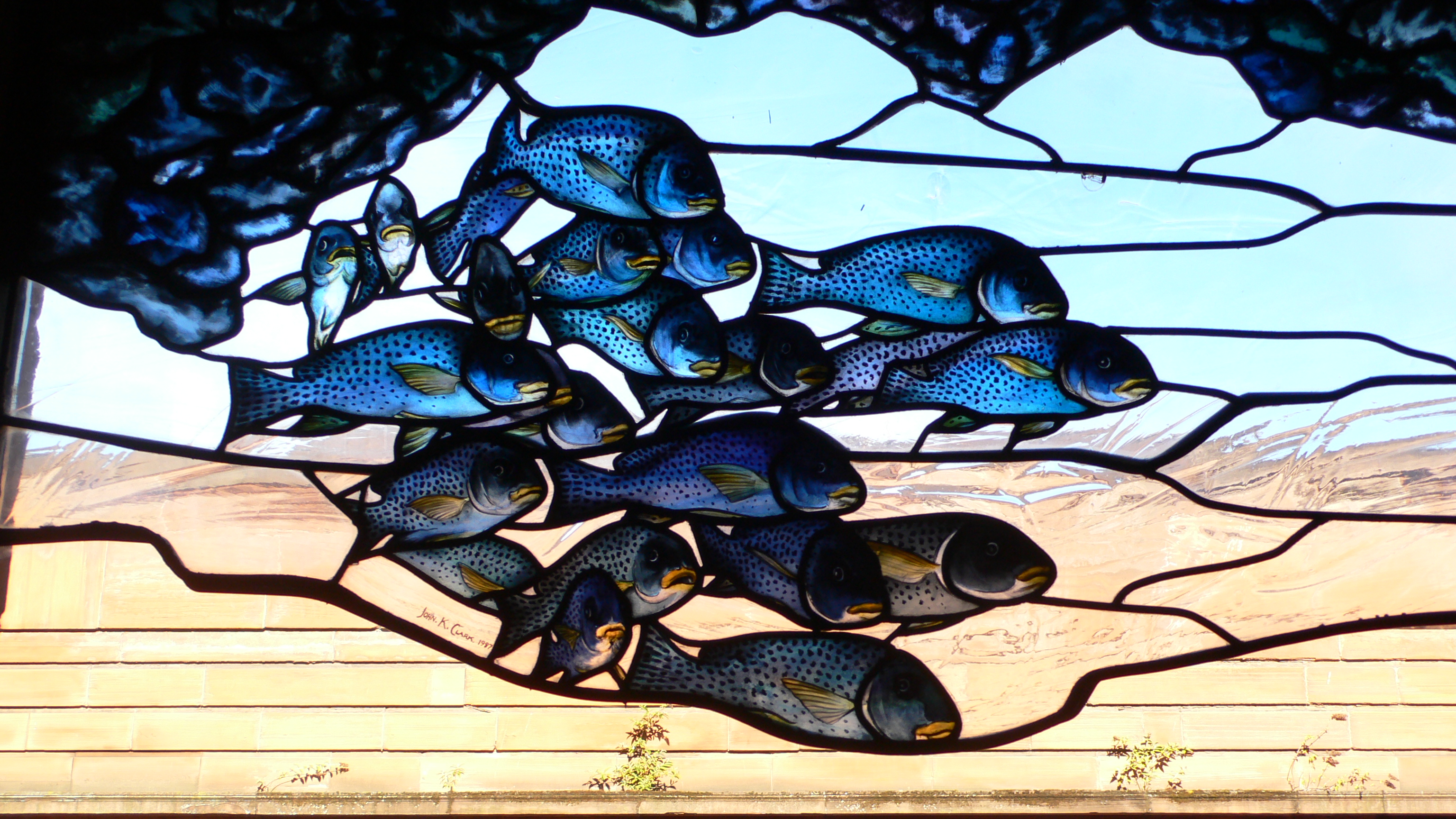
A Flock of Fishes — Cafe Gandolfi, Glasgow, 1984. The windows that began everything.
How It Began
A Japanese friend of mine set up a meeting with one of her clients — a relatively young Japanese man she had been employed to help spend money on interesting things. He had loved the Cafe Gandolfi windows in Glasgow. He asked me to come to Rome to the Hotel Eden.
He seemed completely disinterested in speaking to me. I had brought him two bottles of wine from one of the best winemakers I know from Hochheim — a Trockene Riesling Spätlese and an Auslese. That seemed to be a bridge. He barely spoke English and I didn't speak any Japanese. We went out for a mediocre pizza — a get-to-know-each-other kind of chat through my friend as interpreter. Before we left the hotel, he had ordered a bottle of Sassicaia to be opened and ready. It cost a fortune in that place.
I thought he wanted some glass work. He asked me if I could do mosaic — I said yes, I had studied mosaic and done some work in it. Then he said: wood mosaic. I didn't know what he meant.
We went out and he showed me. It was a very picturesque version of marquetry. My position in things is that if I understand how something is made, I can design for it. He said: "I want you to make me a baby bed."
And so began a very strange time.
The Sorrento Technique
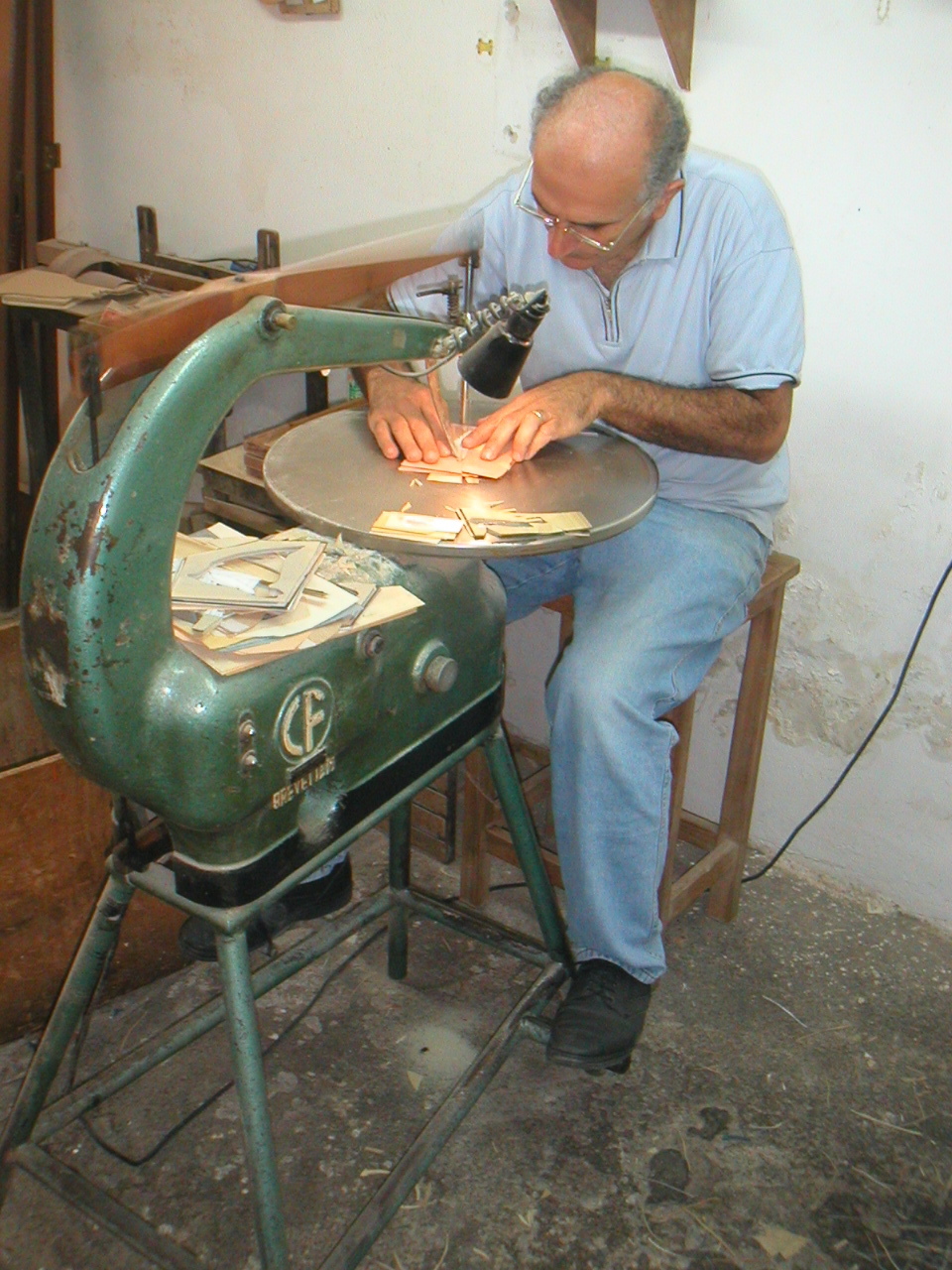
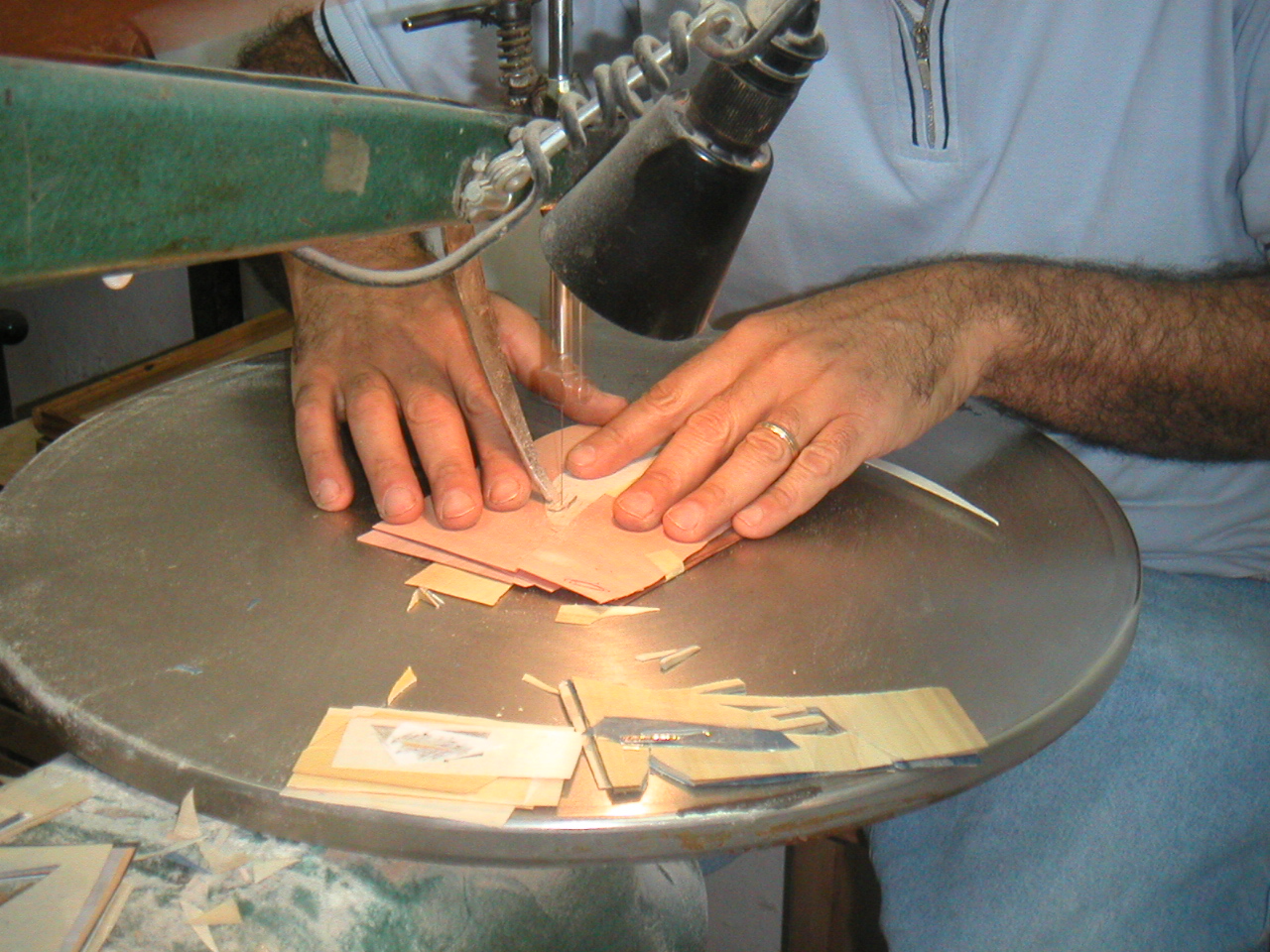
The cutting machine — a thin blade descending from a curved arm, cutting through stacked layers of veneer simultaneously
Wood Mosaic
Sorrento has been the centre of Italian marquetry for centuries — intarsia, the art of pictorial wood inlay. In the workshop I visited, the tool that does the essential work is a cutting machine that looks remarkably like a sewing machine: a thin vertical blade descending from a curved arm above a round metal table, the craftsman guiding the work by hand.
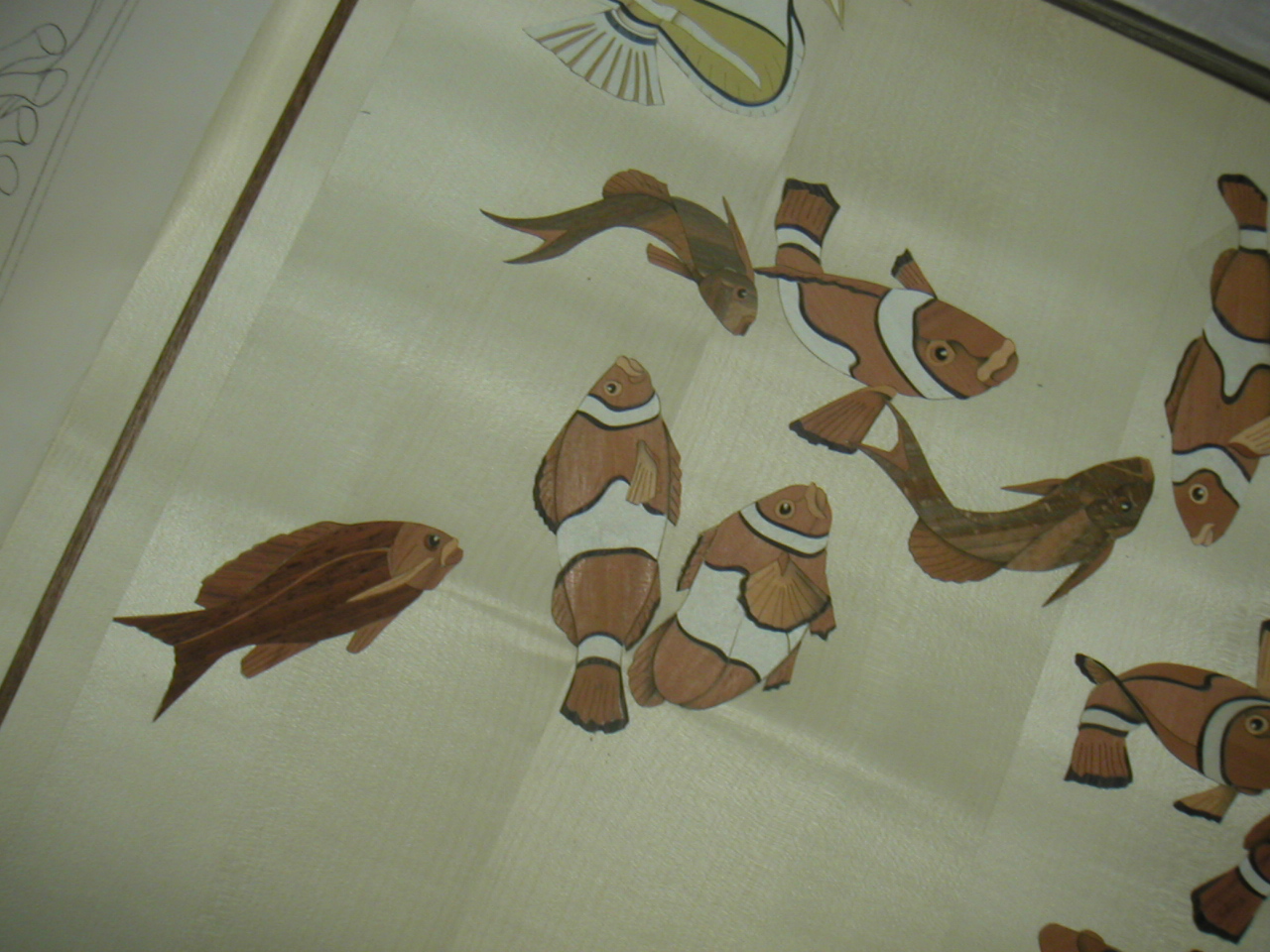
Multiple layers of wood veneer are stacked together — the design drawn on the top layer as a guide. The blade cuts through all layers simultaneously, producing both the positive shape and the negative hole at exactly the same moment. A clownfish cut from one veneer leaves a clownfish-shaped hole in another. The pieces interlock perfectly because they were cut together from the same stack.
I went to Sorrento, visited the workshops, and looked at the range of veneers — the natural colours, the grain directions, the dyed colours, the textures. I took samples. I understood how it was made. I could design for it.
The workshops seemed focussed on how to take the project away from me and take it over themselves. I kind of understand that when artists come into a glass project with no understanding of the material or methods. I carried on regardless, I had been commissioned. In every medium I have ever used — glass, bronze, mosaic, roof tiles — I go to where the work is being made, I watch, I select, I correct. They had sildom been confronted with an artist who worked this way before. But it is the only way I know.
What They Normally Made
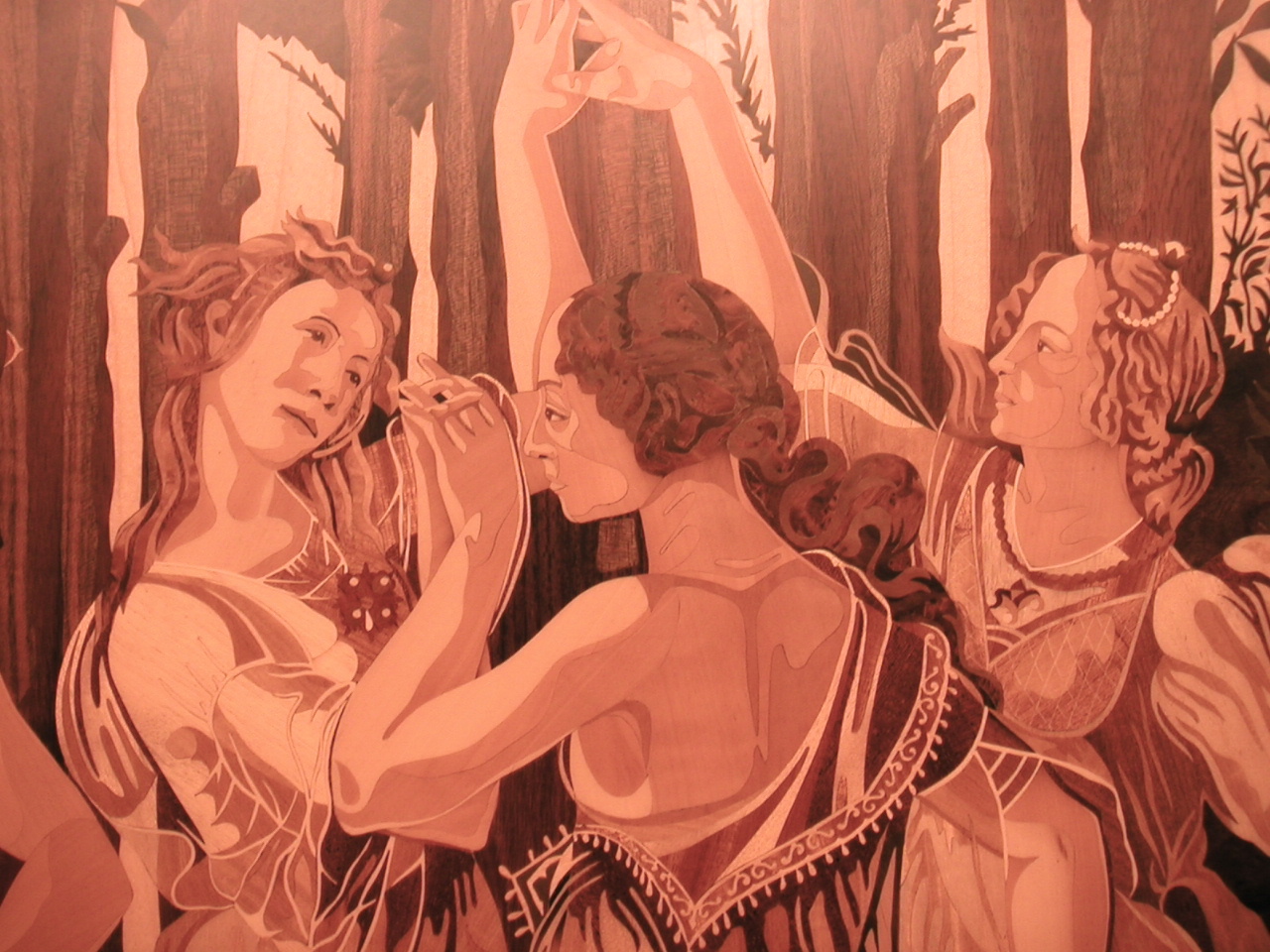
The traditional Sorrento style — figurative scenes of extraordinary craftsmanship in natural wood tones. Beautiful work, but not what this commission required.
A Different Tradition
The Sorrento workshops had their own well-established repertoire — figurative scenes in the manner of Renaissance painting, elaborate botanical subjects, landscapes and allegorical compositions, all executed in the warm rosy tones of natural cherry and walnut veneer. The craftsmanship is breathtaking. The cutting precision, the detail in the faces and the foliage, the tonal range achieved entirely through the selection of different wood species — these are the product of a tradition refined over centuries.
But it is a tradition demonstrating its own virtuosity rather than responding to a specific brief. The workshops were set up to make beautiful things in a particular way. A commission that required something completely different — marine subjects, tropical fish, bright colours, furniture designed for a child's life — was outside their normal frame of reference. They wanted to do what they had always done. At the beginning, I kept asking what does the furniture look like, until I realized that I had to do that too.
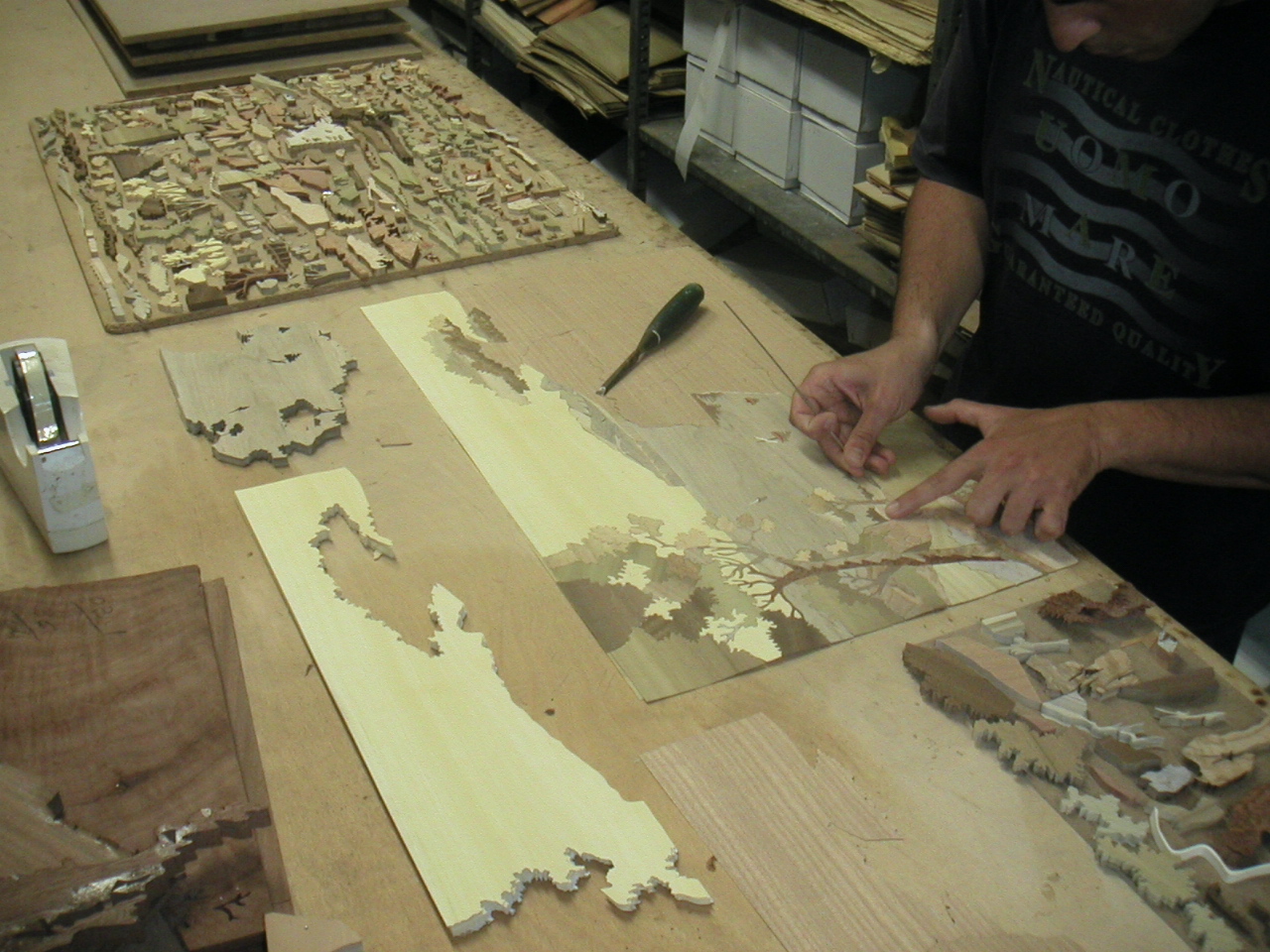
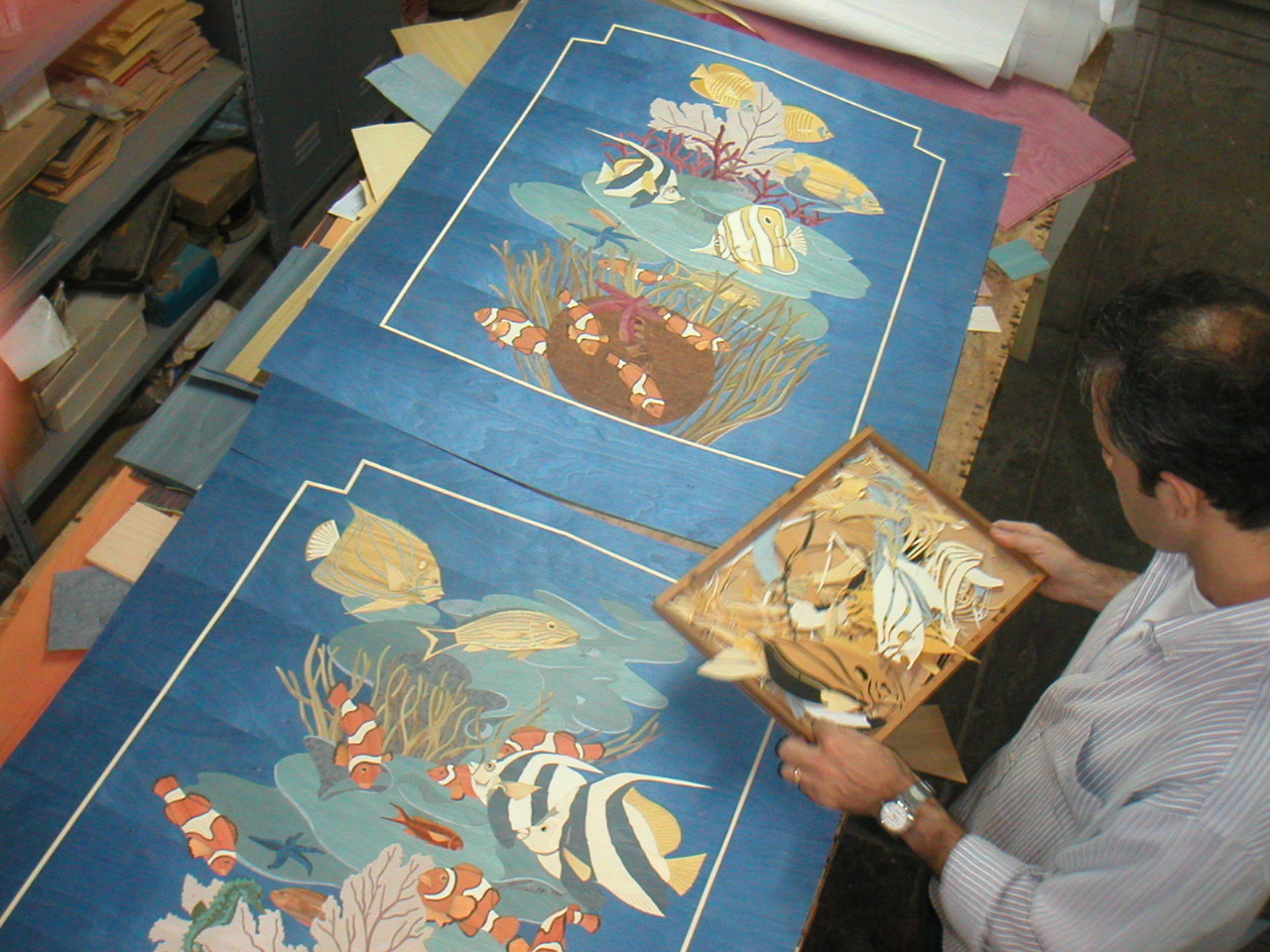
Landscape panels in progress — the tray of city scene pieces in the background shows the multiple-copy production method
The Multiple-Copy Method
The stacked veneer cutting method is designed for repetition. By cutting through ten or more layers of veneer simultaneously, the workshop produces ten identical sets of pieces from a single cut — ten copies of the same landscape, the same figurative scene, the same decorative panel. The economics of the craft depend on this capacity for reproduction.
A unique artist-supervised commission — designs that could not be reproduced, supervised at every stage, corrected as the work developed — was a completely different kind of work. I had to insist on an exclusivity agreement covering the designs. Whether that agreement was fully honoured I cannot say. But the principle mattered: these were designs made for a specific client, for specific spaces, and they should not become part of the commercial repertoire.
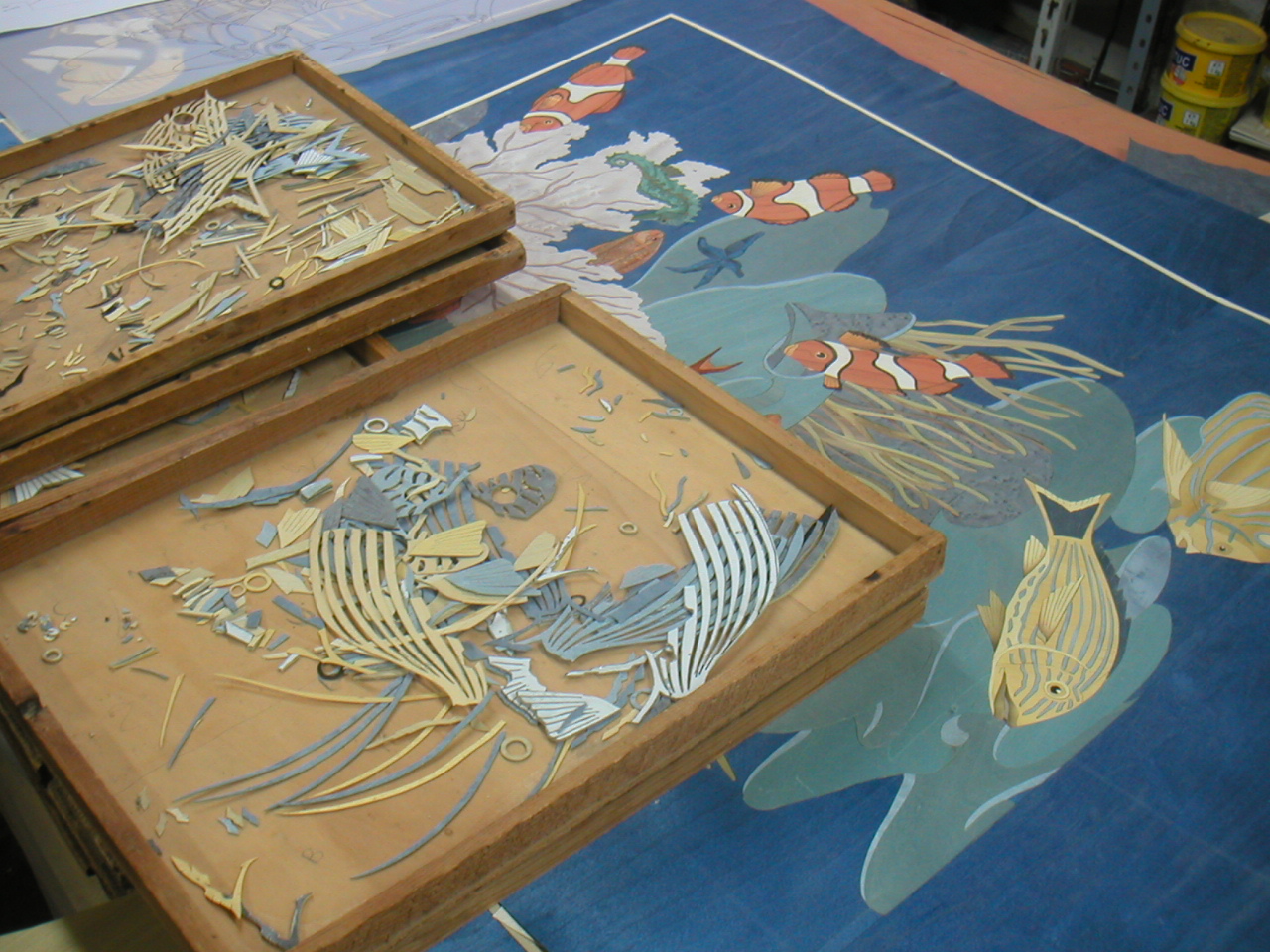
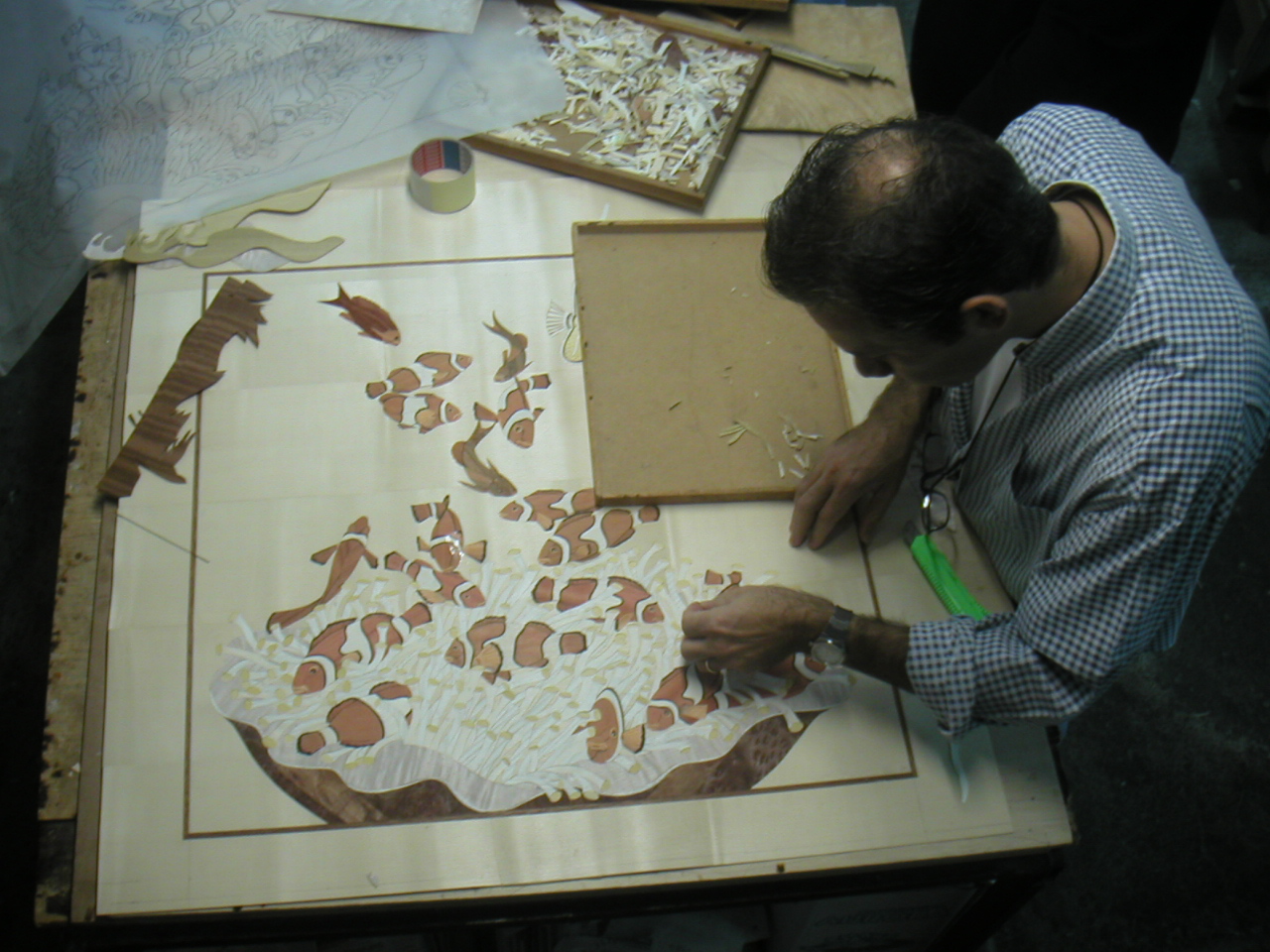
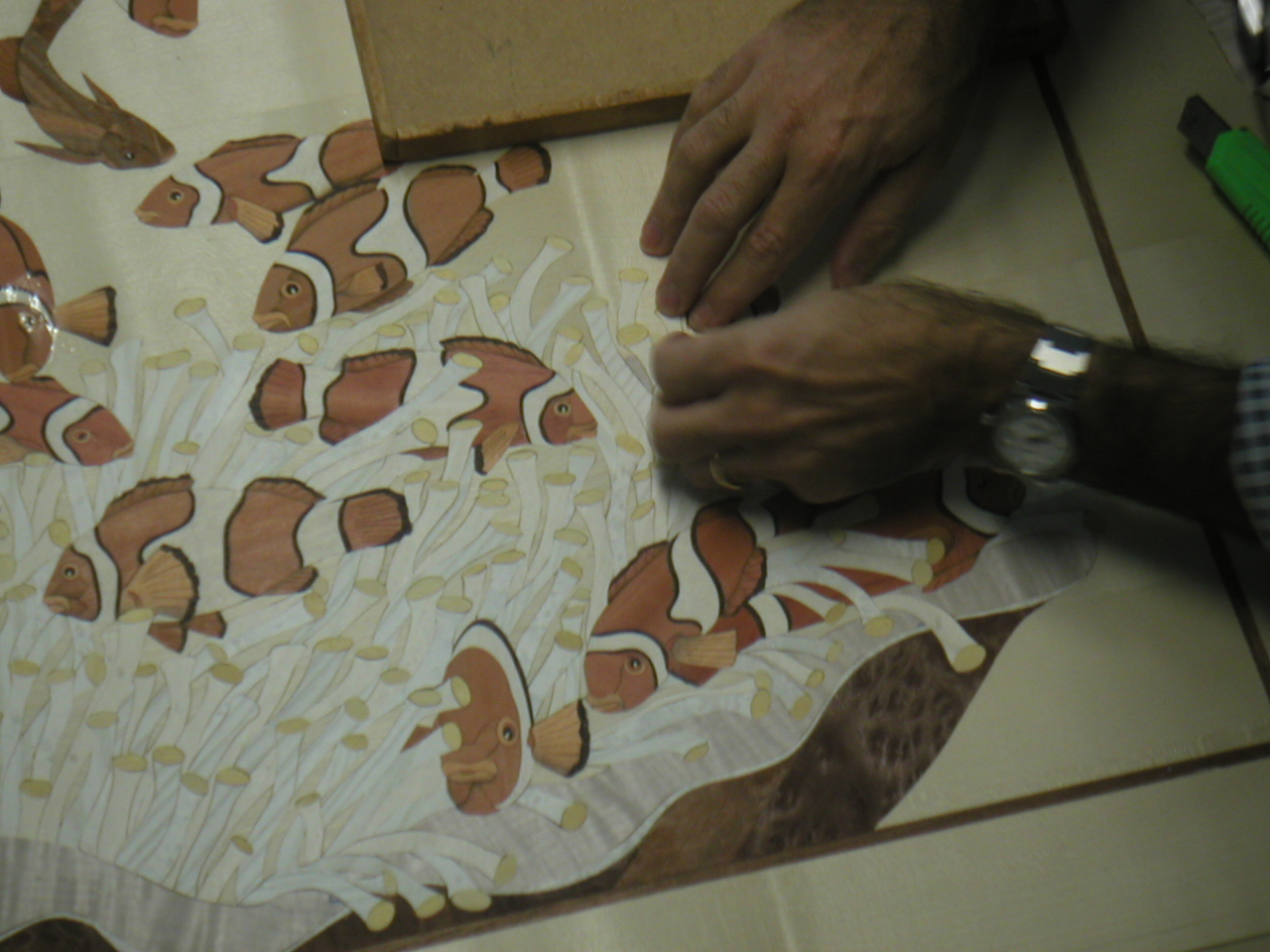
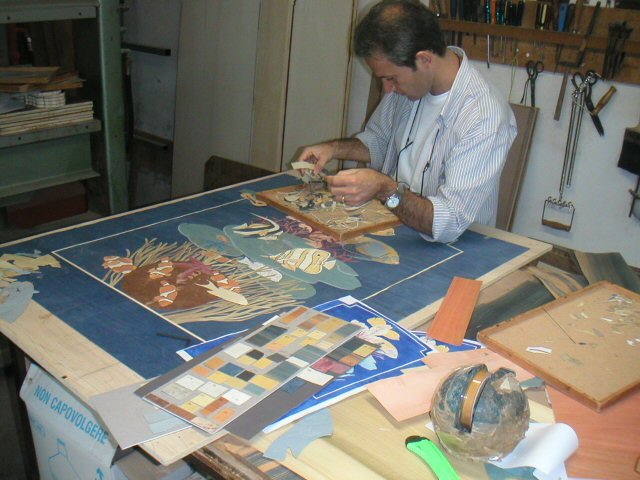
The assembly process — each piece placed by hand into its corresponding space in the composition
Selecting and Correcting
What I brought to Sorrento was not just a set of designs but a way of working that was unfamiliar to the workshops. In every medium I have ever used — glass, bronze, mosaic, roof tiles — I go to where the work is being made. I watch. I select which veneer goes where, just as I select which sheet of glass goes in which position at the light table. I correct when the composition is not reading as it should.
The craftsmen had never worked with an artist who operated this way. Their instinct was to follow the design mechanically and apply their own judgement about the materials. My instinct was to treat the making as a continuation of the design process — the veneer selection as important as the drawing, the assembly as much a creative act as the original concept.
It took time. But that is the only way I know how to work.
The Sweetlips
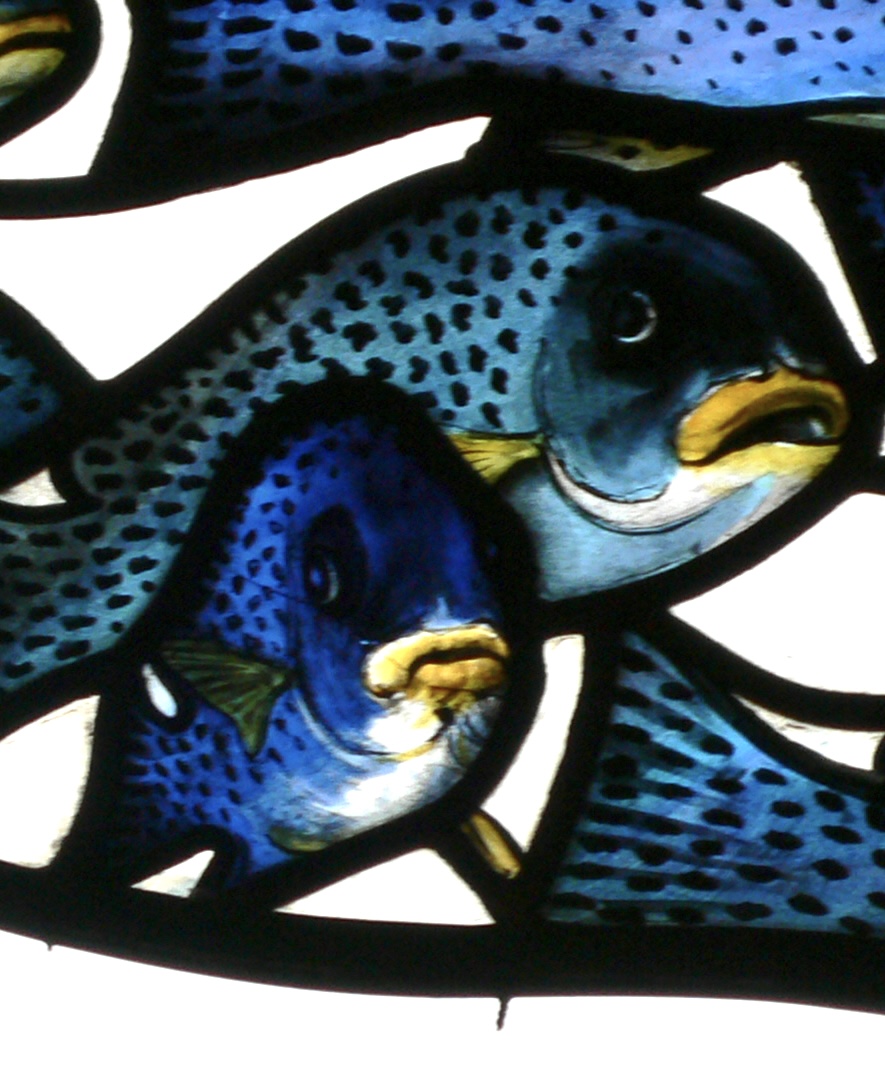
detail of the sweetlips in the Cafe Gandolfi window
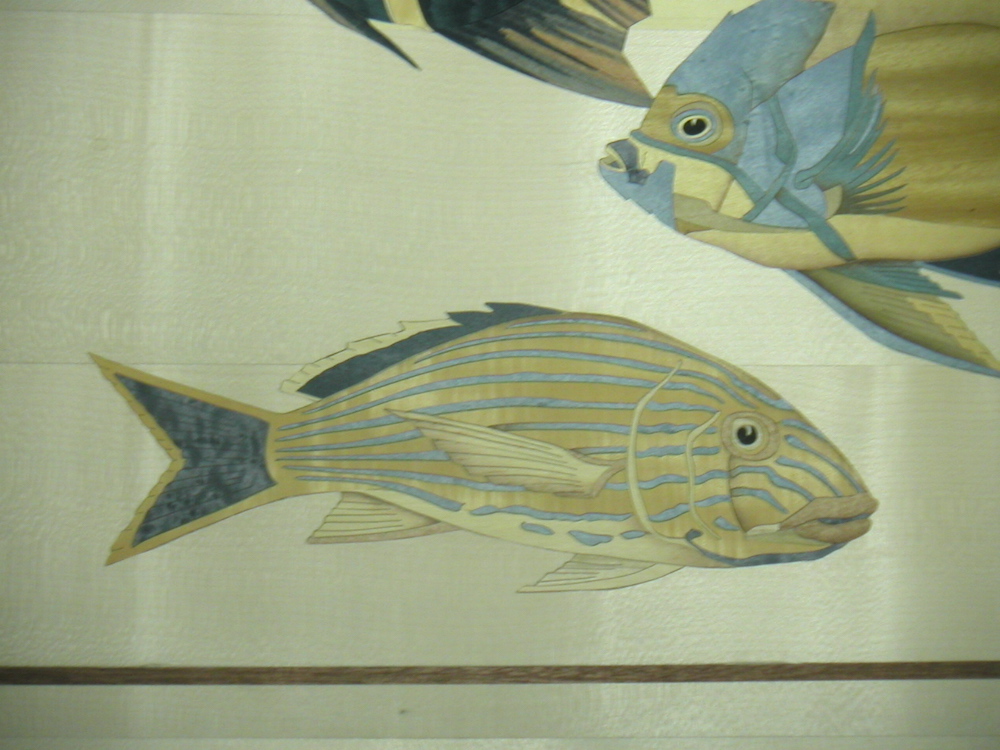
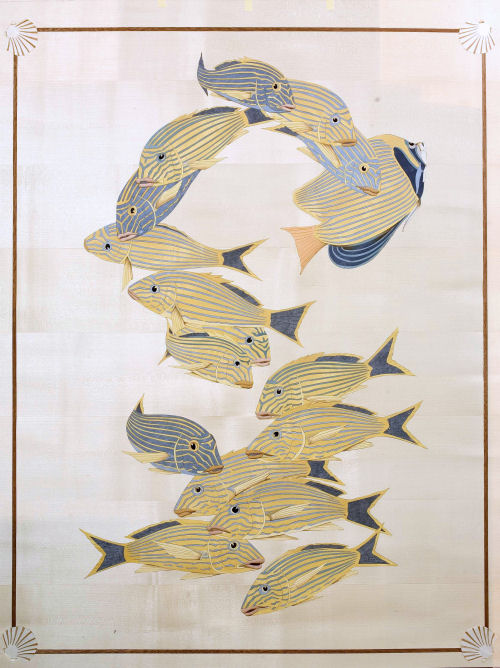
instead of spots, I found a similar fish that had stripes, it worked better.
The Fish That Started Everything
The client had given me no themes except that he liked the fish in the Cafe Gandolfi windows. The fish that I had made in Glasgow in 1984 — the Sweet Lips in deep cobalt blue glass — had brought him to the commission.
I developed the whole series of designs using the sweetlips and spots, it is possible within marquetry that the spots are burned onto the veneer, but it didn't feel right, so I found a striped version of a similar fish, another grouper, and that felt right.Unlike a painting, the colour of a marquetry panel will not fade. The colour is the wood itself — permanent, structural, as durable as the material allows.
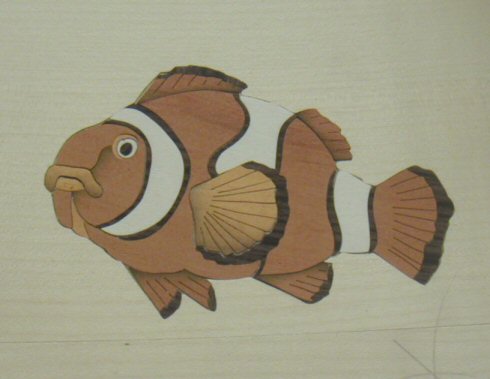
The clownfish appears in both beds — the connecting thread between the two houses in Japan, the same species swimming through both colour worlds.
The Making — Sorrento
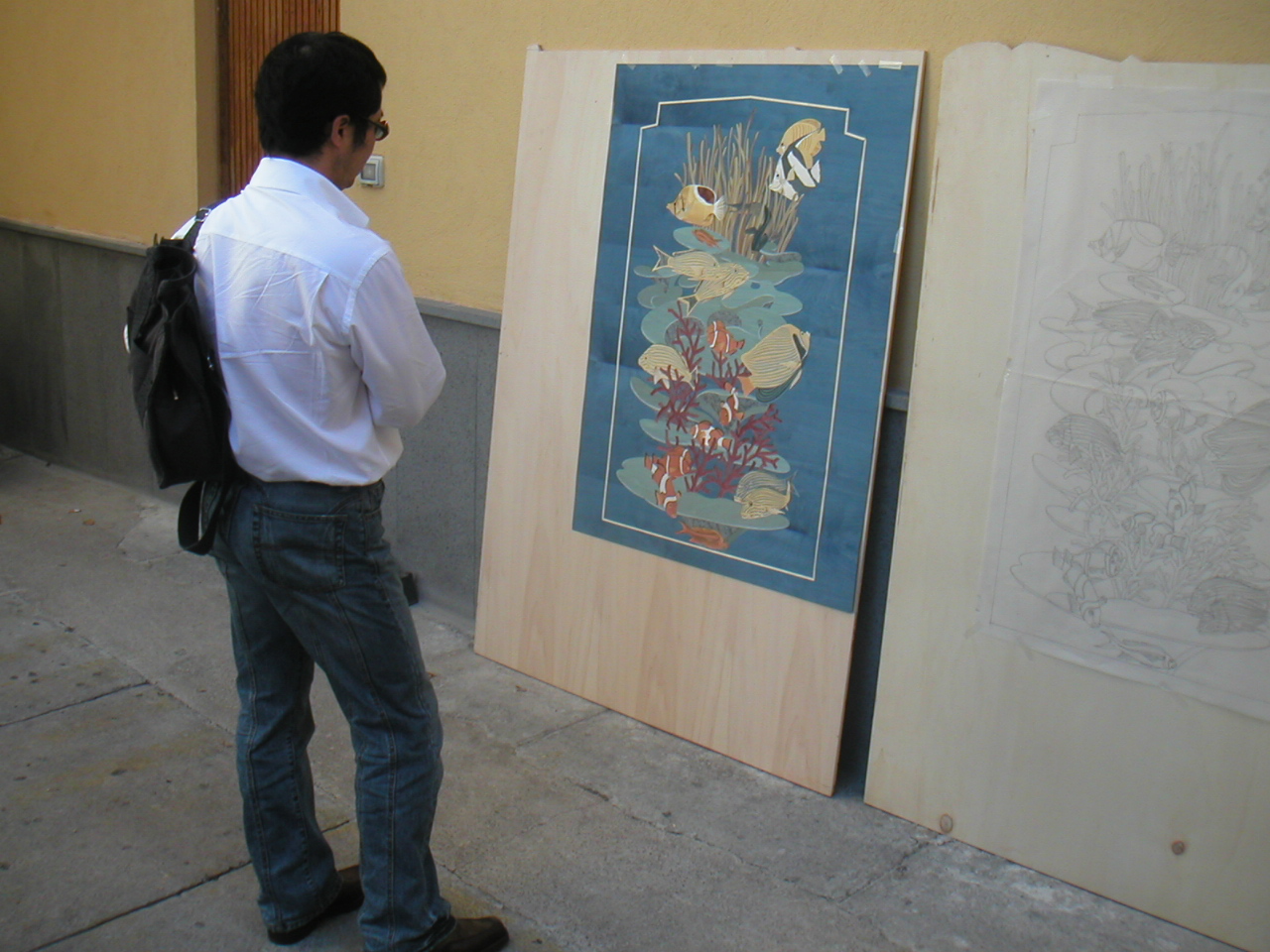
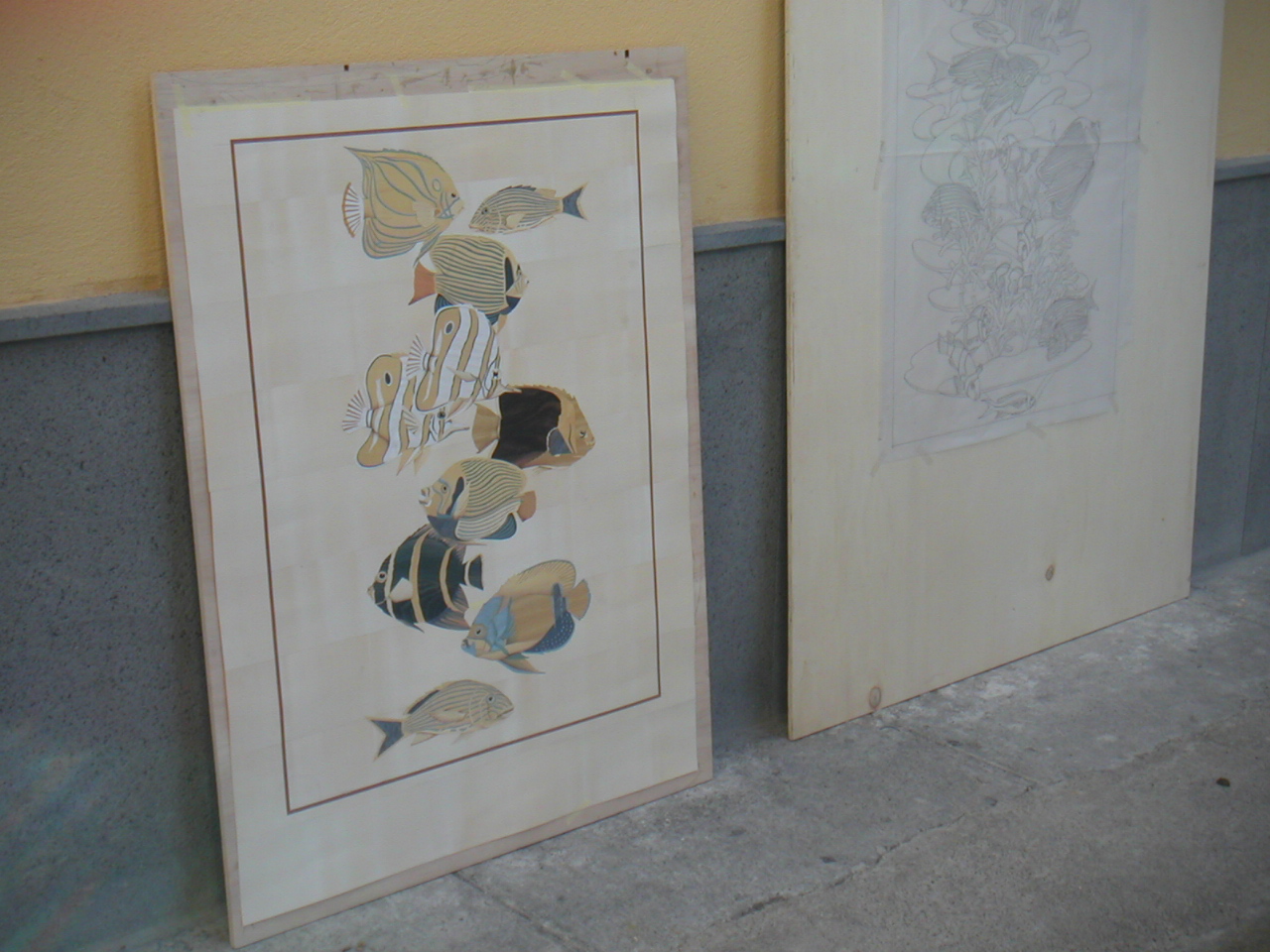
Two Houses — Two Colour Worlds
The client now decided he wanted two baby beds — one for each of his houses in Japan. I decided, without being asked, that both beds should be designed to convert into sofas as the child grew older. A piece of furniture designed for the child's whole childhood rather than only the infant years. The decision to convert was mine, not the client's. It seemed the right thing to do.
Two beds meant two design concepts. Two colour worlds — one for each house, each one a different version of the same underwater theme. The clownfish swimming through both, a connecting thread between the two spaces.
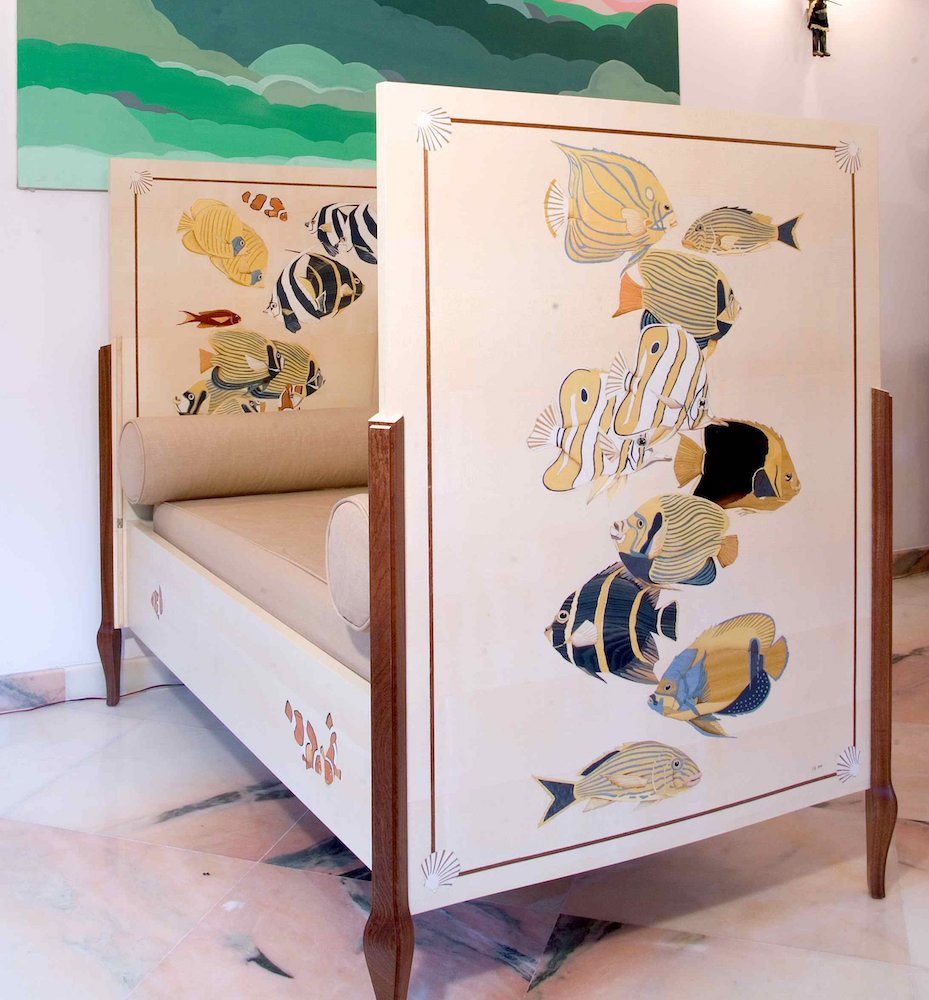
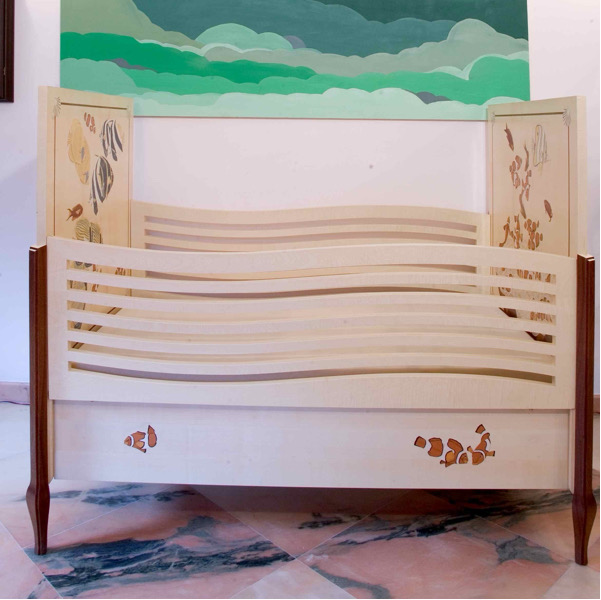
The cream bed — natural wood veneer colours only, the sunlit surface reef
The Cream Bed — The Sunlit Reef
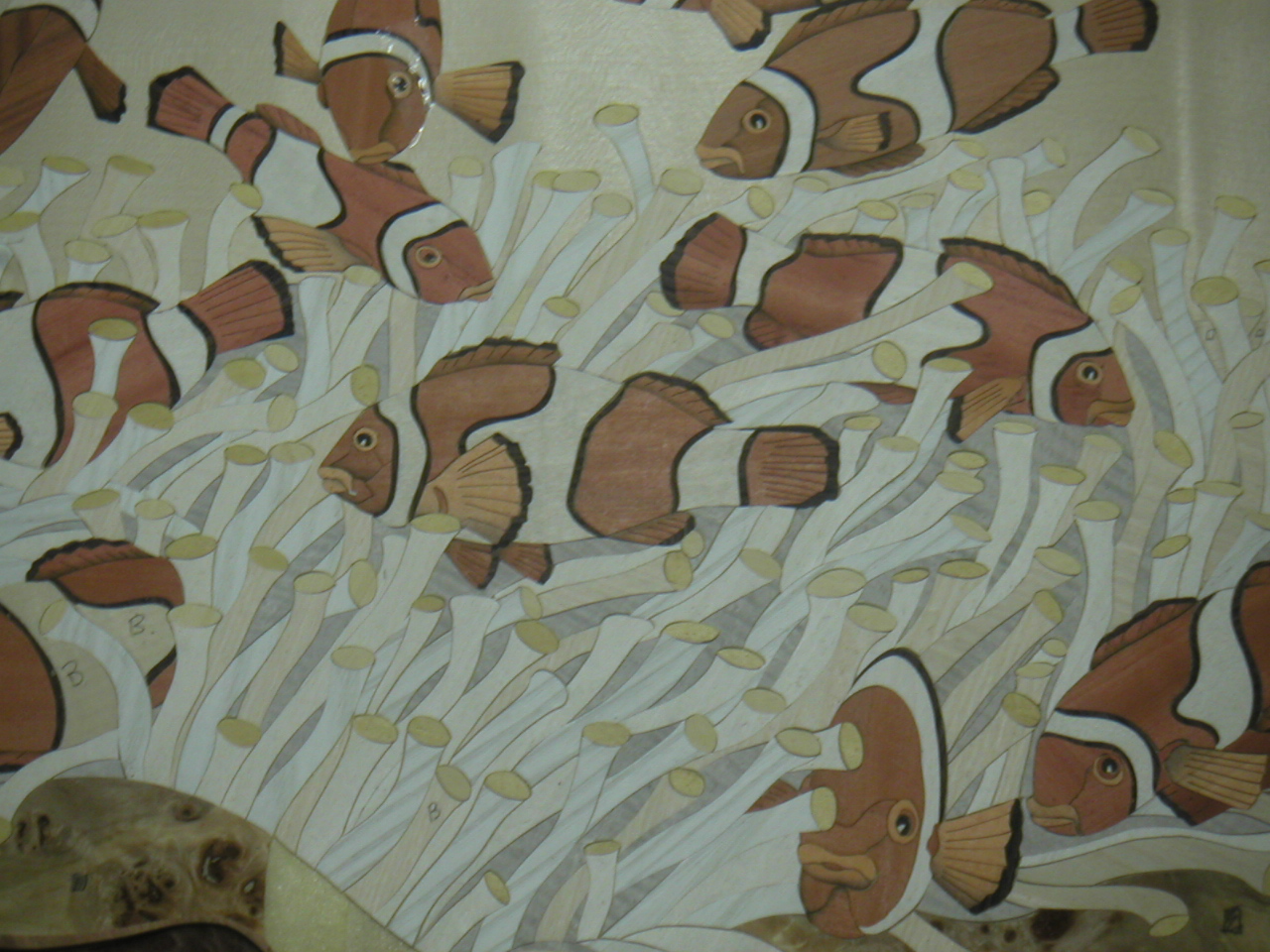
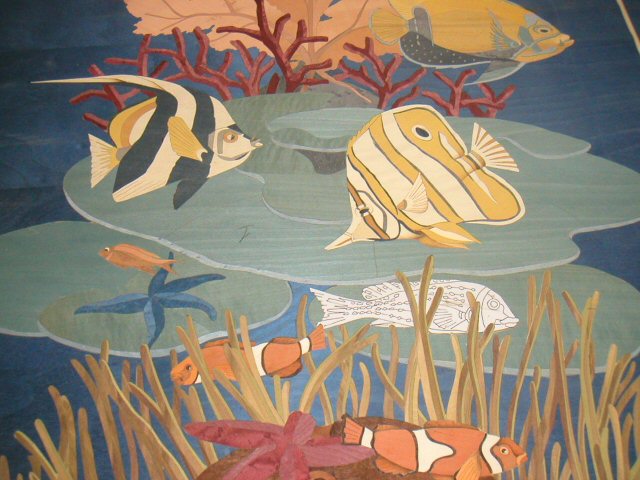
For the cream bed I used only natural wood veneer colours — no dyes. The warm honey tones, the pale creams, the mid-browns, the subtle grain variations of different wood species creating the full tonal range. The result is warm and muted — the colours of shallow water, of sunlight falling through to a sandy reef floor.
The panels show a dense shoal of striped surgeonfish on one side and a more dispersed grouping of tropical reef species on the other — emperor angelfish, moorish idols, butterfly fish. The clownfish run along the base rail, a connecting thread that reappears in the cobalt bed in a different light.
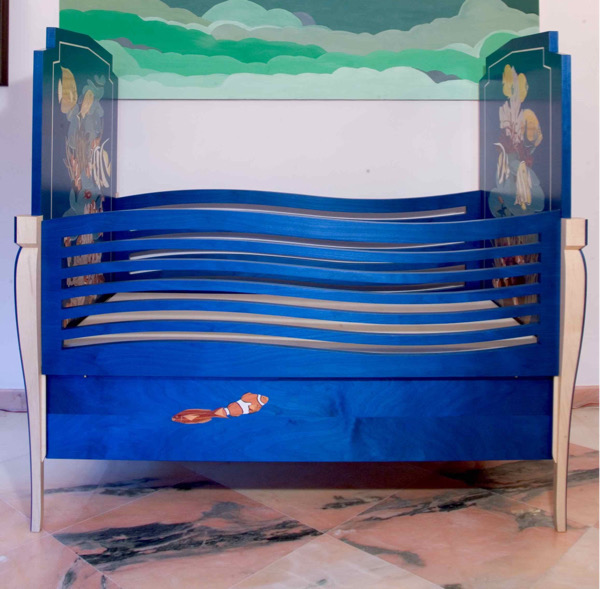
The wavy slatted rail of the cot echoes the water theme of the panels. When converted to a sofa the rail becomes the back support, the upholstered seat and bolster cushions already designed into the piece from the beginning.
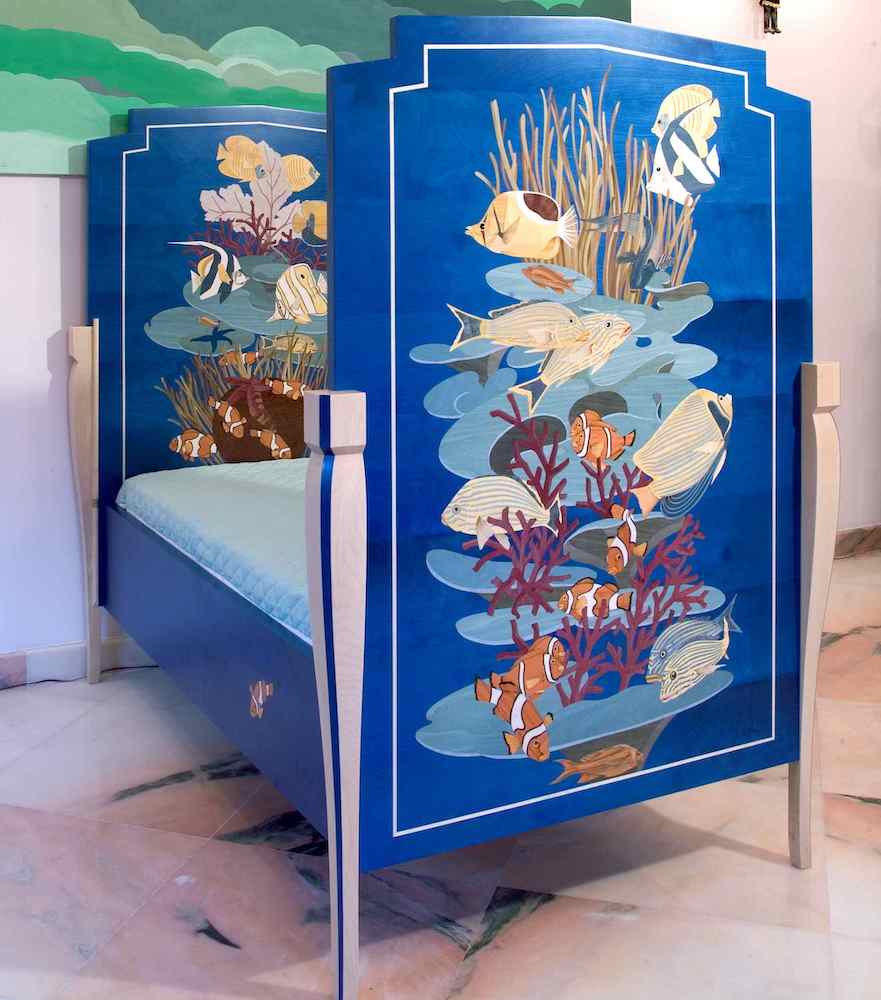
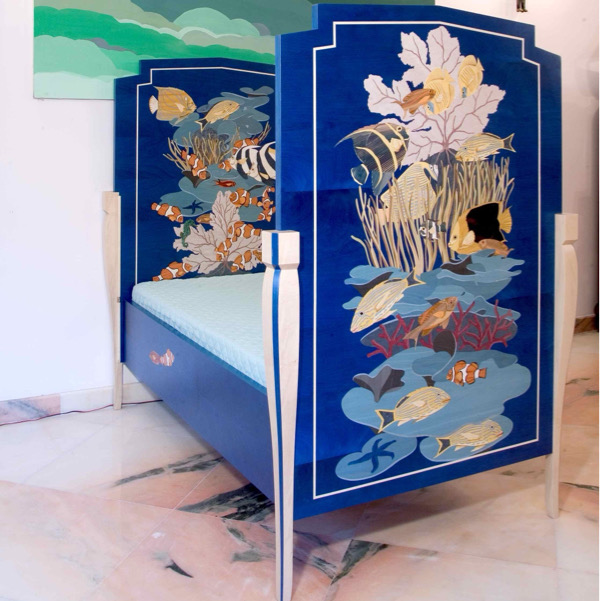
The cobalt blue bed — dyed veneers for the deep ocean world
The Blue Bed — The Deep Ocean
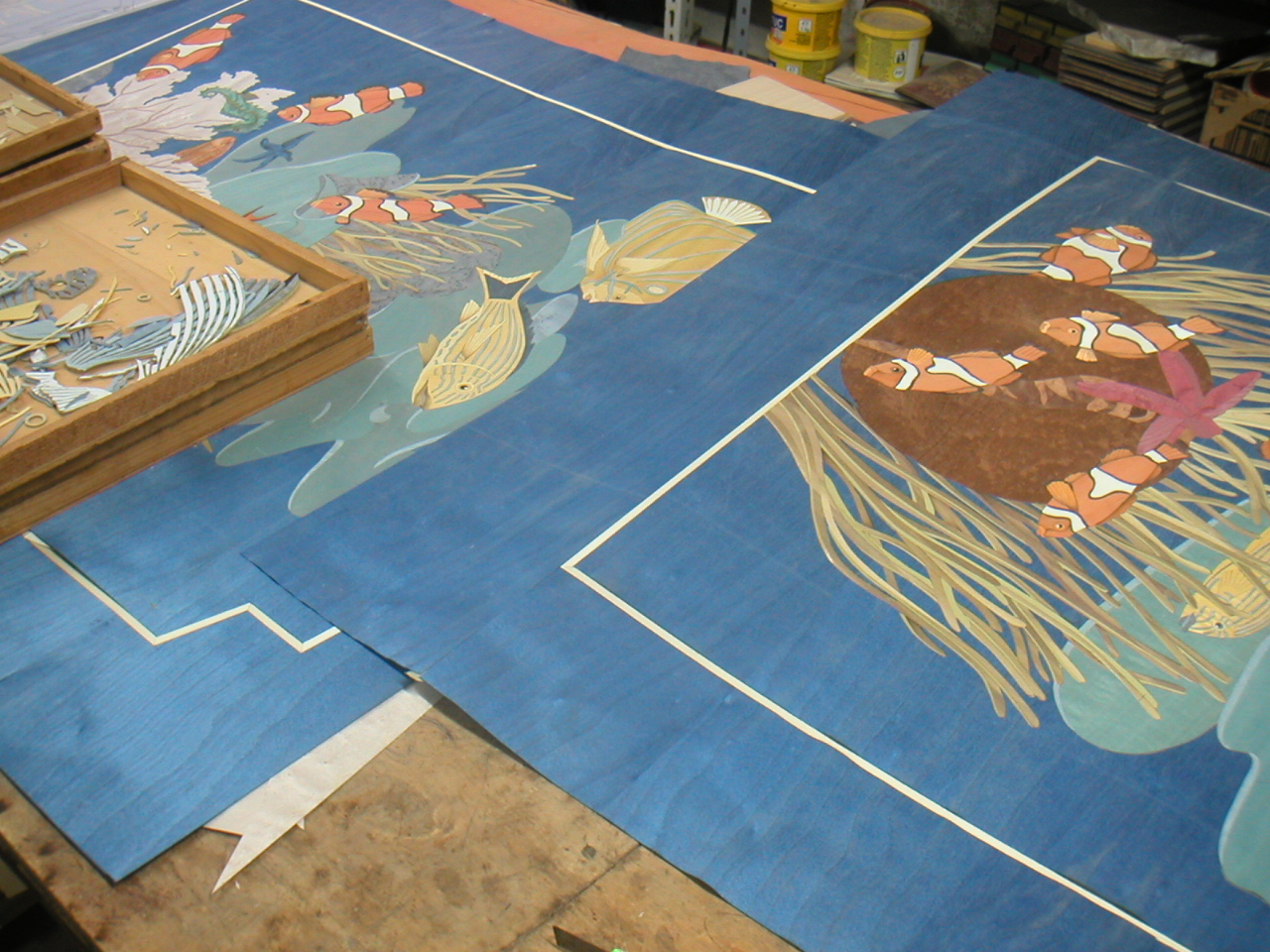
For the cobalt blue bed I used dyed veneers — extending the palette into the deeper, more saturated colours of the ocean world below the surface. The deep blue ground, the richer oranges of the clownfish, the more intense greens of the seagrass.
The panels build a full reef habitat in three layers — seagrass beds at the base, coral heads in the middle register, open water above. The ecological layering creates genuine depth and movement. The same species as the cream bed, now reading as creatures of depth rather than light — a different world, the same fish.
A single clownfish along the base rail connects this bed to its companion across the two houses in Japan. The same fish, different colour, different house, different world. A child moving between two homes finds a different ocean in each one.
The Finished Beds
The Thread
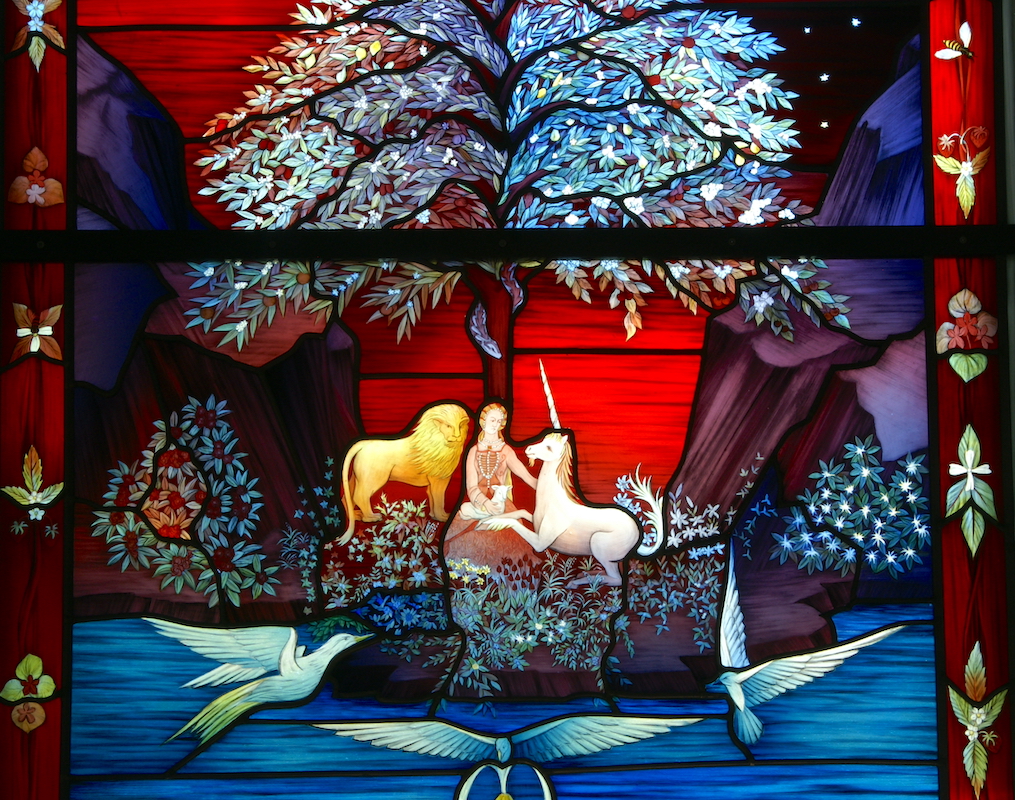
Cafe Gandolfi, Albion Street, Glasgow — A Flock of Fishes, 1984. Saltire Award 1988. Still there.
Glasgow 1984 — Japan — Pinehurst
The same Japanese client subsequently commissioned a further work — End of the Age of Innocence, an allegorical window in the medieval tradition for a private house in Pinehurst, North Carolina. Three commissions across two decades, three completely different media — stained glass, marquetry, painted glass — from one creative relationship that began because a visitor to a Glasgow cafe looked up at a window in 1984.
The Cafe Gandolfi Flock of Fishes is still in place on Albion Street. It has been there for over forty years. The Sweet Lips swim in Hartley Wood mouth-blown glass that can no longer be made — irreplaceable, permanent, visible to anyone who walks in for breakfast.
A single commission generates relationships that last decades and cross continents. That is how a practice actually works.

One Design — Different Materials
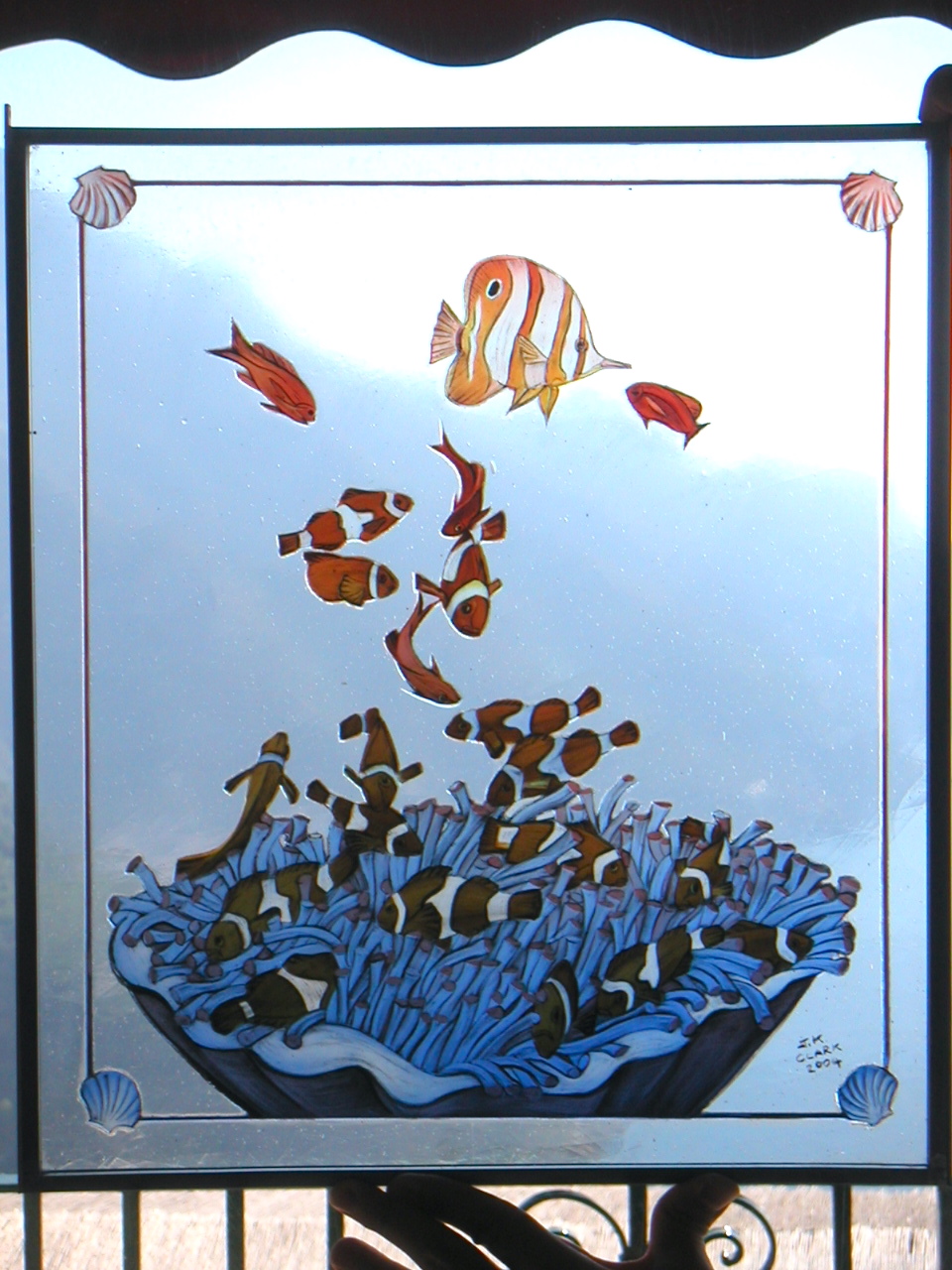
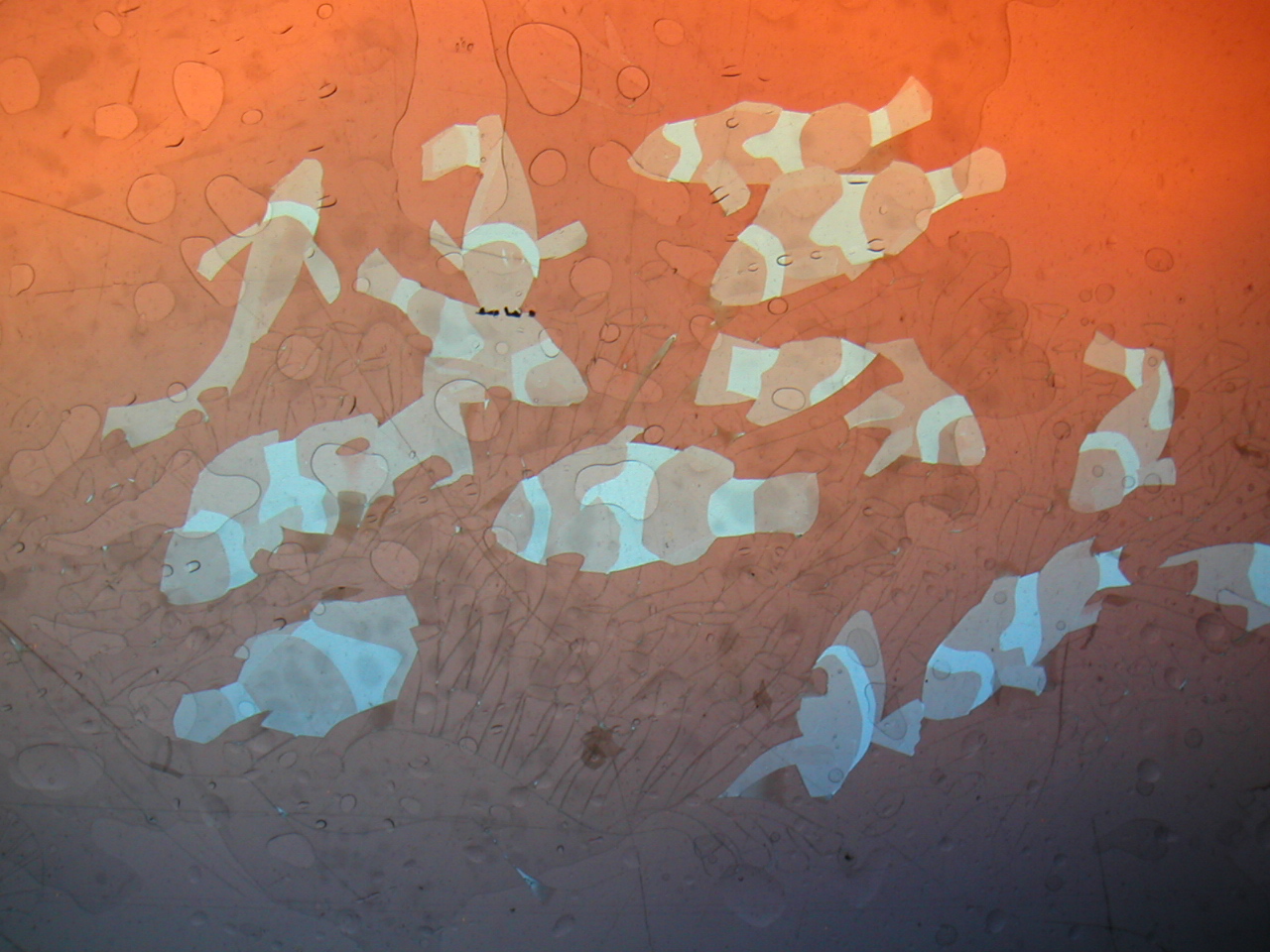
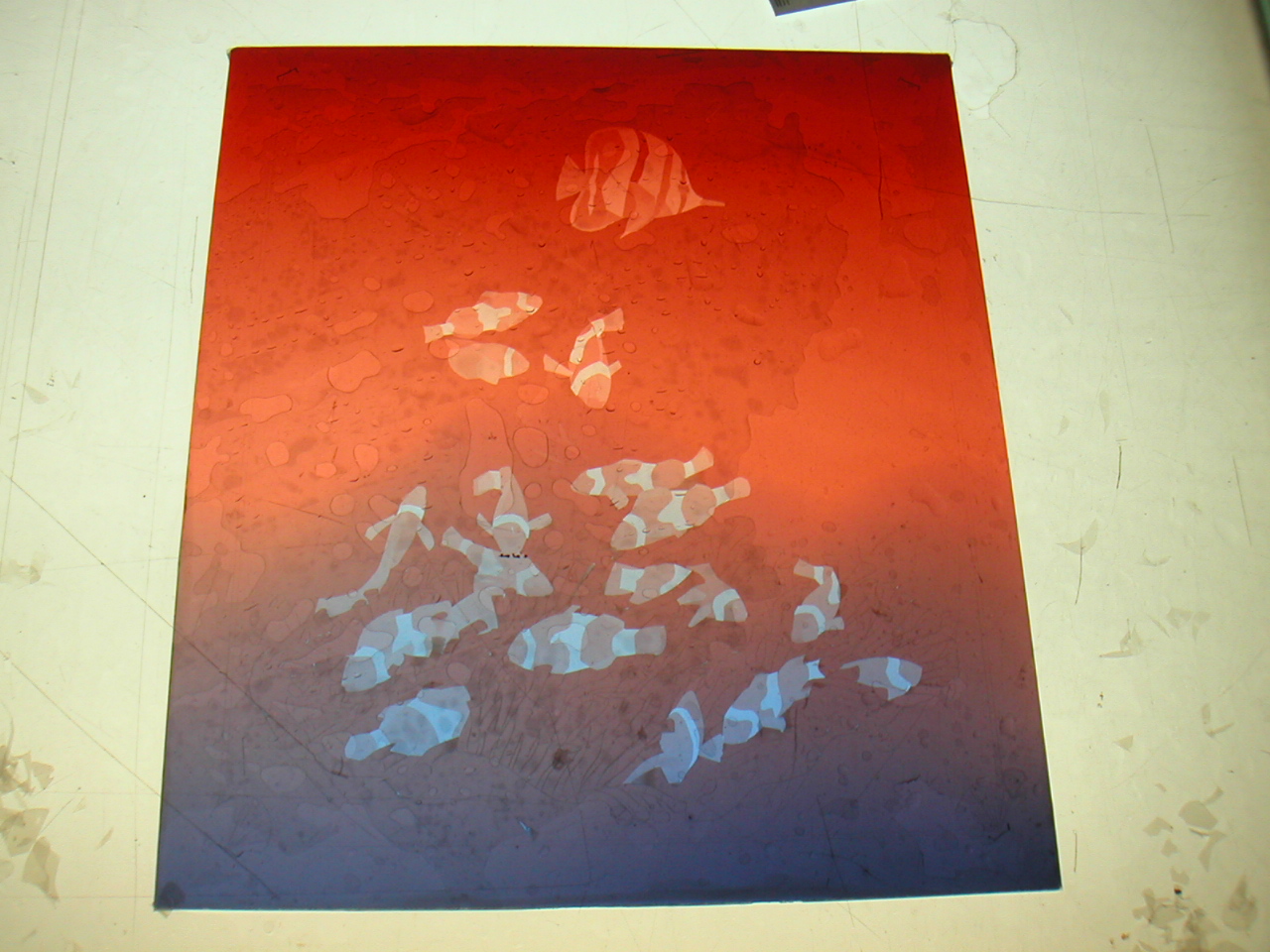
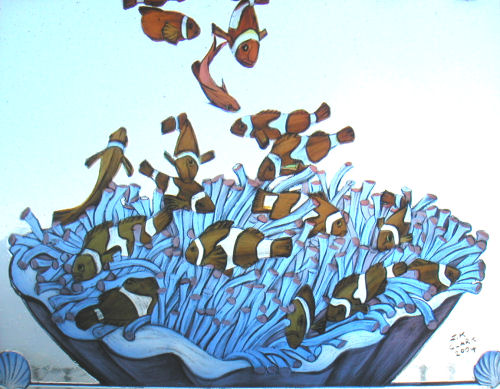
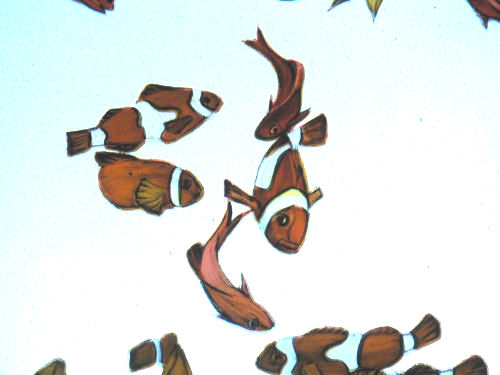
The single sheet panel — clownfish, butterfly fish, and sea anemone colony painted on one piece of glass. J.K. Clark, 2004. Made in Bacharach to settle a bet.
He Said He Didn't Believe Me
At some point during the project, in conversation with the client, I mentioned that I could paint the same fish on a single sheet of glass. He said he didn't believe me. So I made it.
The panel — painted in Bacharach in 2004 and signed — shows the same subjects as the marquetry beds: clownfish, a copper-banded butterfly fish, red fish, and the sea anemone colony that appears across the whole project. The scallop shells in the four corners echo the decorative elements of the bed frames.
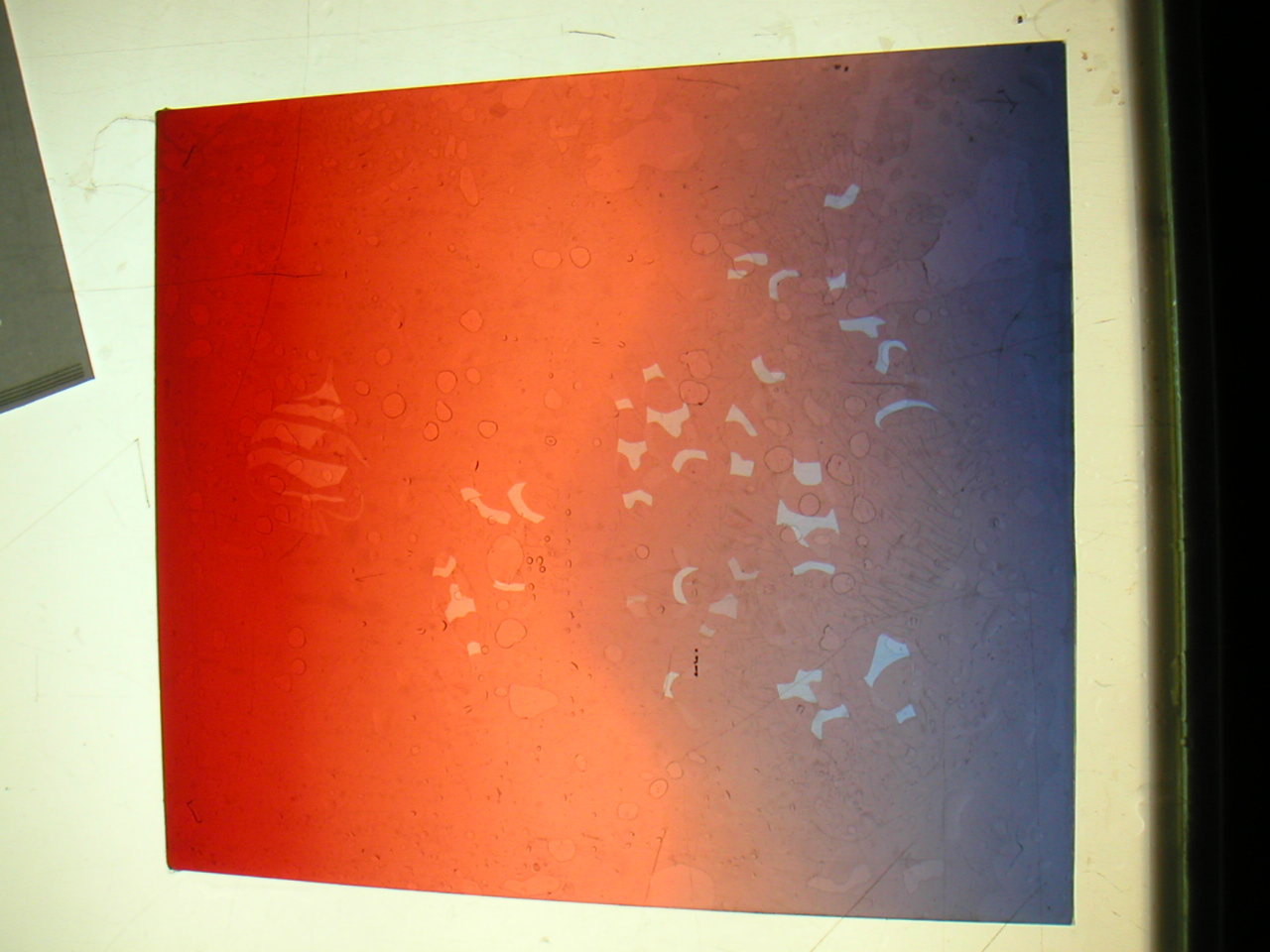
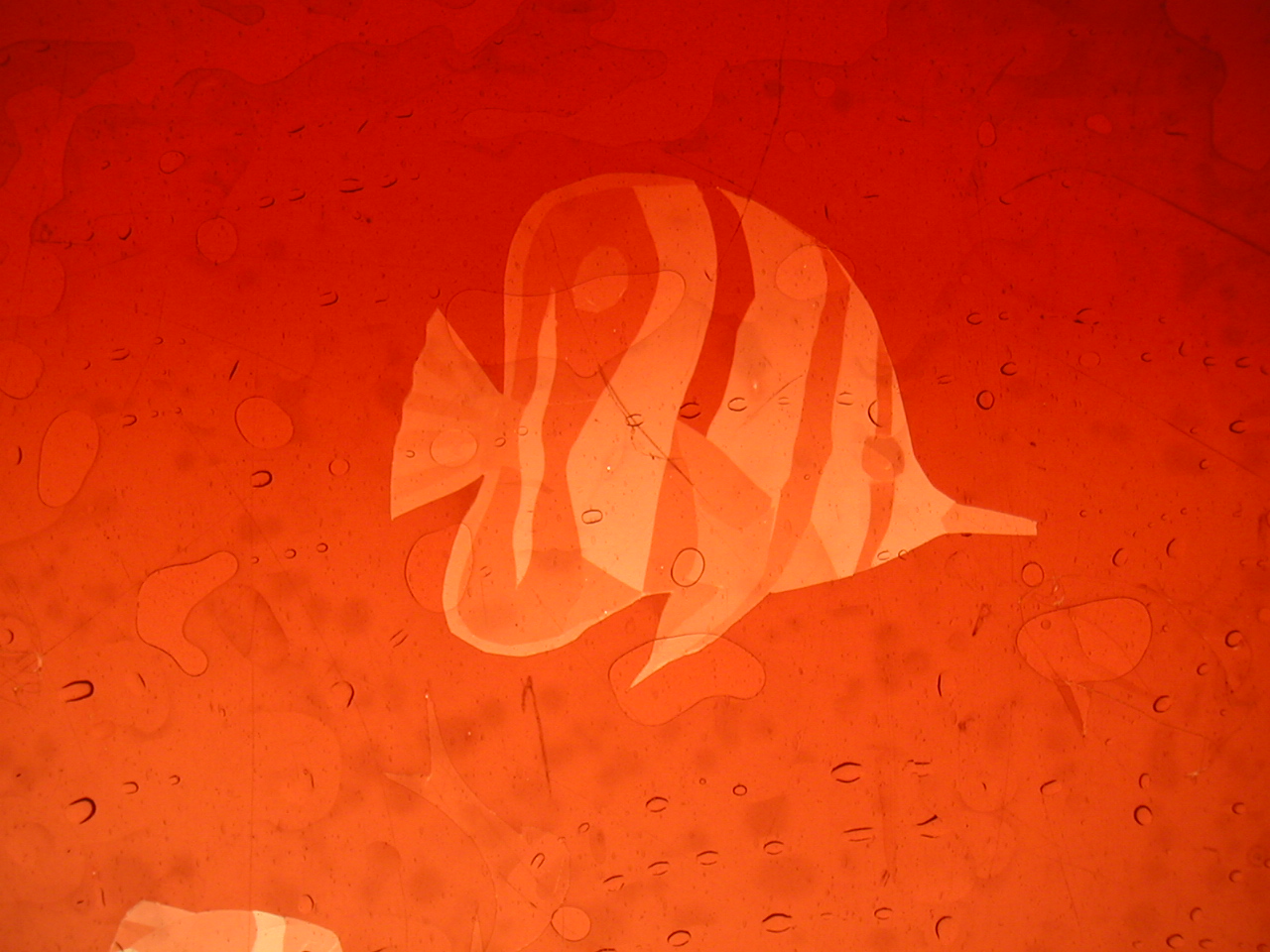
The glass used is a double flashed sheet — a thin layer of red over a thin layer of blue over clear glass. Etching or painting through the layers reveals the colour beneath, or the clear glass itself. The pale blue-grey of the background is the blue flashed layer; the warm tones of the fish are the red layer; the white of the anemone tentacles is the clear glass revealed beneath both. Three colours from a single sheet, without a single lead line.
This is what connects the Cafe Gandolfi Sweet Lips of 1984 to the marquetry beds of Sorrento to this panel of 2004 — the same design intelligence, the same fish, the same observational approach to marine life, expressed in completely different materials. As painters have always had their compositions translated into tapestry or mosaic or marquetry, the fish that began in glass returned to glass — made by the same hand, in the same tradition, twenty years later.
The Panel — Stages and Details
Questions and Answers
What is Sorrento marquetry and how does it differ from other wood inlay traditions?
Sorrento has been associated with pictorial wood marquetry for centuries and the tradition is very much alive in the workshops there today. Whether the specific techniques used in Sorrento differ significantly from marquetry practice elsewhere I honestly cannot say — I am an artist who learned enough about the process to design for it, not a historian of the craft. What I can say is that the Sorrento craftsmen I worked with had extraordinary skill, and that the thin blade cutting machine they used — producing positive and negative shapes simultaneously from stacked veneers — is a tool of remarkable elegance and precision.
How did a glass artist come to design furniture in wood marquetry?
My position has always been that if I understand how something is made, I can design for it. When the client asked me in Rome if I could do wood mosaic, I didn't know what it meant. He showed me. I went to Sorrento, I visited the workshops, I looked at the veneers, I understood the cutting process. Once I understood it, I could design for it. The medium was new. The design intelligence was the same one I use for glass, bronze, mosaic, or anything else.
Why are there two beds with completely different colour palettes?
The client had two houses in Japan. Two beds meant two design concepts — one for each house. The cream bed uses only natural wood veneer colours, giving it the warm, muted tones of shallow water and sunlight. The cobalt blue bed uses dyed veneers, taking the palette into the deeper, more saturated colours of the ocean world below the surface. The same fish appear in both beds — particularly the clownfish, which runs along the base rail of each — connecting the two houses and the two worlds.
Why were the beds designed to convert into sofas?
That decision was mine, not the client's. A baby bed serves a child for perhaps two or three years. A sofa can serve that same child for the rest of their childhood and beyond. Designing the conversion into the piece from the beginning — the wavy slatted rail becoming the back support, the seat and bolster cushions already proportioned for a sitting child — meant the furniture could grow with the child rather than being discarded when the infant stage passed. The idea was that the child would use this furniture at least until his adolescence. No one asked me to think about this. It seemed the right thing to do.
What is the connection between these beds and the Cafe Gandolfi windows in Glasgow?
The Cafe Gandolfi Flock of Fishes — made in 1984 in Hartley Wood mouth-blown glass, Saltire Award 1988, still in place on Albion Street — was the work that brought the Japanese client to the commission. He had seen the fish windows and sought out the artist directly. The marquetry fish are direct descendants of the Cafe Gandolfi fish: the same observational accuracy, the same delight in the specific character of individual species, translated from painted glass into cut wood. A single Glasgow commission generated creative relationships and work across four decades, two continents, and three completely different media.
What was the traditional Sorrento approach and how did your commission differ from it?
The traditional Sorrento marquetry style produces figurative scenes of extraordinary craftsmanship — figures in the manner of Renaissance painting, elaborate botanical detail, landscapes and allegorical subjects, all executed in the warm rosy tones of natural cherry and walnut veneer. The craftsmanship is breathtaking. But it is the craft tradition demonstrating its own virtuosity rather than responding to a specific brief. What I brought was something the workshops had never been asked for — a design that responded to what the client actually loved, furniture conceived for a child's whole life, marine subjects in the bright specific colours of tropical reef fish rather than the muted tones of Renaissance allegory. The craftsmen were simply determined to take the project over and do what they had always done. That was not how I work.
Where are the beds now?
The beds were sent to Japan. Beyond that I genuinely don't know — they are almost certainly no longer with the original client, and I have no way of tracing them. Somewhere in Japan there are two baby beds that have probably long since become sofas, in houses whose owners may or may not know the story of how they were made, or that a Scottish artist came to Sorrento to fight with Italian craftsmen over the design of a fish.
Is this kind of commission — furniture and illustration rather than glass — something you would consider again?
Absolutely — and the answer is in the question itself. My approach has always been that if I understand how something is made, I can design for it. The marquetry commission is no different in principle from designing the roof tile pattern for Kericho Cathedral — a completely unfamiliar medium, learned on site, designed from first principles, the result something that could not have existed without that willingness to say yes before knowing exactly how. I would love to do a project like this again.