Baptistry of Pisa — Window Designs
Pisa, Italy — Invited Competition
Four designs for the missing windows of the Baptistry of Pisa — one of the great medieval buildings of Italy and a UNESCO World Heritage Site. Selected for the second phase of an invited international competition, in association with Derix Glasstudios, Taunusstein. The commission was not awarded. The designs are published here because they deserve to be seen.

The Four Designs
San Giovanni Paolo II
Beato Paolo VI
San Ranieri
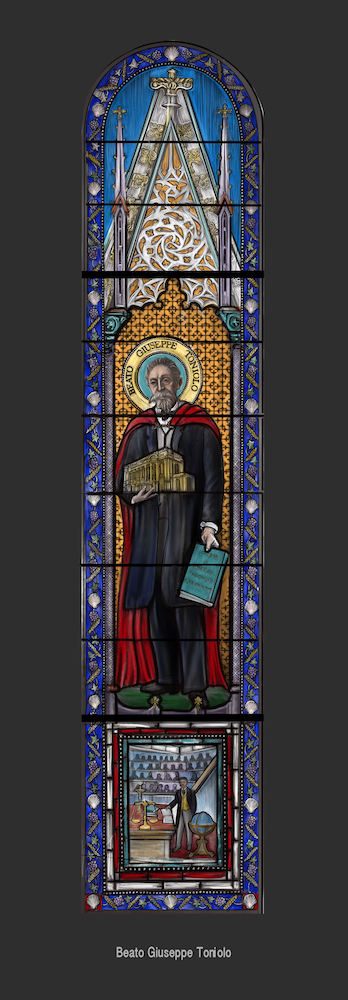
Beato Giuseppe Toniolo
The Building
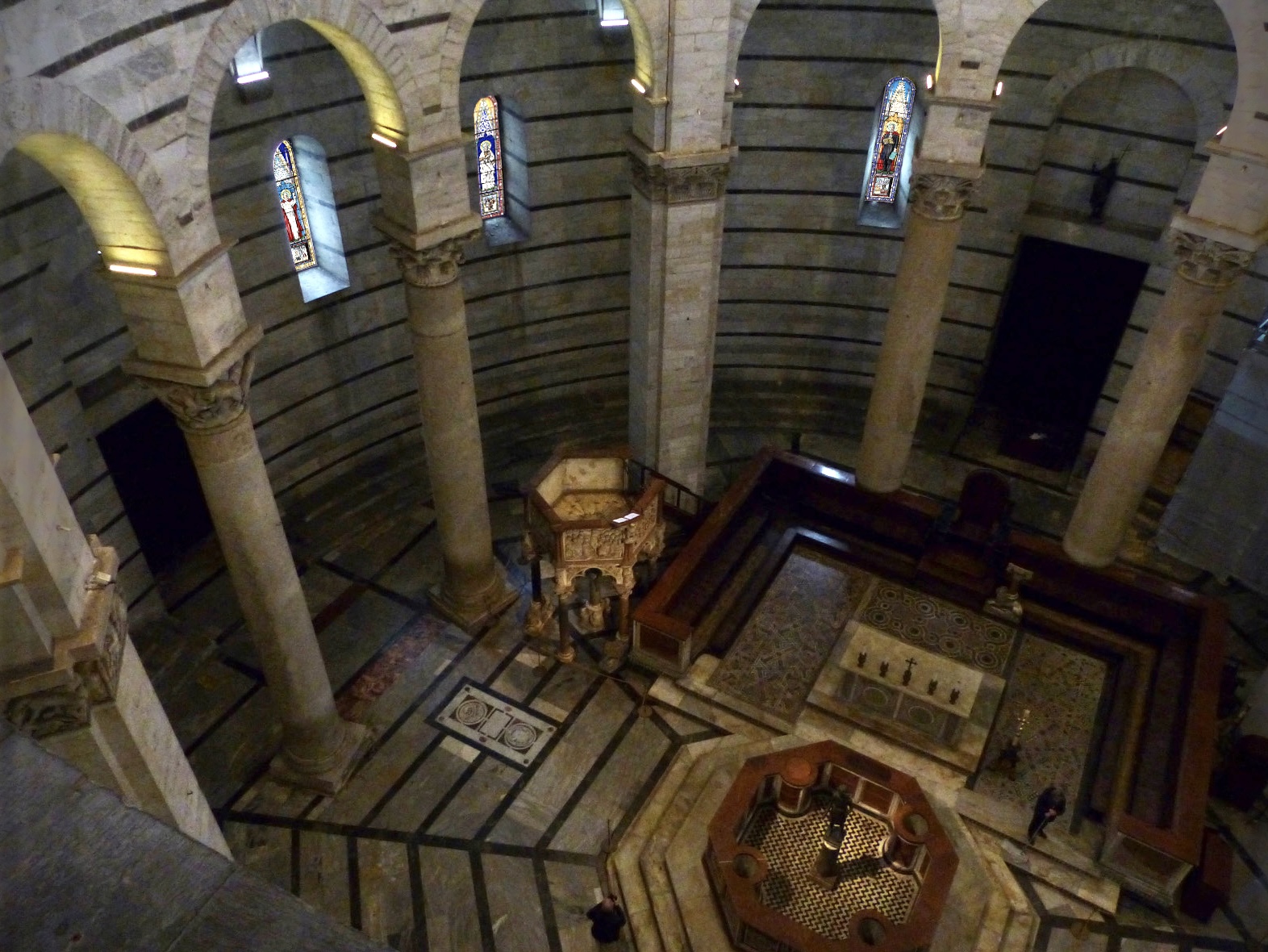
The Baptistry of Pisa — interior showing how my designs would have looked
The Setting
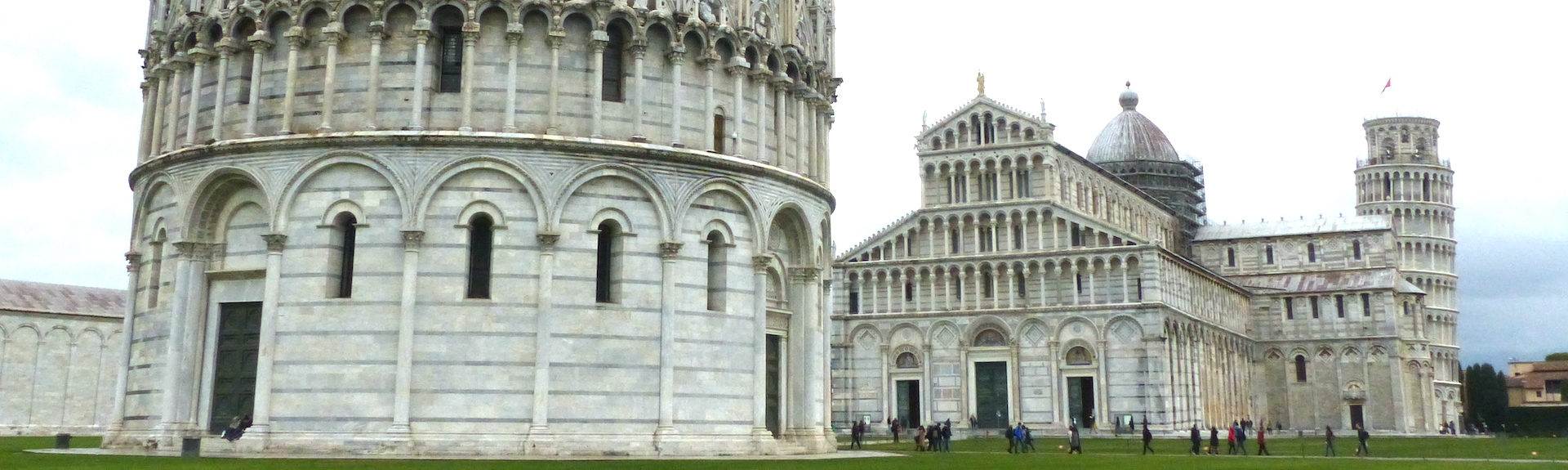
The Baptistry of Pisa stands in the Piazza dei Miracoli alongside the Cathedral and the Leaning Tower — one of the great concentrations of medieval architecture in the world and a UNESCO World Heritage Site. A circular Romanesque building, it contains a series of relatively small lancet windows set approximately six metres from the ground, running around the circumference of the building.
The existing windows are in the Neo-Gothic style — figurative subjects centred within the opening, decorative canopies above, decorative plinths below, each figure holding their attribute. The overall effect is of richness and complexity achieved through concentration of painted borders, backgrounds, and diapering. The windows judged compositionally most successful in the existing series were the Archangel Michael and the Saint Thaddeus — the Saint Thaddeus window was used as the proportional basis for the new designs.
A research visit to Pisa was made specifically for this project, studying the existing windows in their setting and photographing every detail before a single line was drawn.
The Design Concept
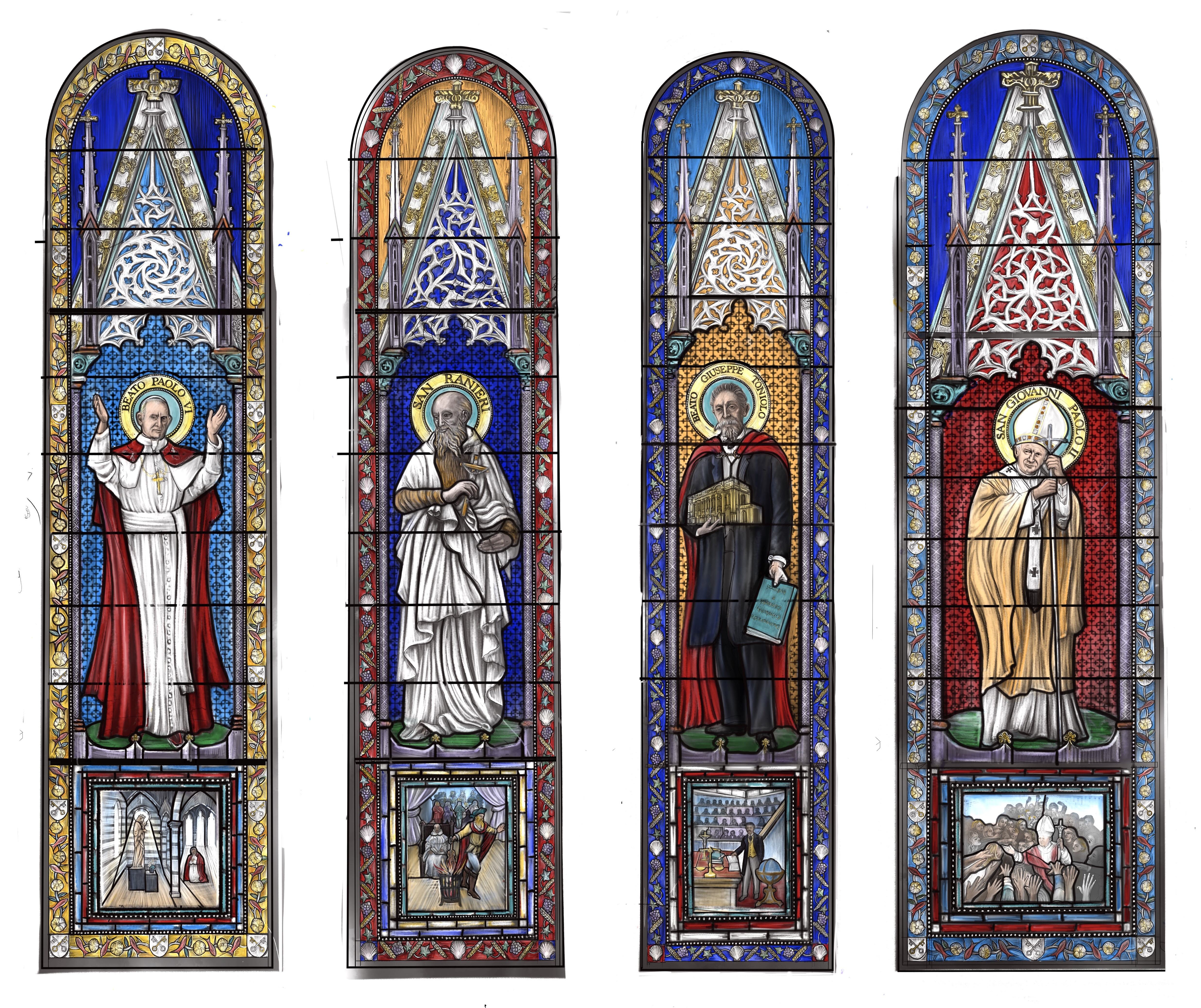
The Four Concepts
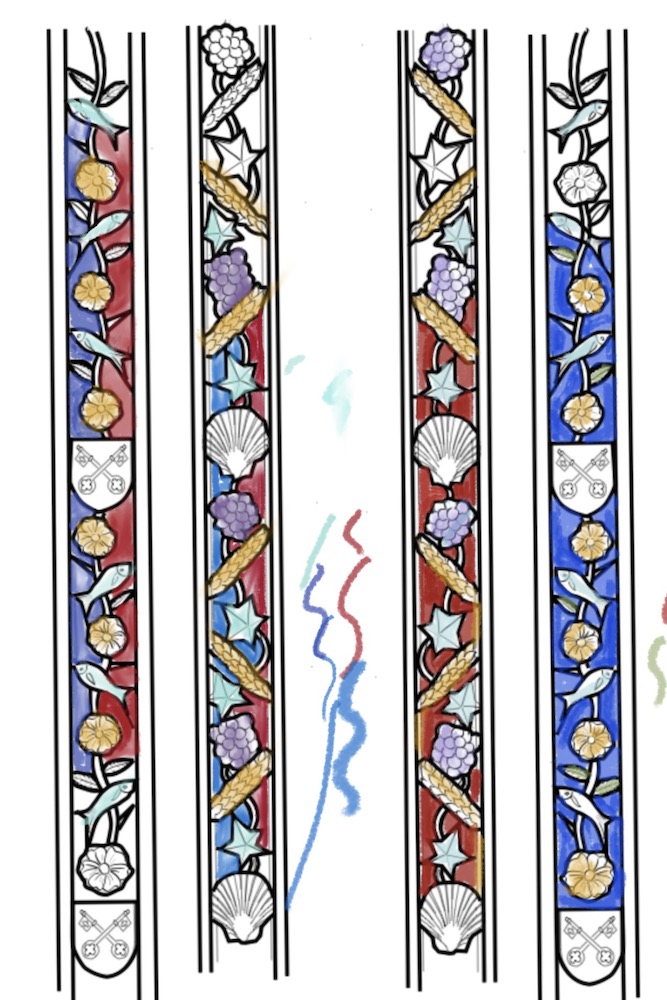
The two border programmes — Papal border and Saints' border
Continuation, not Departure
The proposed designs conform to the Neo-Gothic approach of the existing windows while introducing two new, purpose-designed border programmes with specific iconographic meaning. The intention was to create a recognisable new set within the existing series — neither pastiche nor departure, but continuation.
The existing windows feature highly decorative robing on their figures. For three of the four new subjects — two popes and a blessed — elaborate robing would be inappropriate. To compensate and maintain visual richness, the decoration was concentrated into the borders, which were designed to carry their own theological meaning.
The Papal Border
For Pope Paul VI and Pope John Paul II: the Crossed Keys — the keys of heaven given to St. Peter by Christ; the Fish — reference to the Fisherman's Ring, unique to each Pope; the Golden Rose — symbol of the Papacy.
The Saints' Border
For Saint Ranieri and Blessed Toniolo: Wheat and Grapes — symbols of the Eucharist; the Scallop Shell — symbol of pilgrimage and baptism, associated with the hand of St. John the Baptist.
The Narrative Panels
In keeping with the compositional logic of the existing windows, scenes or events were not placed in the main body of the lancet. Instead, a small framed narrative tableau was added at the base of each window — a traditional solution allowing an aspect of the subject's life to be explored without disrupting the figure composition above.
The Diapering
The Pisan Cross was used to create positive diaper patterning in the backgrounds — a direct reference to the host city's own heraldic symbol, historically appropriate for a building of this location and period.
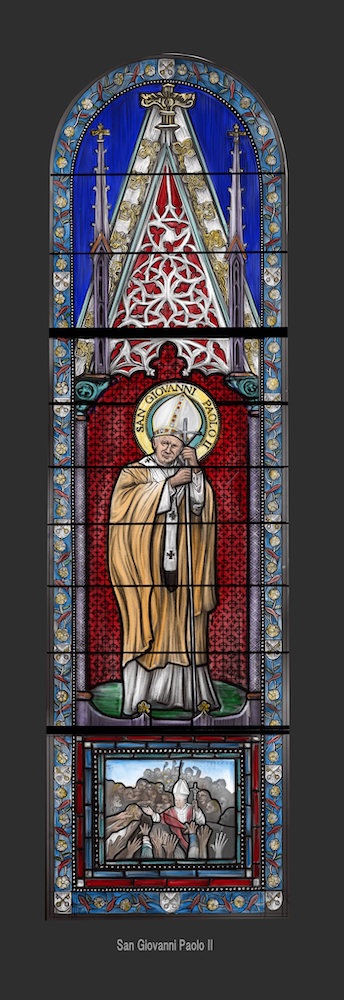
Window 15 — San Giovanni Paolo II
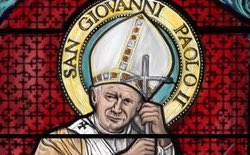
Window 15 — San Giovanni Paolo II
Saint John Paul II
John Paul II is shown leaning on his Papal crozier — a gesture found to be powerful and appropriate for this long-serving and deeply venerated Pope, conveying both his authority and the physical weight he carried in his later years.
The narrative panel at the base depicts World Youth Day — instituted on Palm Sunday 1984 and formally established on 20 December 1985. The Pope is shown surrounded by a crowd of young people, hands reaching upward toward him from all directions. The tonal handling of the crowd — present figures at the front, shadowed figures fading into the background — creates a sense of mass and movement that is among the most contemporary images in the entire series.
Window 15 is located on the inner skin of the building with a secondary light source and a staircase behind it. This window was designed proportionately paler than the others to compensate for the reduced natural light. Samples of glass with differing amounts of patina were to be tested in the building if the design was successful.
Border: Papal border — Crossed Keys, Fish, Golden Rose.
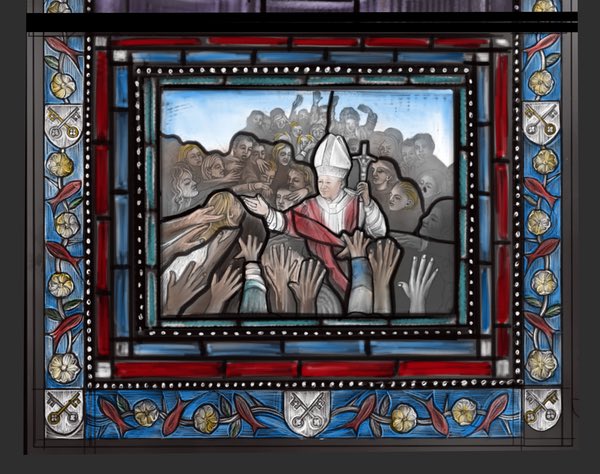
The narrative panel — World Youth Day
The World Youth Day panel is the most contemporary image in the entire series — hands reaching upward from a crowd toward a solitary white figure. It is an image that could only belong to the twentieth century, and yet it reads entirely naturally within the Neo-Gothic compositional framework of the Baptistry.
The border of this panel carries the full Papal programme: Crossed Keys, Fish, and Golden Rose — the symbols of the papacy framing the most human moment in the window.
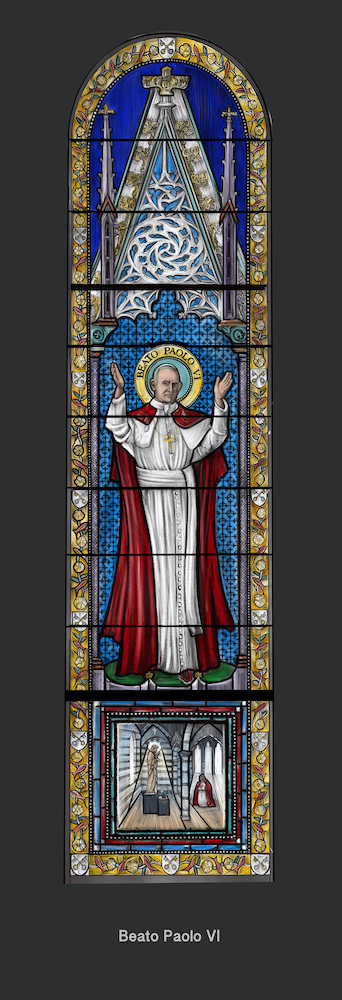
Window 9 — Beato Paolo VI
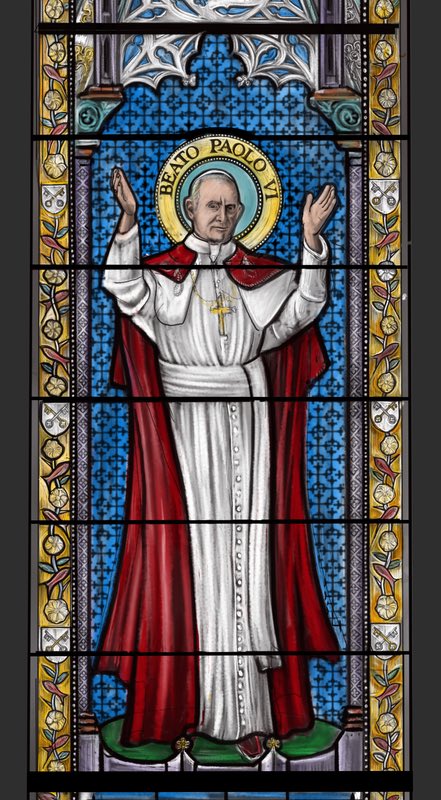
Window 9 — Beato Paolo VI
Blessed Pope Paul VI
Paul VI is shown with arms raised in his characteristic gesture of welcome and inclusion — one of the most recognisable gestures of any twentieth-century Pope, immediately identifiable to anyone who has seen photographs or footage of him addressing crowds.
The narrative panel at the base depicts Paul VI's deep personal devotion to Marianology, and his role in establishing the Madonna's position as Mother of the Church during Vatican II. The scene is set in the Santa Maria della Spina — a small late Gothic church in Pisa, a deliberate local reference that connects the subject to the city of the Baptistry itself. At the centre of the presbytery stands the Madonna of the Rose by Andrea and Nino Pisano — described as one of the highest masterpieces of Gothic sculpture. A kneeling figure in prayer before the Madonna renders the devotional act directly.
Background: Blue diaper on Pisan Cross ground.
Border: Papal border — Crossed Keys, Fish, Golden Rose.
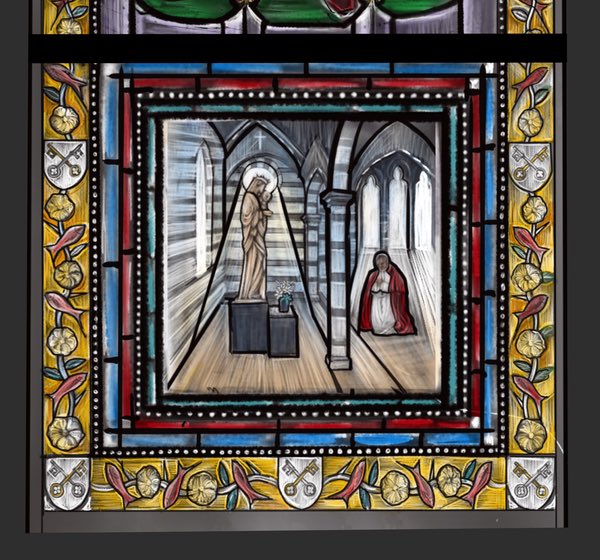
The narrative panel — Santa Maria della Spina, Pisa
The choice of the Santa Maria della Spina as the setting for the narrative panel is a deliberate act of local rootedness — placing a Pope's personal devotion within a Pisan Gothic interior, connecting Vatican history to the city in which the window stands. The striped stonework of the church interior, rendered in glass, creates a sense of architectural depth unusual in a panel of this size.
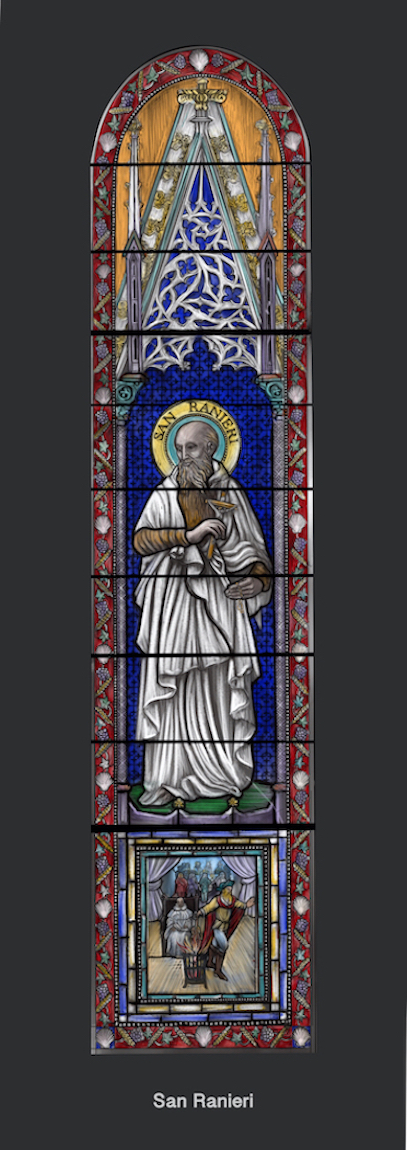
Window 10 — San Ranieri
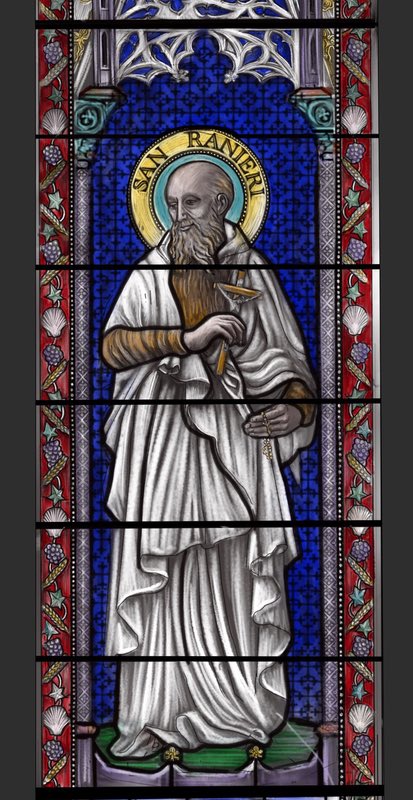
Window 10 — San Ranieri
Saint Ranieri of Pisa
Saint Ranieri is shown holding a crucifix clutched to his heart, a rosary in his right hand. Beneath his simple white cloak, traditional iconography requires a hair shirt — present but invisible beneath the outer garment, a reminder of the private discipline beneath the public devotion.
The narrative panel depicts the transformative moment of Ranieri's conversion — the scene in which he cast his violin into the fire during a long encounter with a holy man, turning his back on his former life as a travelling musician. The figure is shown mid-gesture, the instrument already in the flames, the holy man seated and watching, witnesses framed in the background by stage curtains. It is one of the most dramatic narrative panels in the series, the moment of irreversible decision caught at its peak.
Background: Deep blue ground with white diaper.
Border: Saints' border — Wheat, Grapes, Scallop Shell.
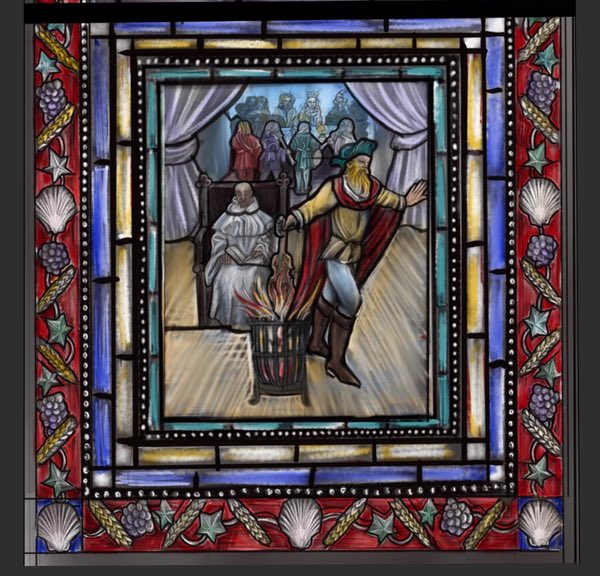
The narrative panel — the violin cast into the fire
The violin panel is the most theatrically composed of the four narrative scenes. The stage curtains framing the witnesses in the background, the fire already taking the instrument, the holy man seated and still against the dynamic forward movement of Ranieri — it reads as a moment from which there is no return. The irreversible decision, made visible.
Window 12 — Beato Giuseppe Toniolo
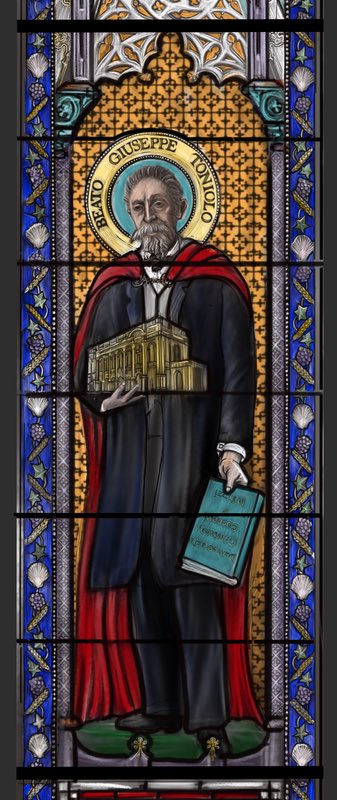
Window 12 — Beato Giuseppe Toniolo
Blessed Giuseppe Toniolo
Toniolo presented the most unusual design challenge of the four — a nineteenth-century economist and social reformer rather than a medieval saint or a pope. The figure is dressed in a period suit of the late nineteenth century, as seen in the few surviving photographs of him, with an academic cloak added to bring the figure into harmony with the existing windows without historical falsification.
He holds a model of the University of Milan, of which he is acknowledged as the spiritual founder, and his major work Democrazia Cristiana, Concetti e Indirizzi. The gold diaper background — deliberately warmer than the other three windows — distinguishes this figure visually while remaining within the established vocabulary of the series.
The narrative panel shows Toniolo in his life's role as a lecturer, addressing students in a tiered lecture theatre. On the desk before him: a globe representing his worldwide approach to economic thought; scales representing his commitment to social justice; a crucifix representing his Catholic faith. The rows of shadowed students in the gallery above are a quietly powerful detail.
Background: Gold diaper ground.
Border: Saints' border — Wheat, Grapes, Scallop Shell.
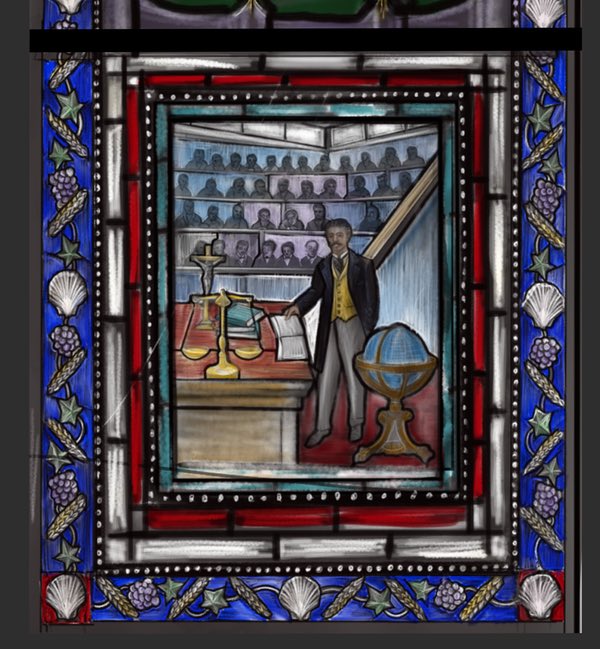
The narrative panel — Toniolo lecturing
A Victorian lecture theatre rendered in glass — students in tiered rows, a globe, scales of justice, and a crucifix on the desk. It is the most modern scene in the series and the most complex symbolically, asking the viewer to read three separate symbolic objects simultaneously against a realistic architectural setting. That it works as a composition is a measure of the design confidence behind it.
Technique
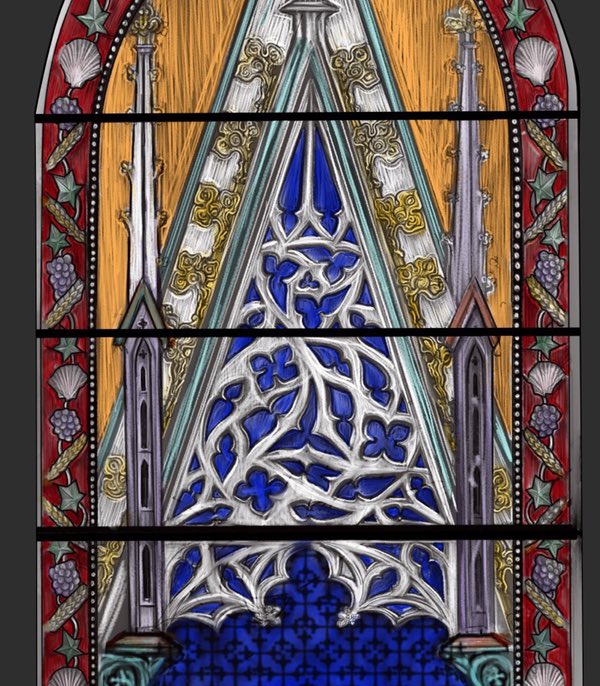
Detail showing the quality of hand painting and silver staining
Traditional Methods Throughout
All techniques proposed for these windows conform exactly to those used in the existing Baptistry series — the work would have been indistinguishable in method from windows made a century earlier, while being entirely new in subject matter.
Glass: Mouth-blown antique glass, colours in keeping with those already present in the building. Flashed glass used where appropriate, particularly in the tracery of the canopies where acid etching would be applied.
Painting: Hand painting using traditional glass paint throughout. No photo printing or screen printing. Minimal use of fired enamels in faces, as seen in some existing windows.
Silver staining: An ancient technique in which a silver compound is painted onto the outside of the glass and fired, producing yellow tones ranging from pale lemon to deep amber. Applied where required throughout the composition.
Leading: Traditional leading and soldering. Support bars in bronze or treated stainless steel, fitted externally as per the existing windows, panels attached with copper wire soldered to the panels.
Pisa Baptistry Window Designs
Competition — Invited, second phase
In association with — Derix Glasstudios, Taunusstein, Germany
Windows — 4: San Giovanni Paolo II, Beato Paolo VI, San Ranieri, Beato Giuseppe Toniolo
Material — Mouth-blown antique glass
Technique — Hand painting, silver staining, acid etching, traditional leading
Location — Baptistry of Pisa, Piazza dei Miracoli, Pisa, Italy
Status — Designs complete — commission not awarded
The Drawing Process
Procreate time lapse — one of the four lancet designs
Designing in Procreate
This time lapse shows the development of one of the four lancet designs from blank screen to finished composition — the figure emerging, the canopy building up, the borders developing around it. The whole design process compressed into a few minutes.
The digital design process allowed rapid testing of the colour relationships and compositional proportions before any glass was specified or drawn at full scale.
Note: this film is best viewed at the scale shown here — it was made as a personal record of the process rather than as a polished production.