
Music into Glass
A system for translating musical frequencies into coloured glass
There is a direct and verifiable relationship between the frequency of sound and the frequency of light. Sound travels as pressure waves measured in hertz. Light travels as electromagnetic waves measured in terahertz. When the twelve notes of the musical chromatic scale are mapped proportionally onto the visible light spectrum, each note corresponds to a specific colour.
A = 440Hz. Pink = 440THz. The correspondence is exact at this point and proportional throughout.
This is not metaphor. It is physics. And from this discovery, made in summer 2018, a complete system for translating music into coloured glass has been developed — one whose implications have not yet been fully explored, and whose possibilities are only beginning to be understood.
"If the music is harmonious, the glass will be harmonious. If a work is musically harmonious, it will be visually harmonious too."

The Discovery
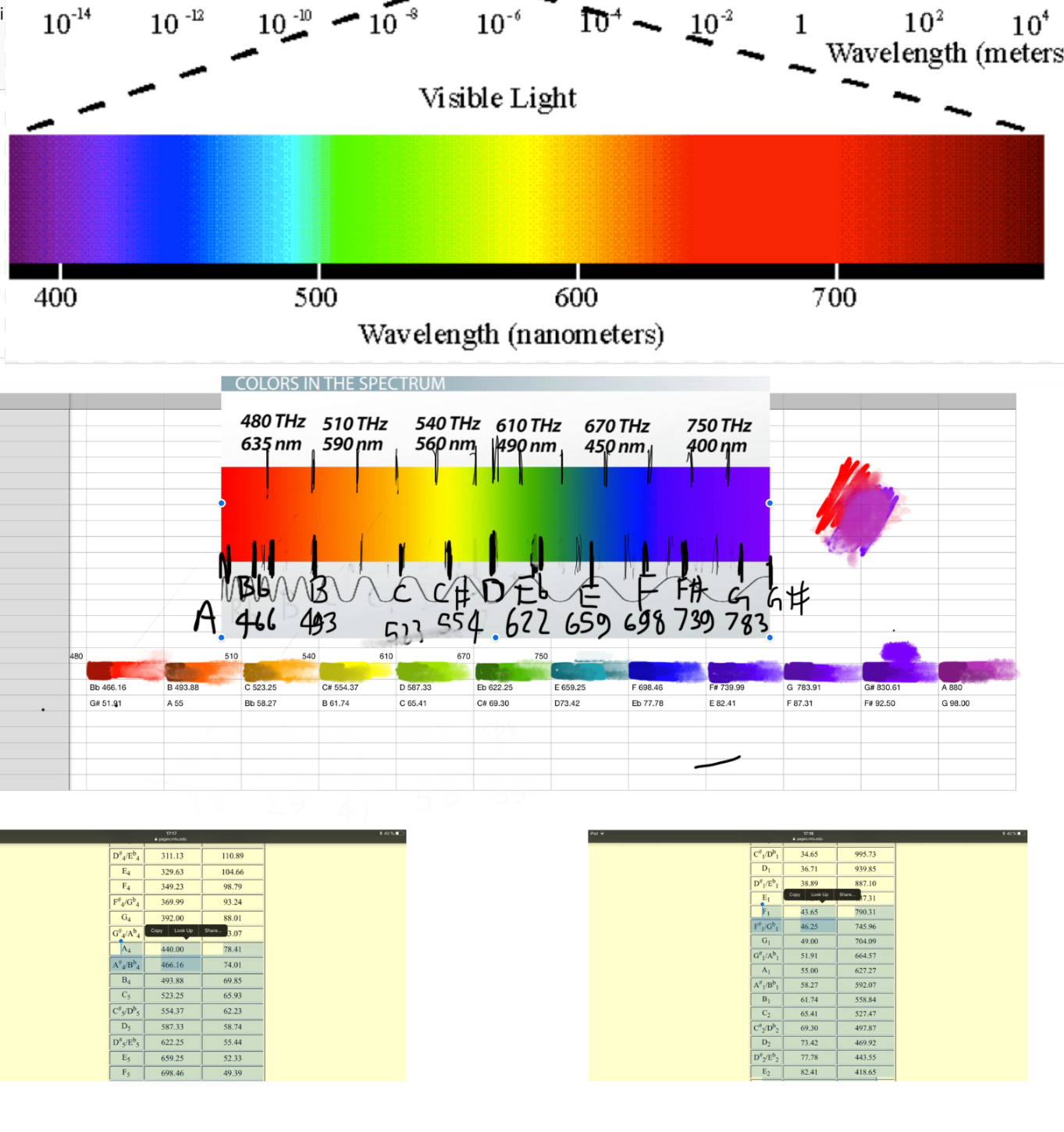
The research — musical frequencies in hertz mapped against light frequencies in terahertz
Summer 2018
The research began with a simple question: is there a verifiable relationship between the frequency of musical notes and the frequency of colours in the visible light spectrum? The human ear perceives frequencies from approximately 20Hz to 20,000Hz as sound. The human eye perceives frequencies from approximately 405THz to 790THz as visible colour.
When the twelve notes of the chromatic scale are mapped proportionally onto the visible spectrum, A = 440Hz corresponds exactly to pink = 440THz. The correspondence holds proportionally throughout — each of the twelve notes corresponding to a specific colour position. This is not an approximation. It is a structural fact about the physical world.
The Colour Wheel and the Keyboard
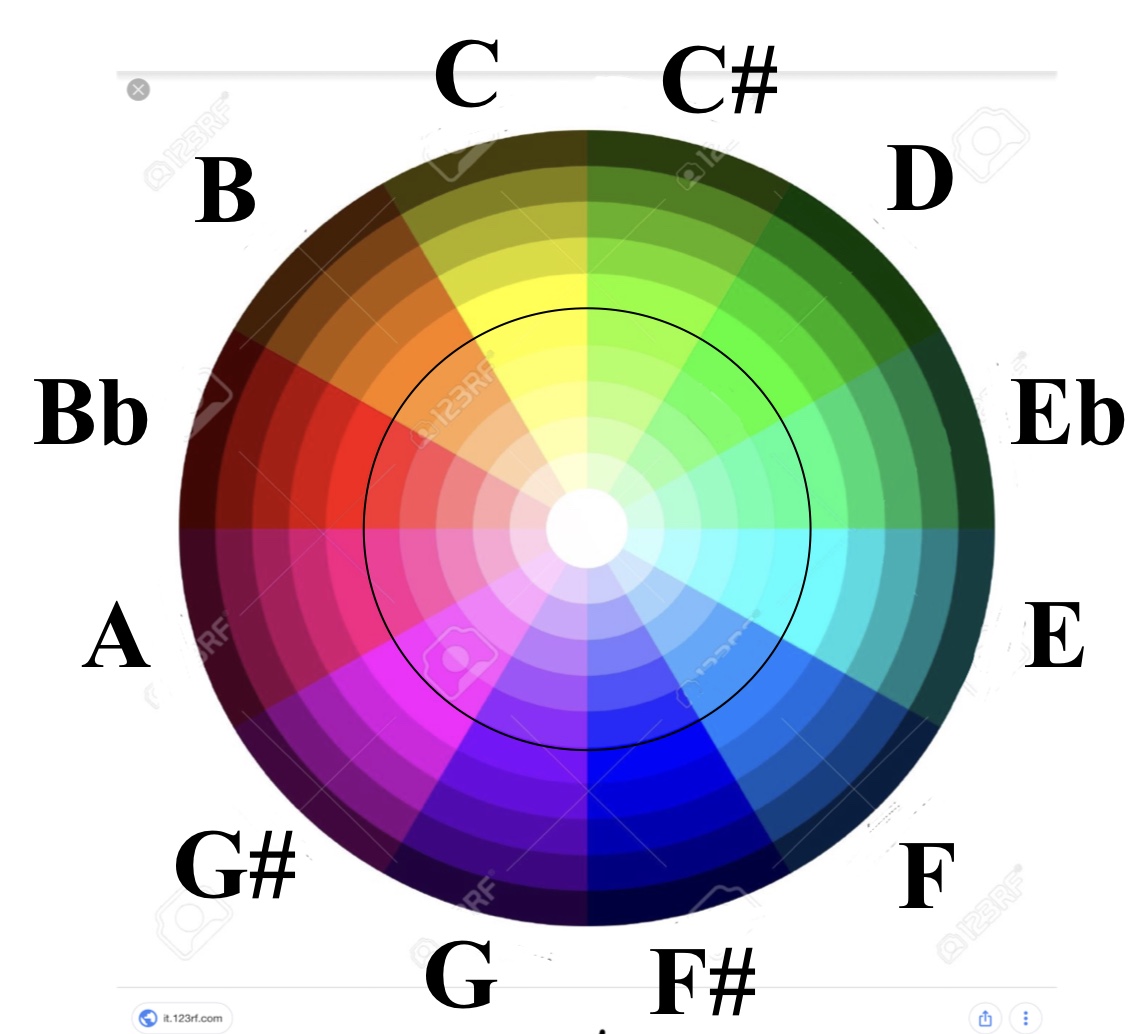
The colour wheel — twelve notes mapped to twelve colour positions
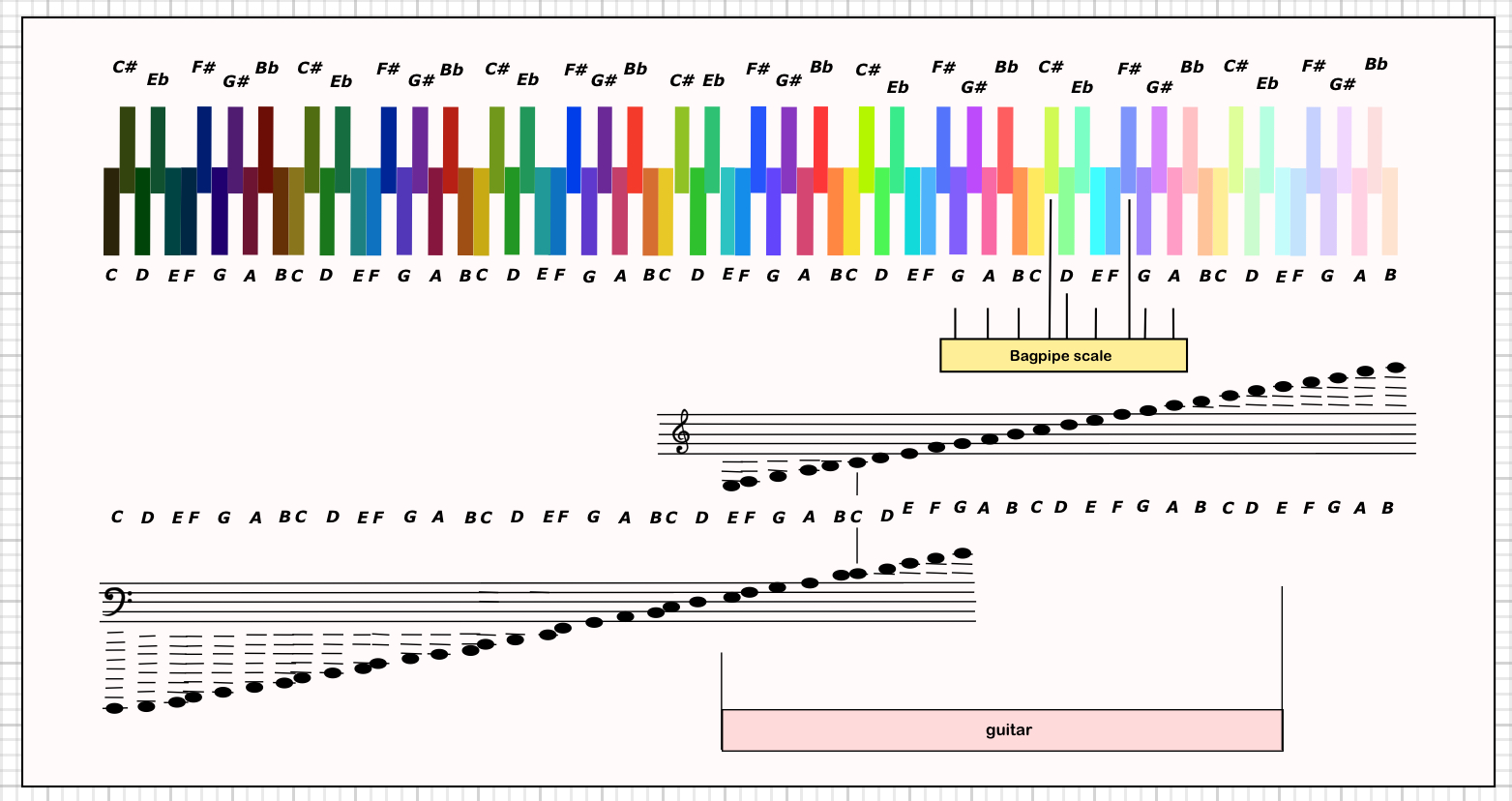
The colour keyboard — piano, guitar, and bagpipe ranges in colour notation
Building the System
The first tool was a colour wheel with the twelve notes of the chromatic scale mapped around its circumference. This immediately revealed something important: notes that are harmonically consonant in music sit in visually harmonious relationships on the wheel. Notes that are dissonant sit in positions of visual tension. The harmonic logic of music and the colour logic of the spectrum are the same logic.
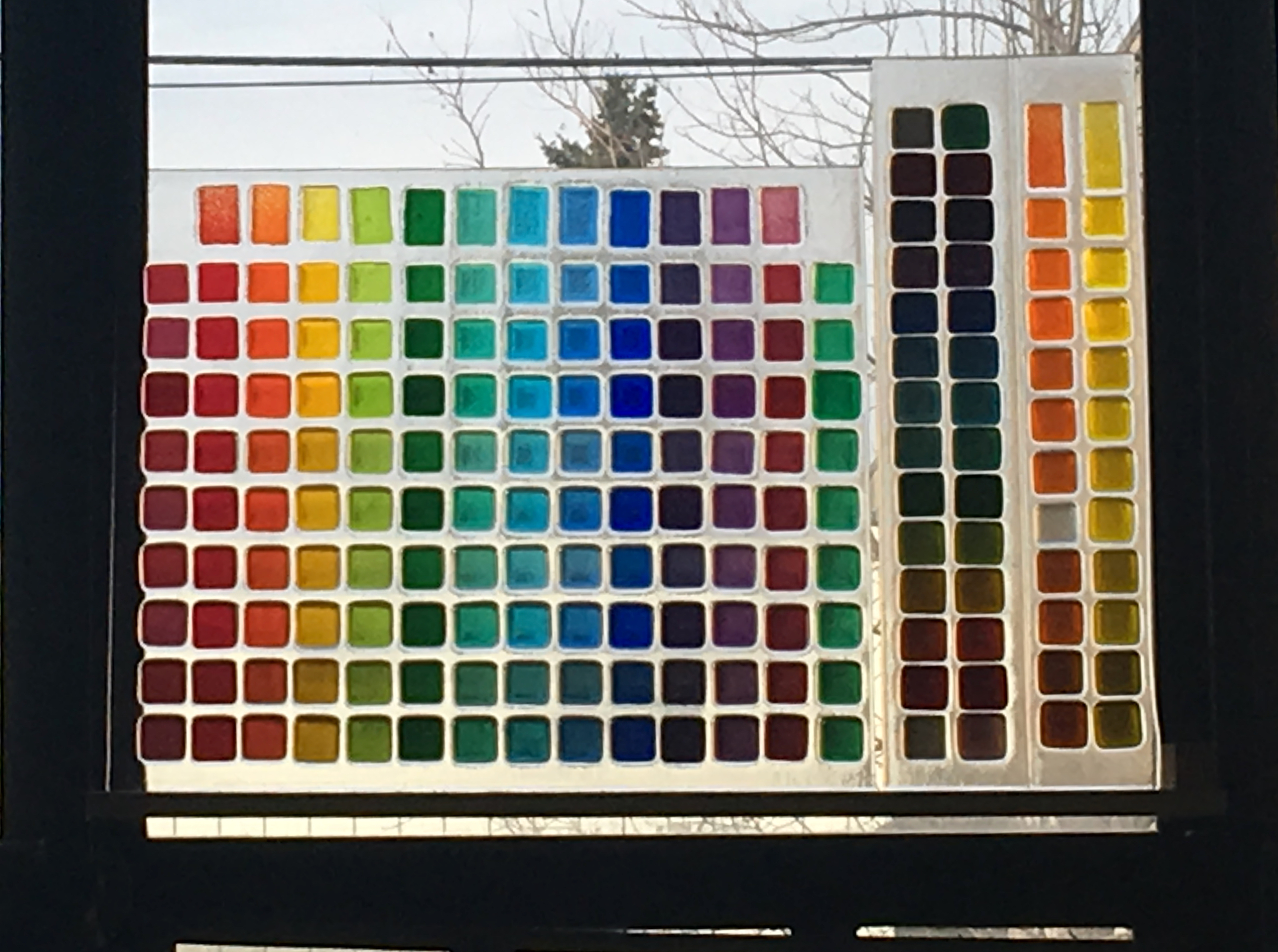
From the colour wheel a complete colour keyboard was built — the chromatic scale across nine octaves, each octave using the same twelve colours at progressively deeper tones for the lower registers and lighter tones for the higher. The keyboard covers the full practical range of Western musical instruments, developed specifically for piano, guitar, and bagpipe.
The twelve notes and their colours:
A = Pink
Bb = Purple
B = Violet
C = Dark Green
C# = Green
D = Yellow-Green
Eb = Yellow
E = Orange-Yellow
F = Orange
F# = Red-Orange
G = Red
G# = Dark Red
Darker tones = lower octaves. Lighter tones = higher octaves.
The Octave Sample Sheet
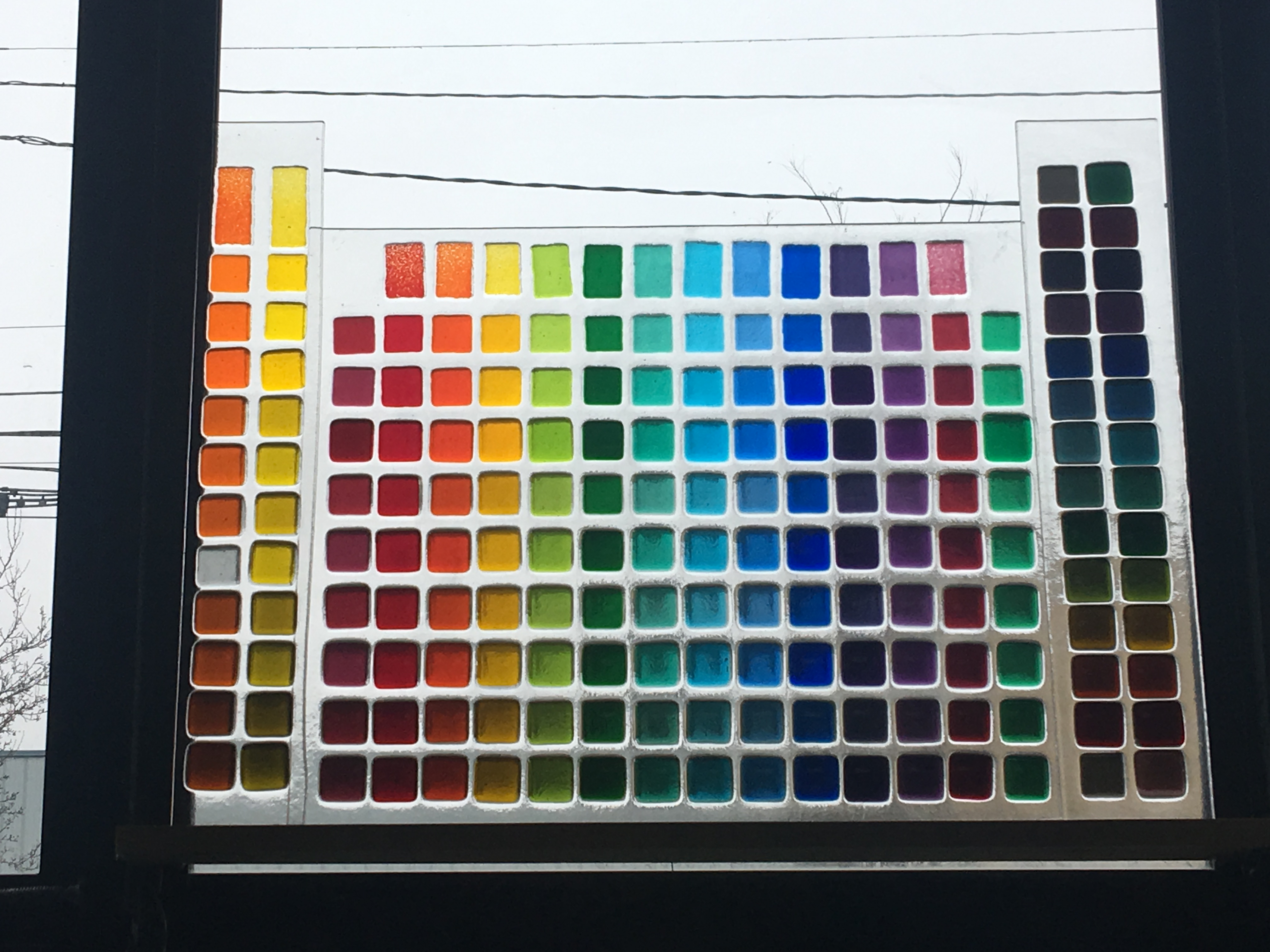
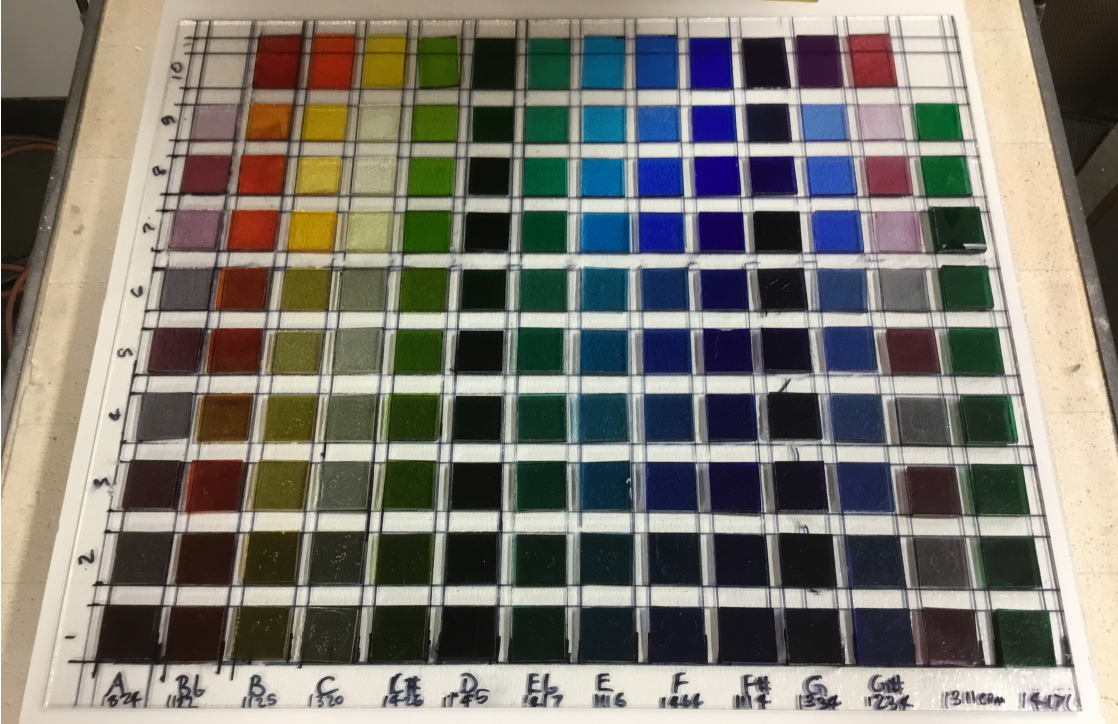
The complete octave sample sheet — the image that stopped the Bullseye Glass team
Portland, Oregon — January 2019
The system was developed in the material during a four-week residency at Bullseye Glass Co. in Portland, Oregon — invited by Lani MacGregor, co-owner of Bullseye and the eventual client for the Caithness window. Bullseye glass, manufactured specifically for fusing with every colour in the range compatible with every other, was the ideal material for realising the system in glass.
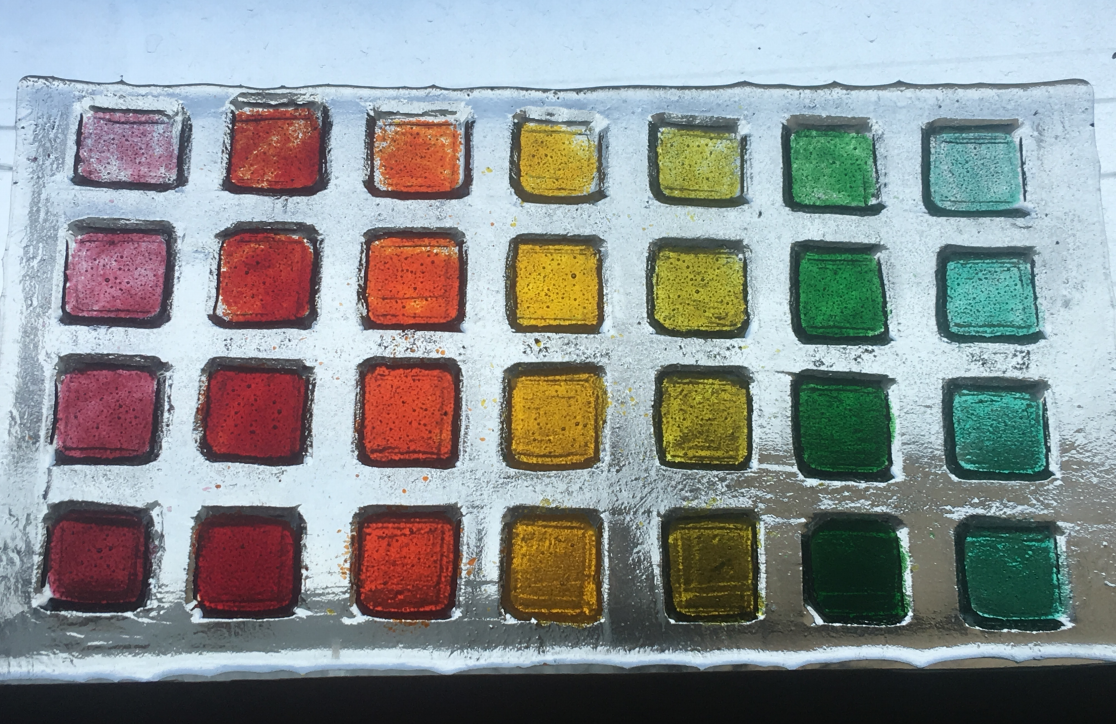
The challenge was the deep bass register — the lower octave tones are so dark and saturated that finding the right Bullseye colour combinations required sustained experimentation. When the completed octave sample sheet was shown to the Bullseye team — twelve notes across, nine octave rows, each note a fused glass square — their response was immediate:
"We have never seen those colours made with our glass."
The lower octave tones were combinations within their own palette that the manufacturer's own team had not previously discovered. New colour territory found within a material they had been producing for decades.
The First Transcriptions
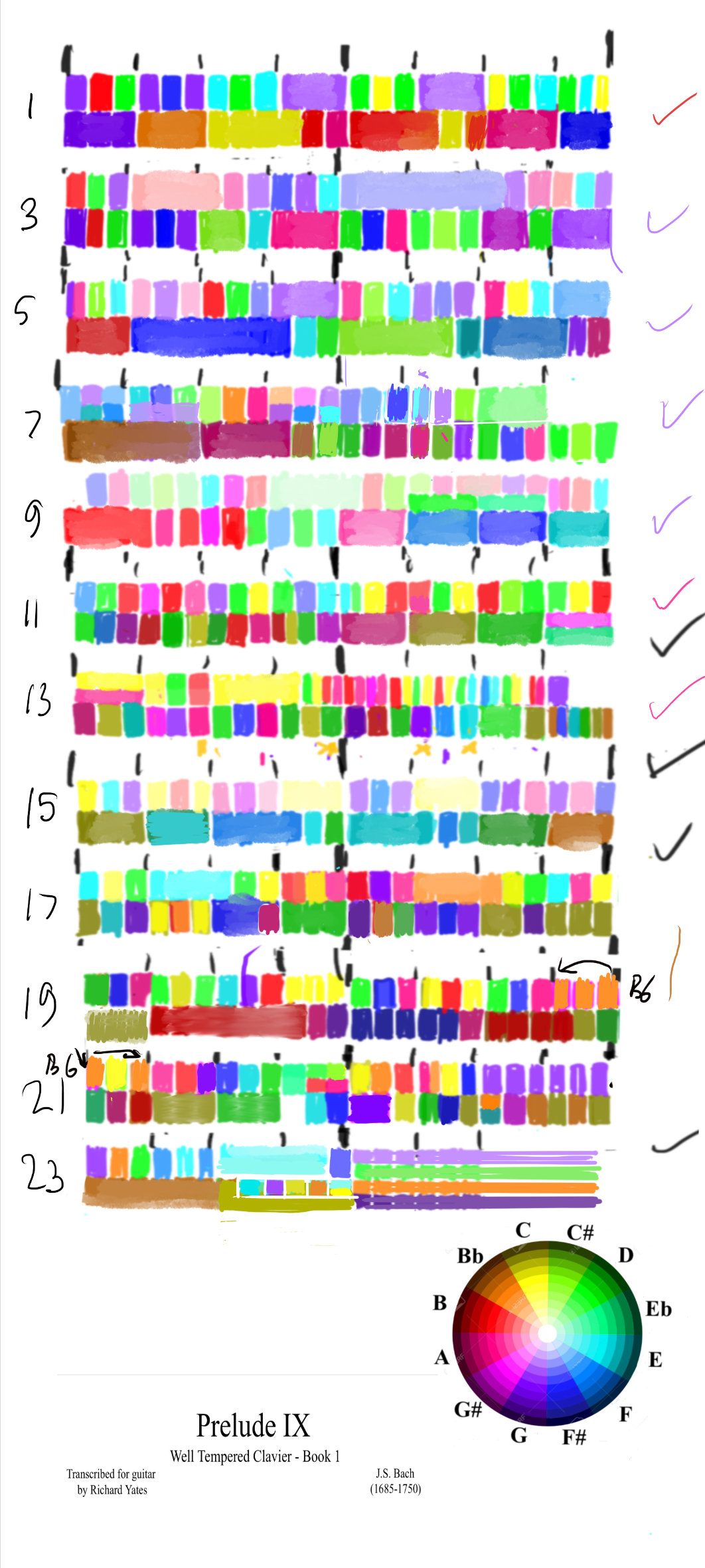
Prelude IX, Well-Tempered Clavier — the first Music-Glass transcription
Bach — and then Bagpipes
The first piece transcribed was Prelude IX from Bach's Well-Tempered Clavier, in a guitar arrangement. The rectangular method — each note represented by a coloured rectangle, its width proportional to its duration — was immediately clear as the most direct approach.
But it was what happened next that astonished. In Scotland, the question presented itself: what would bagpipe music look like? The Flowers of the Forest was transcribed. Even from the first rough drawing, pattern and structure were immediately visible. When the precise computer version was made, the full extent of that structure became clear.
"This truly astonished me."
The Flowers of the Forest transcription revealed that musically harmonious pieces produce visually harmonious colour arrangements — the structural logic of the music becoming directly visible as pattern and colour relationship.
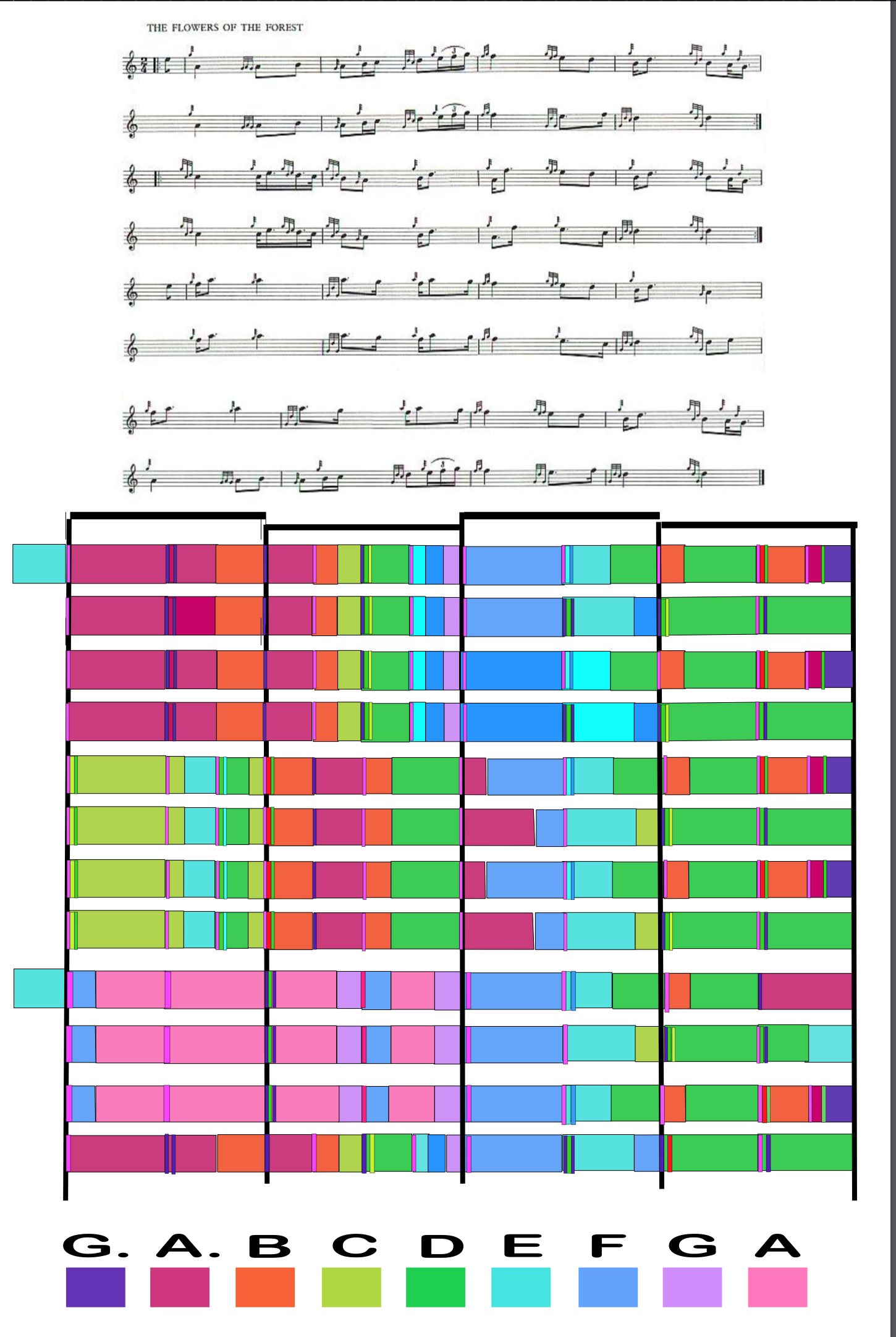
The Flowers of the Forest — the tune's visual structure revealed for the first time
The Flowers of the Forest
One of the most famous and moving pieces in the Scottish piping tradition — traditionally played at funerals and acts of remembrance. When transcribed using the Music-Glass system, its repeating phrases appeared as repeating colour sequences. Its variations appeared as colour modulations. The overall architecture of the music — its symmetries, its emotional arc, its resolution — was visible at a glance across the whole composition.
This is what the system does that no score and no performance can do: it makes the large-scale structure of a piece of music visible simultaneously, where the ear can only follow it sequentially.
The Research

Keys as Colour Worlds
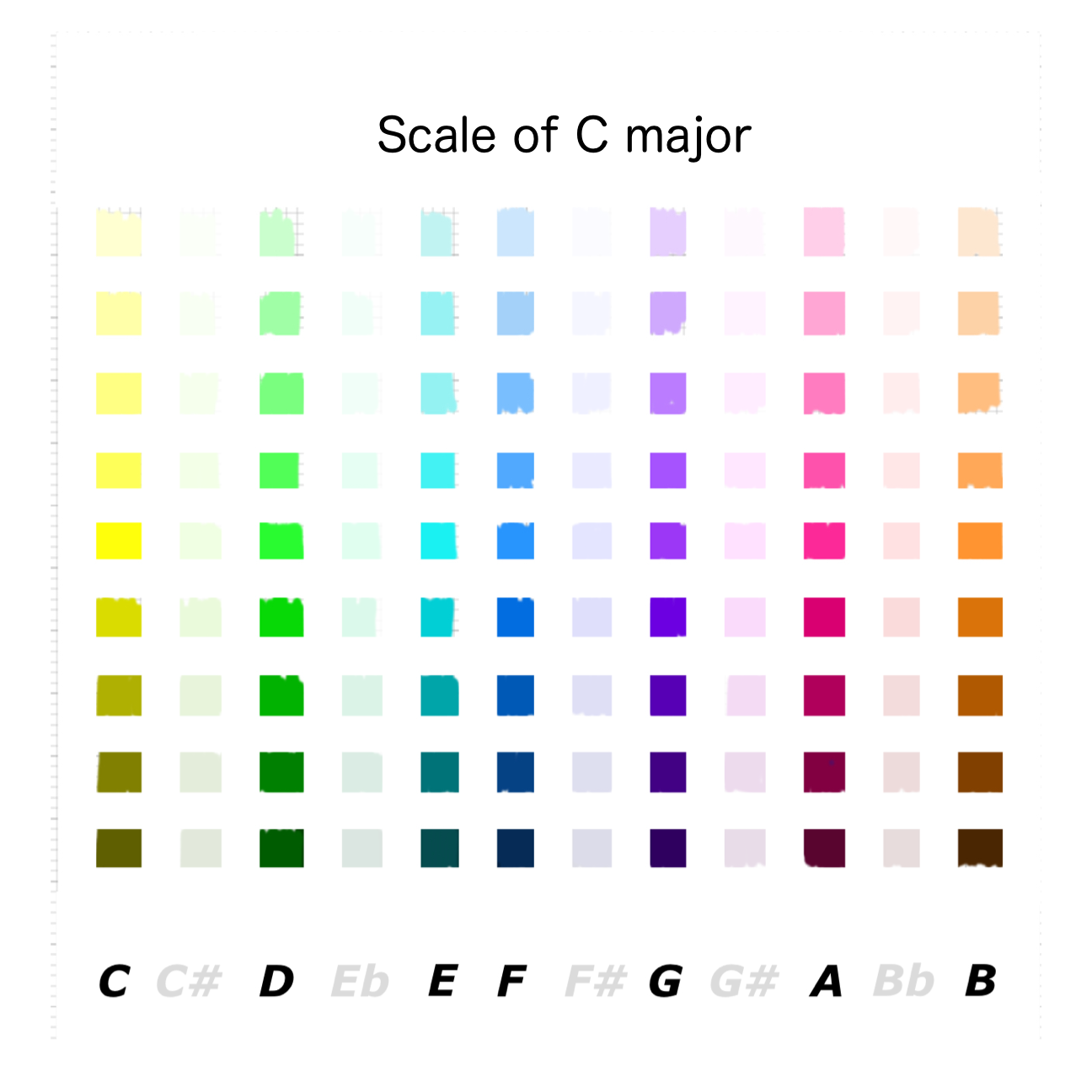
Fan example of the key of C major, each sharp or flat that is added changes the colour pallette.
Different Keys, Different Palettes
One of the most powerful dimensions of the system is the relationship between musical key and colour palette. A piece written in a specific key uses primarily the seven notes of that key's scale — seven colours out of the twelve — with the remaining five appearing as accidentals at moments of harmonic colour or modulation.
D major — the key of Bach's Mass in B Minor, Beethoven's Ninth, Brahms's Second — produces a warm, luminous palette of yellows and greens. D major has always been associated with brilliance and triumph. The Music-Glass system shows why: its notes occupy the warm, luminous part of the visible spectrum.
A minor — the key of Bach's Chaconne, Mozart's darkest piano sonata — produces a palette of pinks, purples, and cooler oranges. A minor has always been the key of grief and melancholy. Again, the physics explains what composers have always known intuitively.
The 18th century theorists called this the Affektenlehre — the doctrine of musical affects. The Music-Glass system makes the Affektenlehre visible for the first time.
The Designs — Bacharach am Rhein
Three Pieces — Three Colour Worlds
The two transcriptions that follow demonstrate the central claim of the Music-Glass system more clearly than any explanation can. Each piece is in a different key. Each key produces a completely different colour world. The emotional character of the music is visible in its colour temperature — and when the harmony modulates through different keys, the colour palette shifts with it.
This is what the eighteenth century music theorists called the Affektenlehre — the doctrine of musical affects. The Music-Glass system makes it visible for the first time.
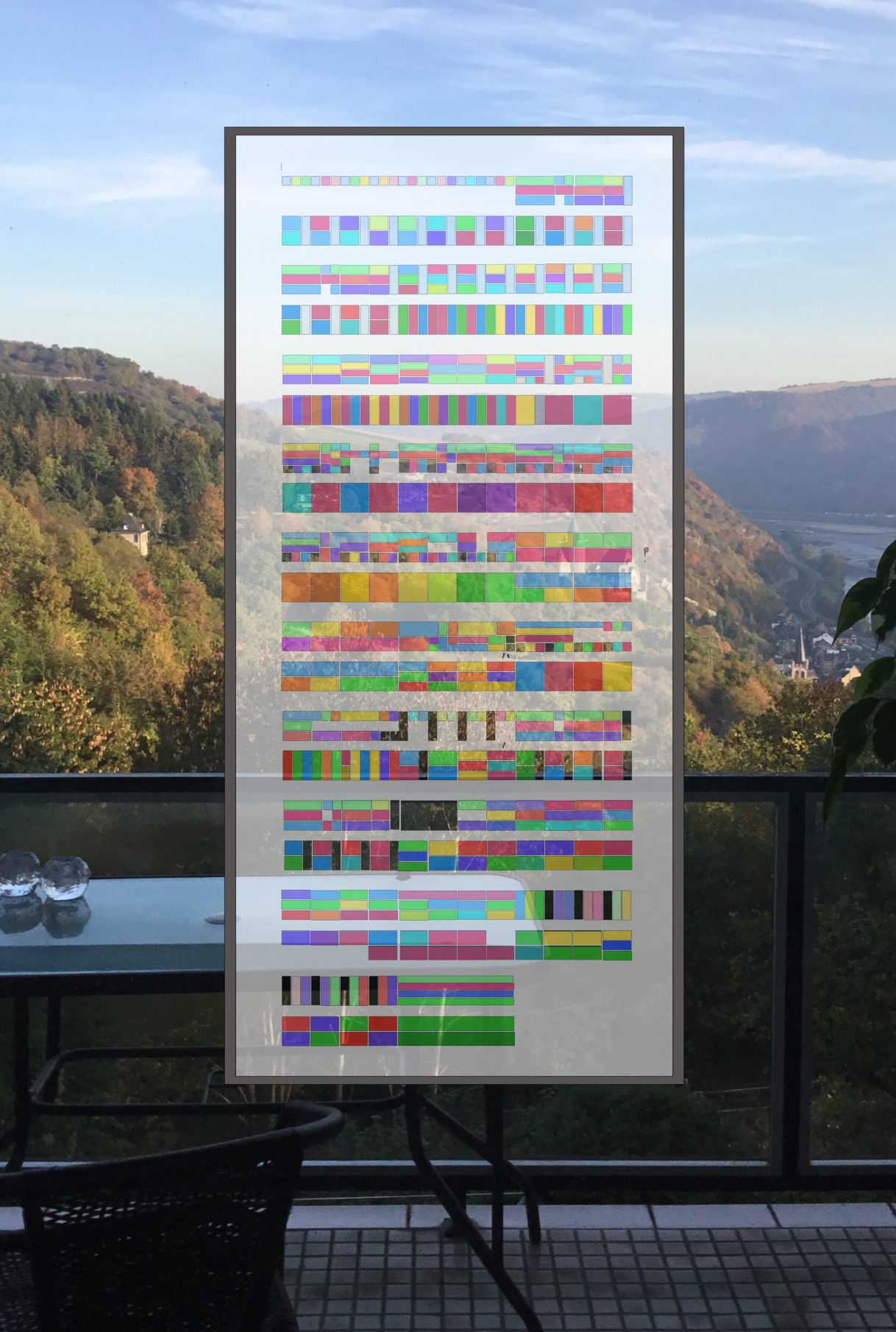
The Lacrymosa, K.626 — W.A. Mozart (1756–1791). Piano transcription. D minor. The last music Mozart wrote before his death on 5 December 1791.
The Lacrymosa — Mozart's Requiem
The Lacrymosa — Weeping — is the eighth movement of Mozart's Requiem, and the last music he wrote before his death on 5 December 1791. He completed only the first eight bars.
The piece is in D minor — in the Music-Glass system a palette centred on yellow-green (D), with the characteristic inflections of the minor key: F (orange), A (pink), Bb (purple), C (dark green). The overall effect is cool and shadowed, the minor key's characteristic colour temperature of purples, blues, and cooler oranges dominating throughout.
This is a piano transcription — both hands are present, melody and accompaniment moving simultaneously. The density and complexity of the composition is visible as a richly layered colour structure across the full width of the transcription, the two voices of the piano moving independently and in harmonic relationship.
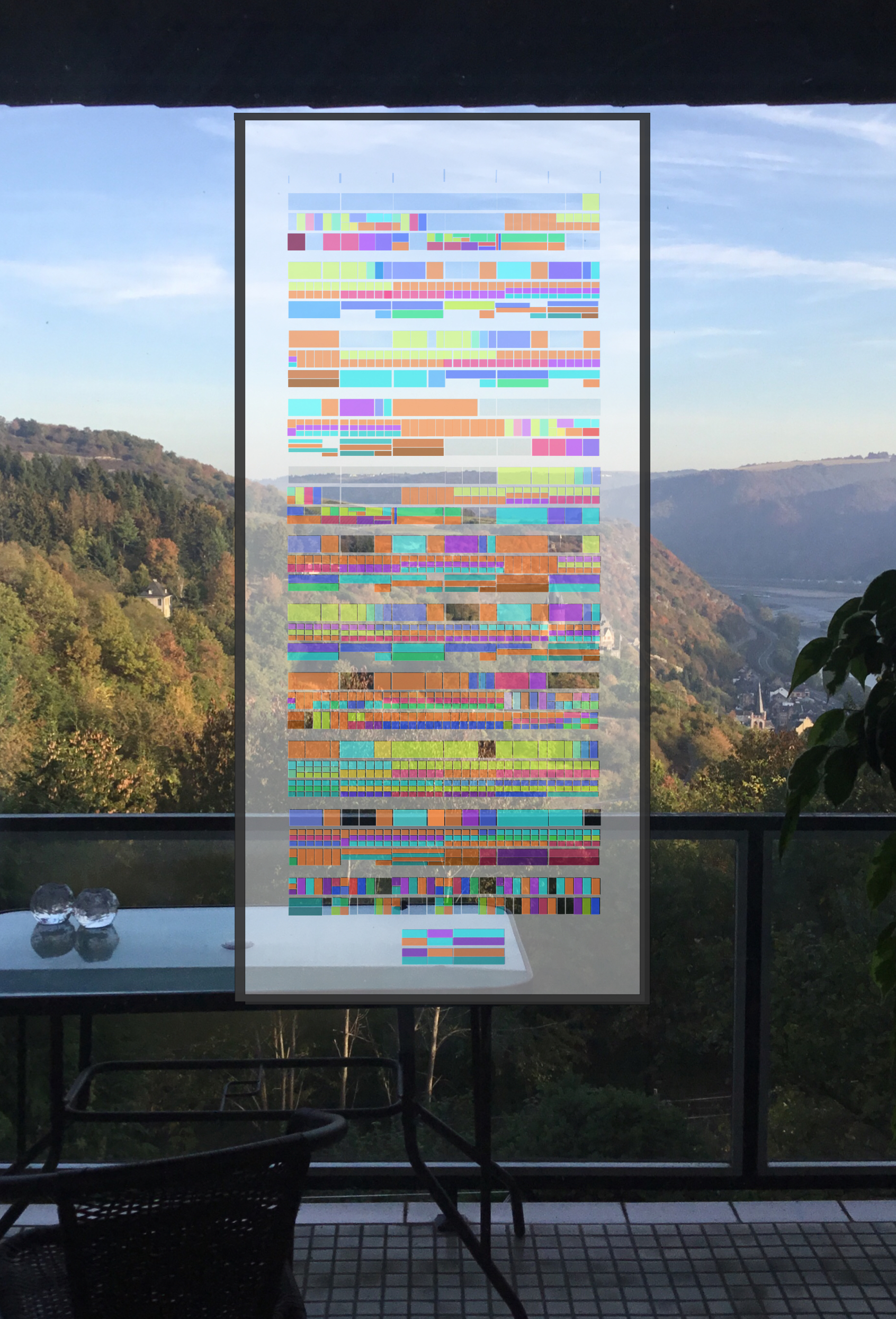
Mondlicht — L.V. Beethoven (1770–1827). Song version — vocal line above the two piano lines. C# minor, with modulations. The key changes are visible as shifts in colour palette.
Mondlicht — Beethoven's Moonlight Sonata
This transcription is from the song version of the Moonlight Sonata — three simultaneous voices are present: the vocal line running above the two piano lines of the left and right hands. Three rows of colour moving in parallel, the harmonic relationships between the voices visible as the colour relationships between adjacent rows.
The piece is in C# minor — a palette dominated by warm oranges, yellows, and lime greens, with the blues and purples of the minor inflections providing contrast. Immediately and strikingly different from the cool palette of the Lacrymosa in D minor. Same system, same rules, completely different colour world.
Most importantly, this transcription demonstrates the key changes. As the harmony modulates away from C# minor and back, the colour palette shifts visibly — the dominant orange and yellow-green giving way to cooler blues and purples at the modulations, then returning as the music resolves. Musical tension and resolution become colour tension and resolution.
Compare this to the Lacrymosa and the argument is made without further explanation: different keys produce entirely different colour worlds. The system does not interpret — it reveals.
One Note — Nine Octaves

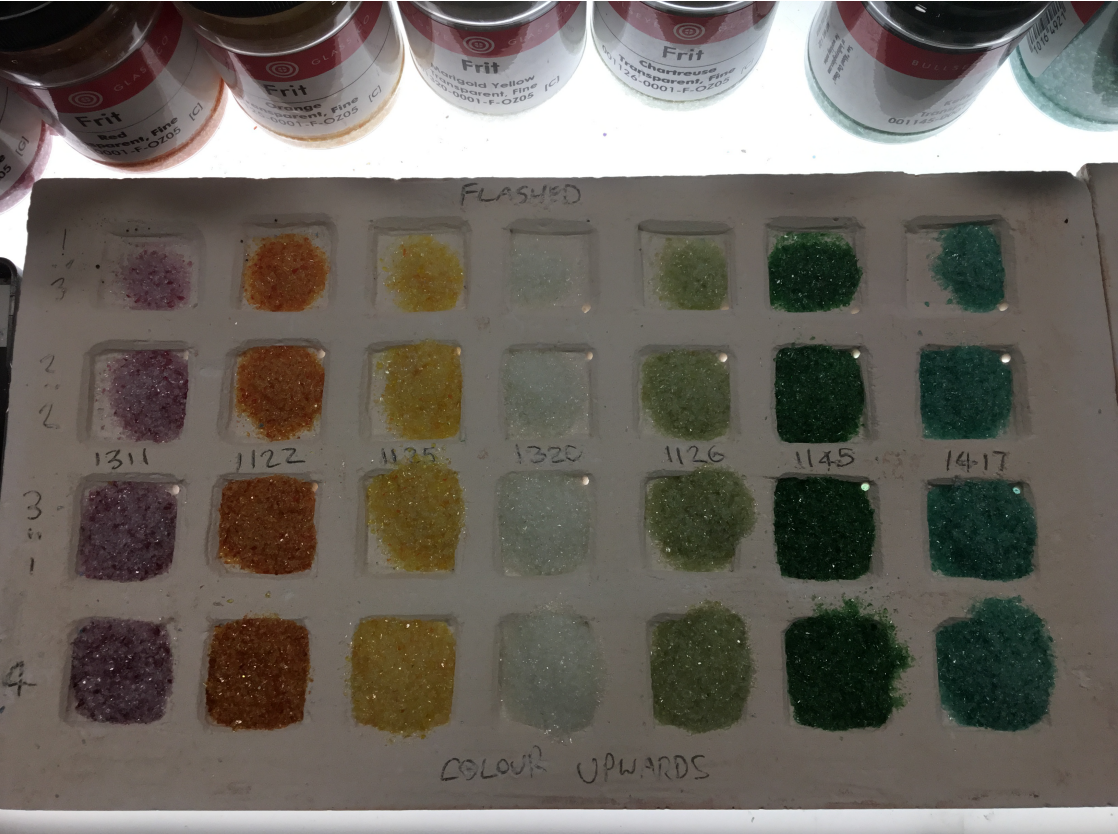
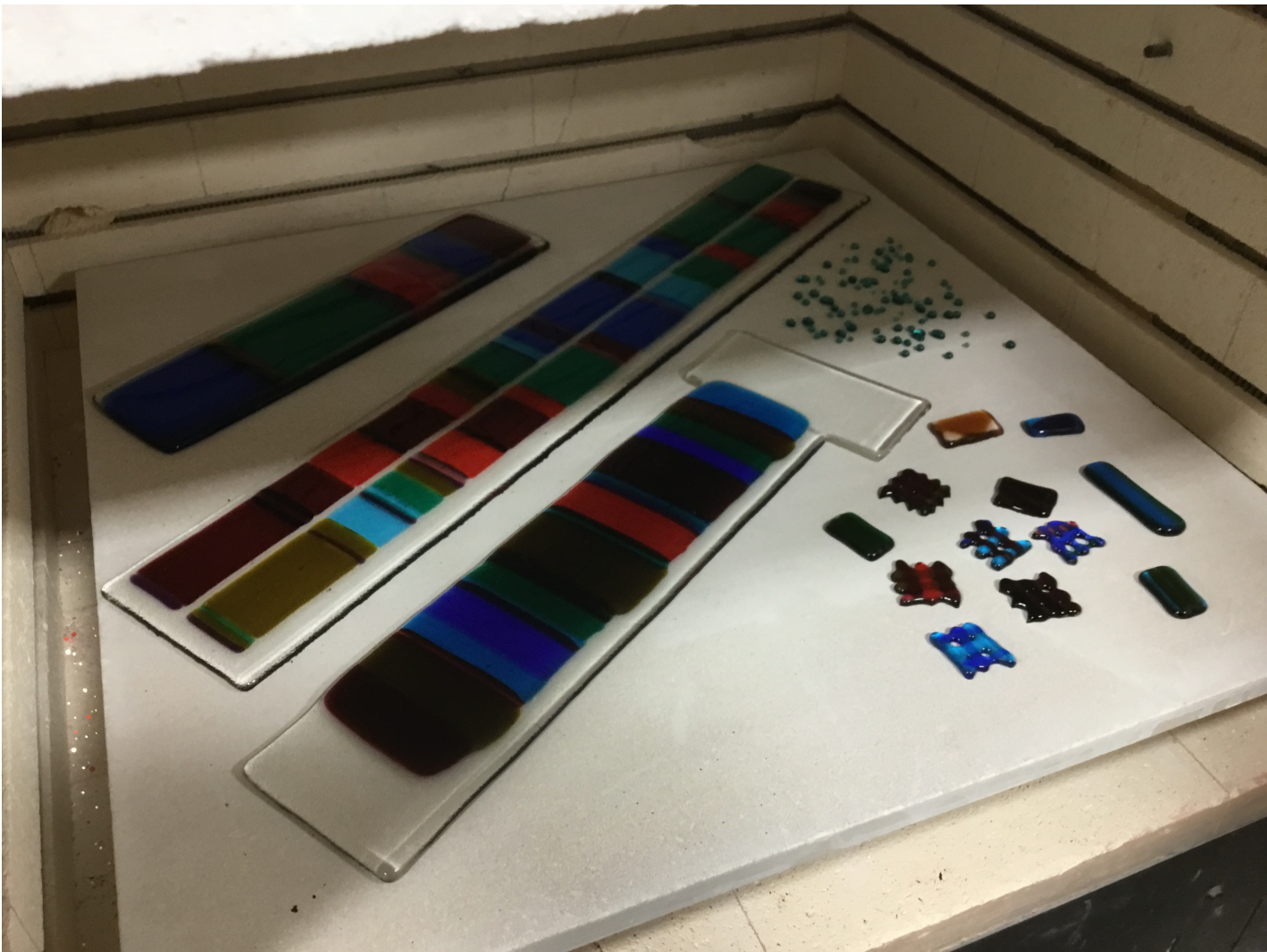
One note — the turquoise of E — shown across nine octaves in fused Bullseye glass. The same colour deepening from pale sky blue at the highest octave to near-black teal at the lowest. The crosses mark the octaves rejected during testing; the ticks mark those accepted for the final system.
Pipes and Stripes
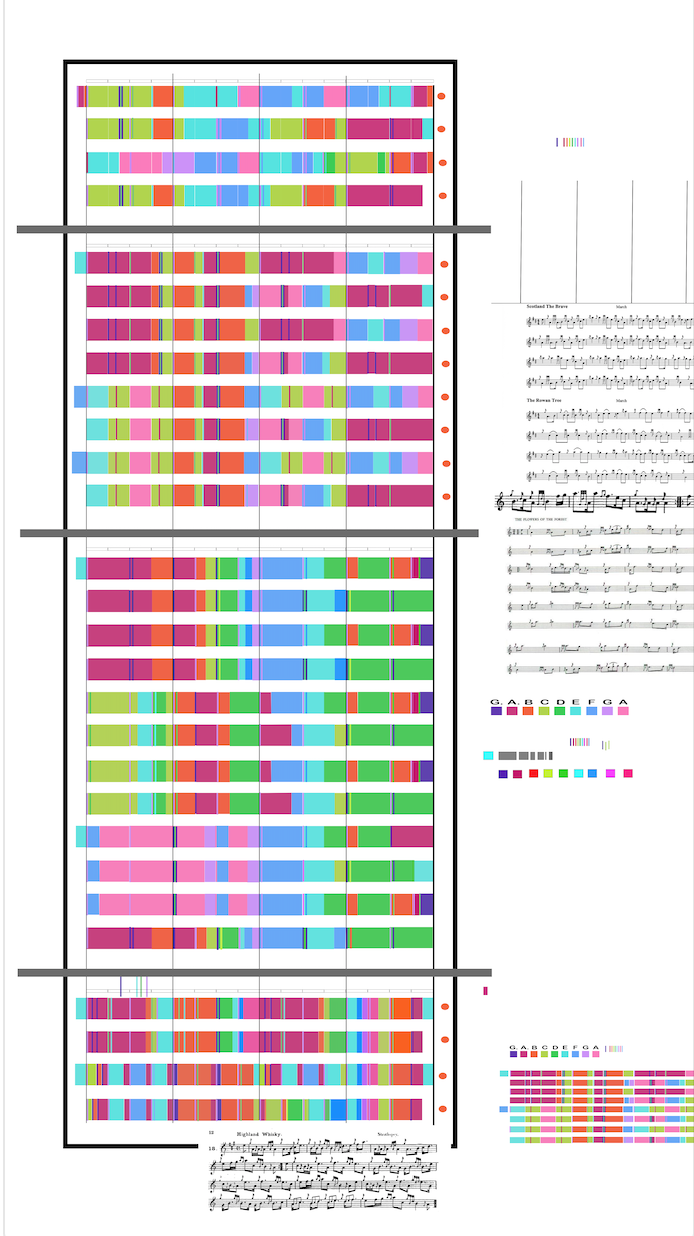
The complete working design — colour transcription alongside the original musical notation for each of the four tunes
From Notation to Colour
The working design places the colour transcription and the original musical notation side by side — the two forms of the same music visible simultaneously on the same page. Four tunes are transcribed across the full height of the window, each separated by a grey panel division bar:
- The Rowan Tree — a Scottish song of deep personal resonance, its slower, more lyrical character producing wider, more sustained colour bands in the second section.
- Miss MacGregor's March — chosen because the client is Lani MacGregor.
- The Flowers of the Forest — the lament traditionally played at funerals and acts of remembrance. Its repeating phrases are visible as repeating colour sequences across the third and largest section of the window.
- Highland Whisky — a lively reel closing the window, chosen for the whisky theme of the house and its Scottish setting.
The bagpipe scale and colour reference key at the bottom shows the system at work — each note assigned its specific colour, the same colour appearing wherever that note is played across all four tunes. A musician reading the notation and a viewer reading the colour bars are looking at exactly the same music.
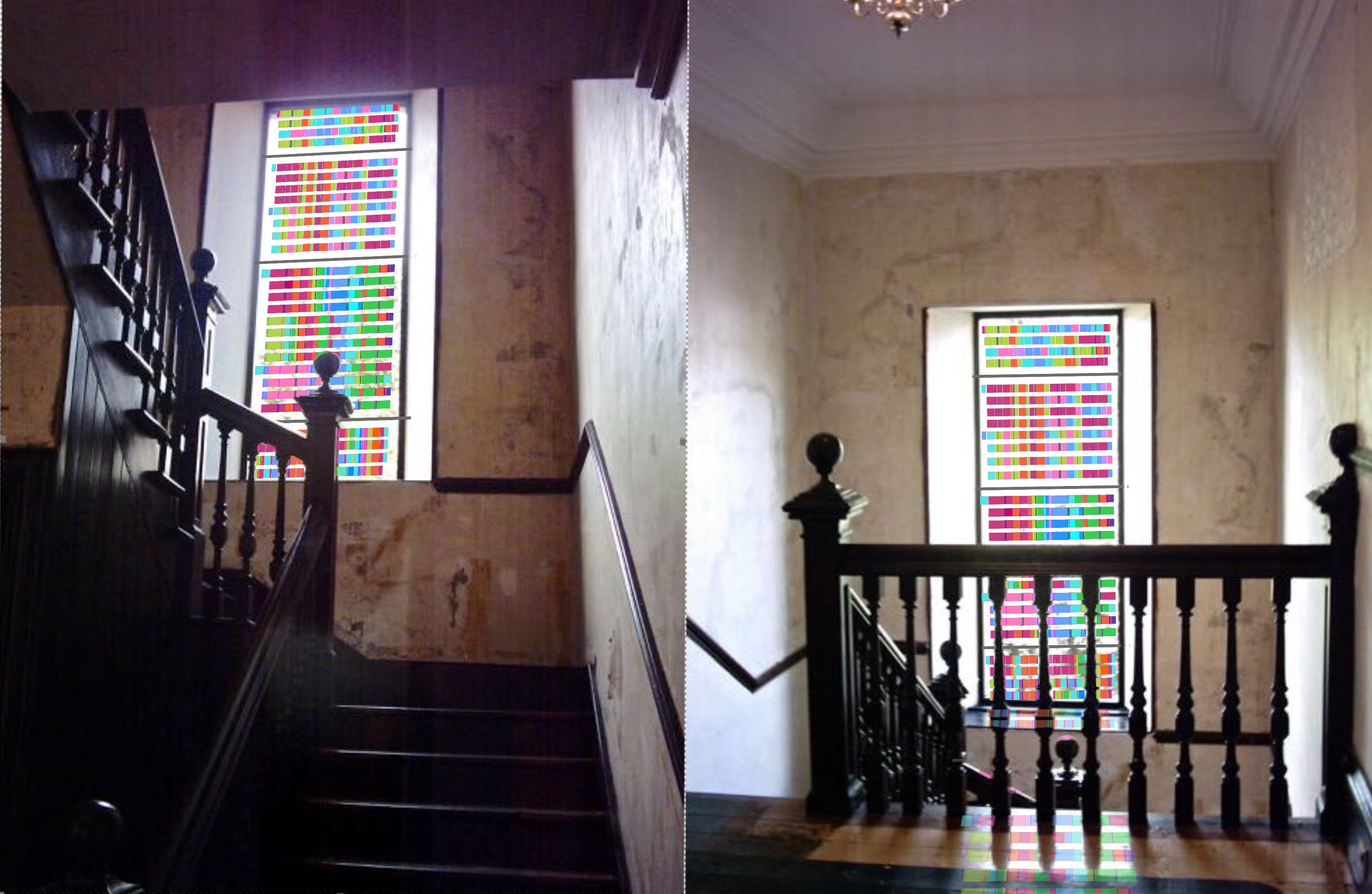
Photomontage of the design in the location — the window visualised in the Latheron House staircase before the glass was made
The Design in the Space
Often, when I want to see how a design will work within a space, a photomontage works very well. You see anything wrong with the layout or composition when you do this. It also lets you become aware of how the window works with the various obstructions — the balustrade, the staircase angle, the proportions of the window opening itself.
In this case the montage also revealed something important — the colour already projects onto the floor through the balustrades, even in the photomontage. That projected colour became one of the most striking features of the finished installation.
The Completed Window
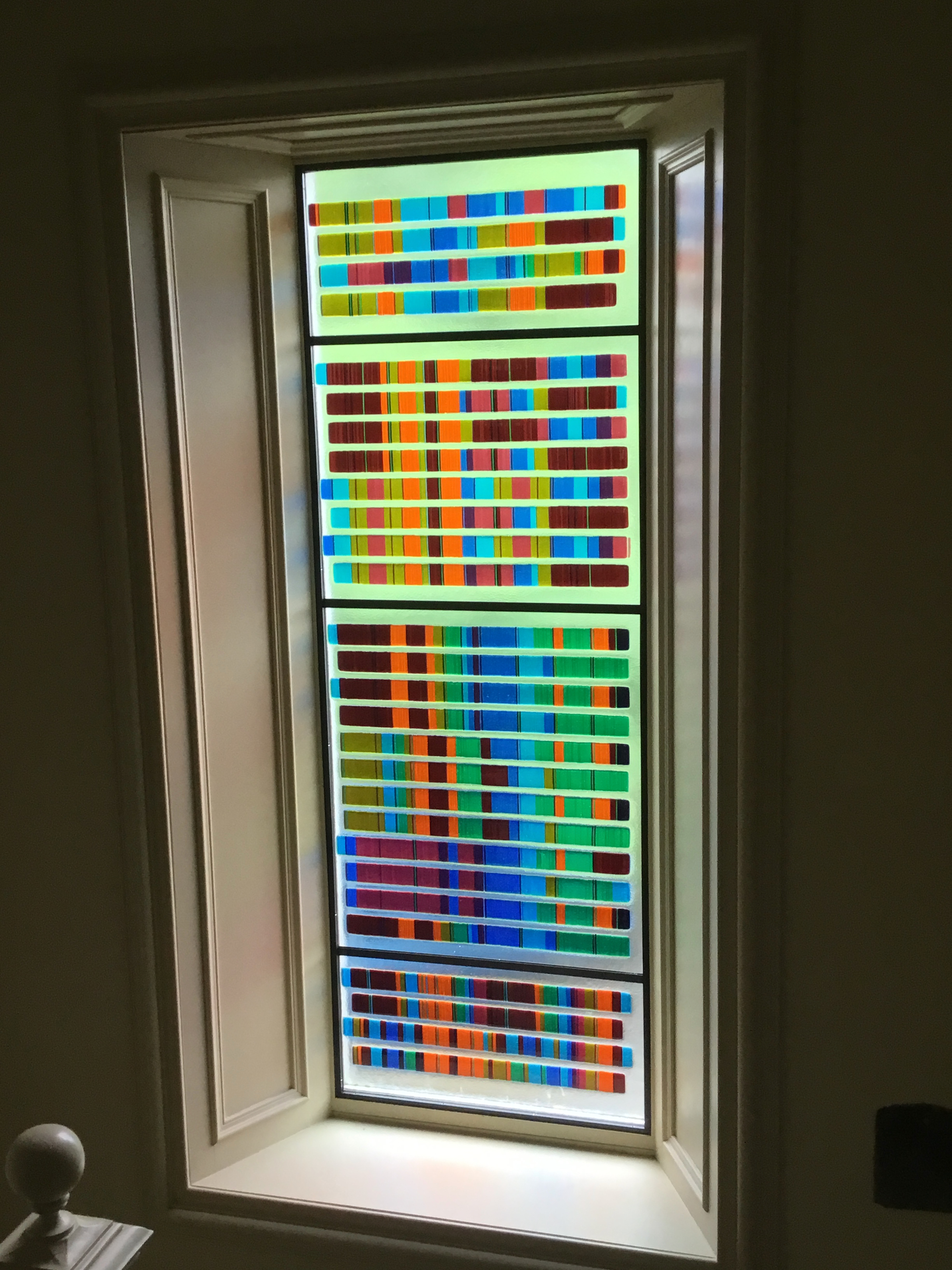
Pipes in Stripes — the completed window in daylight at Latheron House, Caithness
Pipes in Stripes — Latheron House, Caithness
The completed window consists of approximately 10,000 pieces of Bullseye glass. Each horizontal row is a phrase of the music. Each coloured rectangle is a note. The width of each piece corresponds to the duration of the note. The window is a complete and exact visual transcription of the four tunes — readable as music by anyone who knows the system.
The window is installed in the staircase — the coloured light projecting through the balustrades onto the floor below, creating a second work made of light and shadow that moves with the changing light of the day.
Codaworx Merit Award 2019
Material — Fused Bullseye Glass, Portland, Oregon
Dimensions — approximately 3m × 0.9m
Panels — approximately 10,000 pieces of glass
Location — Latheron House, Latheron Wheel, Caithness, Scotland
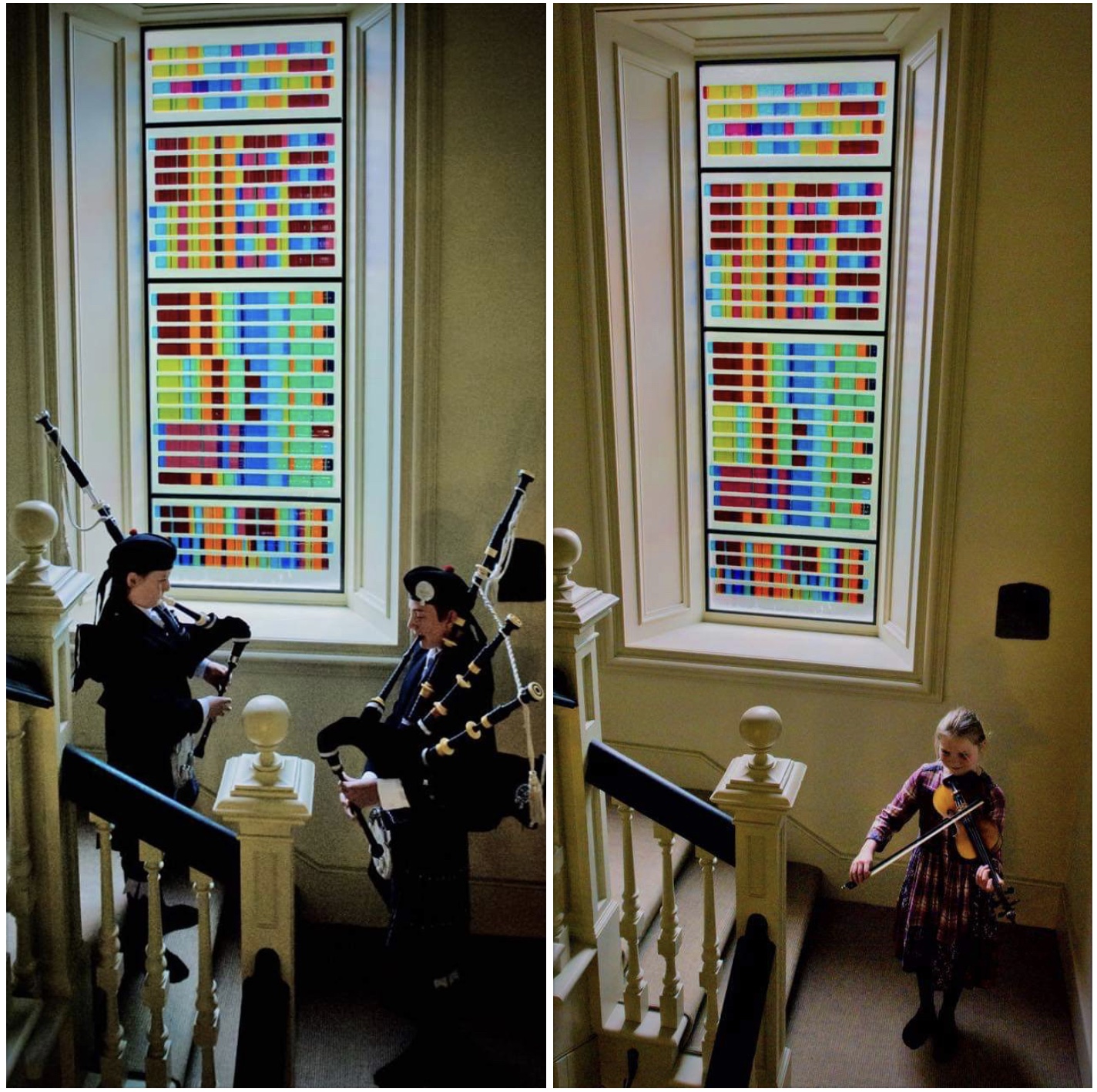
The dedication — two pipers play the tunes encoded in the window. A young violinist plays before it. The music in the glass is performed in the air simultaneously.
The Window Can Be Played
At the dedication of the Pipes in Stripes window, two pipers stood before it and played the tunes encoded in the glass. The music that the window contains was being performed in the air in front of it at the same moment it was visible in colour behind them.
This is what no other kind of window can do. A figurative window can be looked at. An abstract window can be experienced. A Music-Glass window can be played. The notation is in the glass. Any musician who has learned to read the colour keyboard can stand before it and perform what they see.
The young girl playing violin is the image of what this system is ultimately for — music passing to the next generation, visible in light, permanent in glass, playable by anyone who understands the language.
As long as light falls through it, the music is there.
The Window — Installation and Dedication
The Next Step — Hildegard von Bingen

O virtus Sapientiae — Hildegard von Bingen (1098–1179). Antiphon from the Symphonia armonie celestium revelationum
Music, Colour, and Light — United
Hildegard von Bingen (1098–1179) was a Benedictine abbess, composer, and mystic who lived and worked on the Rhine her entire life — at Disibodenberg near Bad Kreuznach, and at Rupertsberg near Bingen, directly on the Rhine. She developed a unified theology in which music, colour, and light were understood as different manifestations of the same divine reality.
The Music-Glass system arrives at structurally the same position through physics: sound and light are both wave phenomena; the frequencies of the musical scale correspond proportionally to the frequencies of the visible light spectrum. What Hildegard understood theologically, physics demonstrates scientifically. Nine centuries separate them. The understanding is the same.
The proposed first transcription is O virtus Sapientiae — O Power of Wisdom — a short antiphon of great beauty from her Symphonia armonie celestium revelationum. The piece is in A minor, producing a palette of pinks, purples, and warm oranges. Its monophonic plainchant melody — single notes, no harmony — would produce wide, sustained bands of colour, the melody tracing a slow arc through the spectrum.
A Hildegard Music-Glass window made for the Rhine region, where she lived and composed, connecting the medieval theological tradition and contemporary physics in a single permanent glass artwork — this is the proposal for BUGA 2029.
Questions and Answers
What is the Music into Glass system?
It is a method for translating music into coloured glass based on a verifiable scientific correspondence between musical frequencies measured in hertz and light frequencies measured in terahertz. Each of the twelve notes of the chromatic scale corresponds to a specific colour in the visible spectrum. A = 440Hz corresponds exactly to pink = 440THz. The system covers nine octaves — the full practical range of Western musical instruments — with the same twelve colours appearing at progressively deeper tones for lower octaves and lighter tones for higher octaves.
How does the transcription work?
Each note is represented by a coloured rectangle. The colour identifies which of the twelve chromatic pitches the note is. The tone or shade of that colour identifies which octave. The width of the rectangle corresponds to the duration of the note — a long note produces a wide rectangle, a short note a narrow one. Grace notes are included as narrow slivers. Reading from left to right across a row is reading a phrase of the music. Reading from top to bottom is reading through the piece sequentially. A person who knows the system can read the music from the glass and play it back.
Why will a harmonious piece of music produce a visually harmonious window?
Because the harmonic relationships between musical notes — the intervals that sound pleasing together — correspond to real colour relationships in the visible spectrum. Notes that are consonant in music sit in visually harmonious positions in the colour system. Notes that are dissonant produce colour tensions. The physical basis of musical harmony and the physical basis of colour harmony are the same: frequency relationships. A piece of music whose notes are in harmonious relationship will produce a glass composition whose colours are in harmonious relationship. If it sounds beautiful, it will look beautiful.
What is different about this compared to other attempts to connect music and colour?
Most previous attempts to connect music and colour — from Newton's colour/note correspondences to Scriabin's colour organ — have been arbitrary, metaphorical, or based on personal association rather than physical fact. The Music-Glass system is based on a measurable, verifiable correspondence between hertz and terahertz — the same unit of measurement, different scales. It is not a creative interpretation. It is a structural fact about the physical world that was always there, waiting to be found and applied.
What music could be transcribed using the system?
Any music that can be notated can be transcribed. The system has been applied to Scottish bagpipe music and to Bach. It is particularly suited to plainchant — Hildegard von Bingen's monophonic melodies would produce wide, sustained bands of colour with extraordinary luminosity. A Bach fugue would produce a window in which the same colour sequence appears in multiple voices simultaneously, the counterpoint visible as interweaving colour streams. A complete transcription of Bach's Well-Tempered Clavier — 48 preludes and fugues in all 24 keys — would cover the entire colour spectrum and constitute the most ambitious architectural glass work of the twenty-first century.
How can I commission a Music into Glass window?
Any piece of music can be the subject of a commission. The client chooses the music — a favourite piece, a piece with personal significance, a piece connected to the location of the window. The Music-Glass system translates it into a design. The design is then realised in fused Bullseye glass. Please contact John Kenneth Clark directly to discuss a commission.