Windows on the Fundamental Elements
Domaine Mechtildshausen, Wiesbaden — 2003 and 2005
Domaine Mechtildshausen is a high-quality organic market, restaurant, café, and hotel located just outside Wiesbaden in Rheinland-Pfalz. The commission — two phases of windows on the theme of the fundamental Elements — was one of the most technically innovative projects in the practice, and the one in which the concept of controlled spontaneity was first fully developed.
The windows contain no paint and no enamels. The entire image — in every panel — is created solely through acid etching and, in three of the windows, silver staining. Nothing else. The results are unlike anything else in European architectural glass.

The Commission
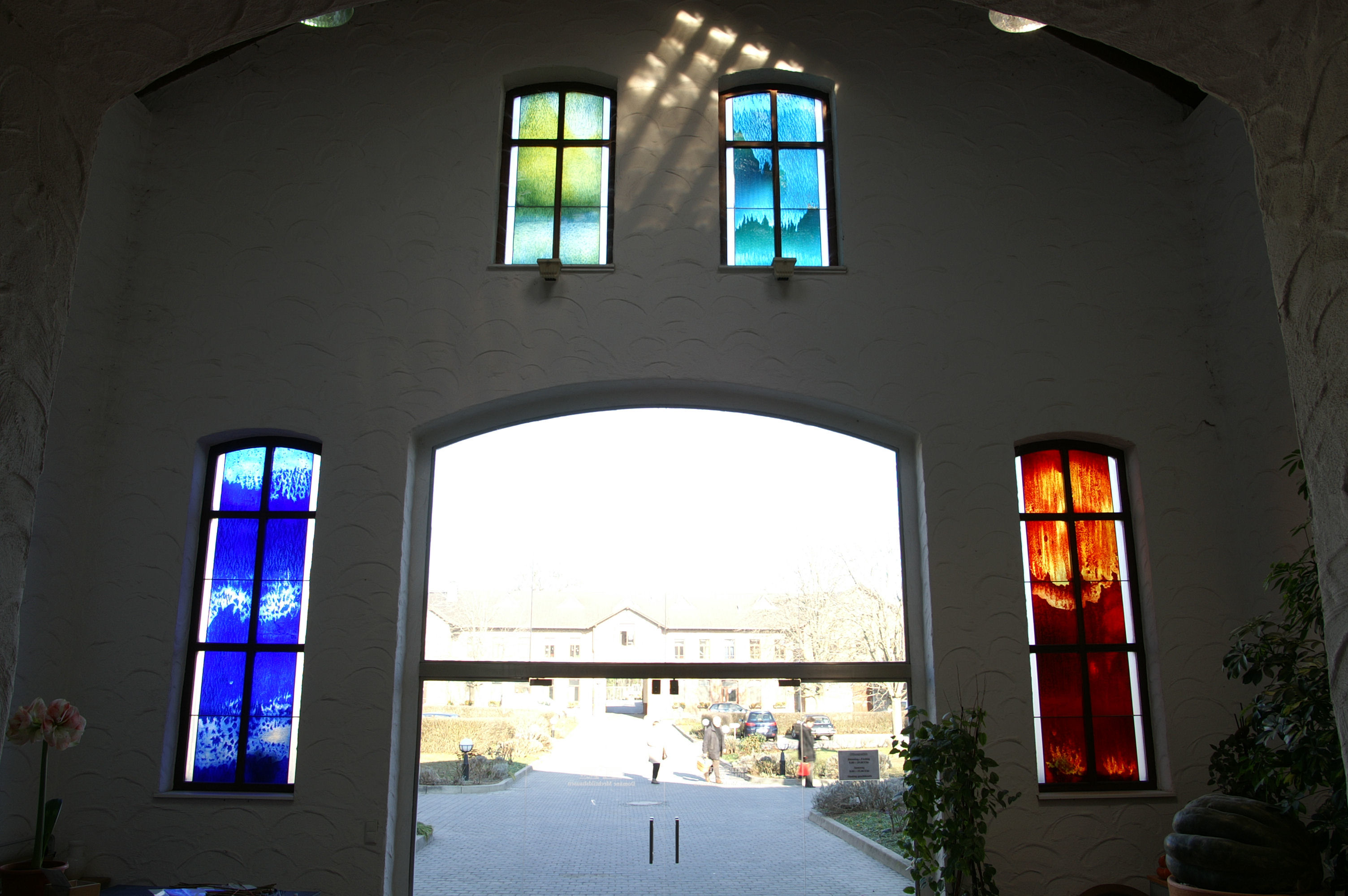
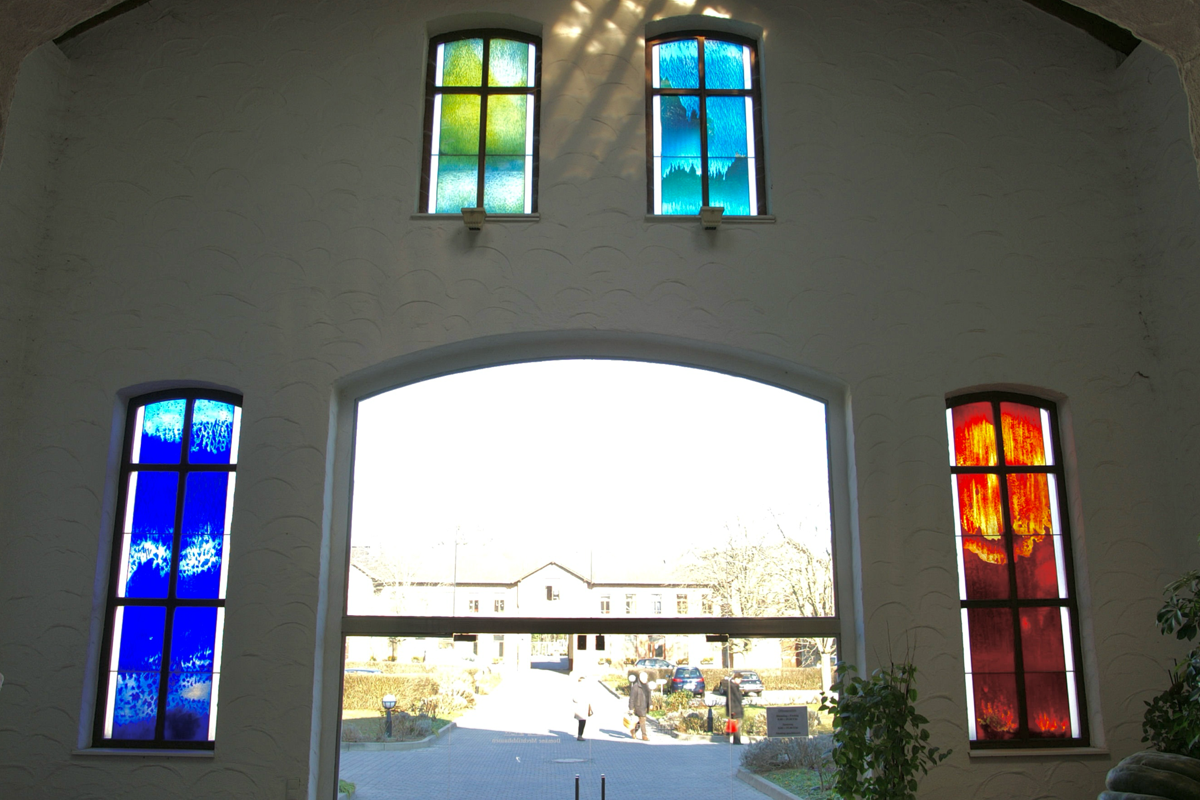
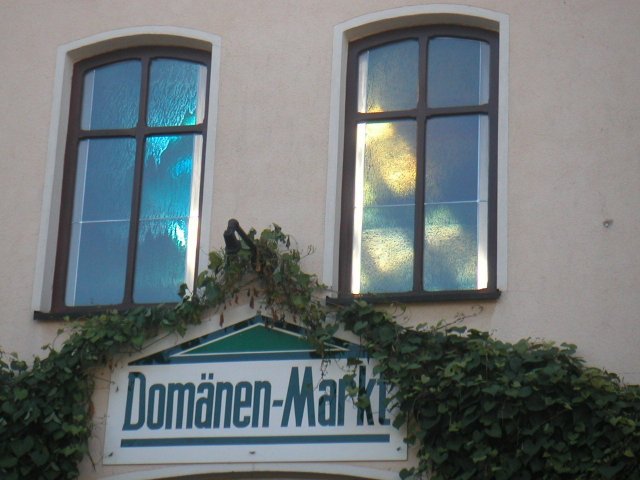
The four windows in their setting — Fire, Water, Earth, Air
How It Began
Herr Bourgett visited an exhibition and asked if I would make some work for the new market hall at the Domaine. There was no specific design brief — only that I should design something appropriate to the building and location.
From early on in the project I realised that something abstract would probably be most appropriate. It should also have some link to the holistic and organic philosophy underlying the Domaine itself. I had been drawn toward a set of windows based on the concept of the fundamental elements found in many cultures — fire, water, earth, and air. I began looking for images that reflected the essential qualities of each.
The designs were produced, met with approval and surprise at the design approach — and then nothing happened for quite a long time. When the project eventually came to life, the location of the market hall had changed and another building had been selected. A complete redesign for the new location was required. The façade design is the result of these revisions.
Phase 1 — 2003
4 windows on the theme of the Fundamental Elements
2 × 2.5m × 0.82m, 2 × 1.7m × 0.82m
Phase 2 — 2005
2 windows on the theme of the Elements
7 panels various sizes, largest 1.60m × 1m
Location — Domaine Mechtildshausen, Wiesbaden, Rheinland-Pfalz
Technique — Acid etching, silver staining — no paint or enamels
The Design Process
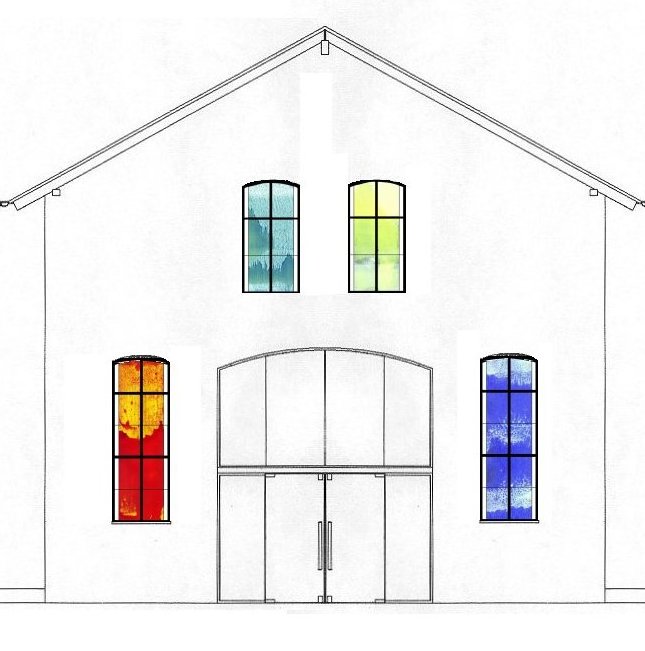
design of the first four windows — the starting point for the acid etching process
Mono-Print — A Random Principle
The designs were not produced through conventional drawing. Instead they were created using a mono-print technique — a random principle over which the only real control was the selection of colours. This freed the design from the limitations of a drawn approach and produced images with a quality of spontaneity and freshness that conventional methods could not achieve.
The concept of the fundamental elements provided the framework: fire, water, earth, and air. Images were selected that reflected the essential qualities of each element. The concept was a starting point and a creative direction, not a dogma — the designs followed the material rather than imposing a fixed programme on it.
When the project came to life and the question of how to make the windows arose, the challenge was clear: how to translate the spontaneity of the mono-print designs into glass without losing it in the making process. The conventional approach — drawing a large-scale version of the design — produced results that were exciting as drawings, but did not capture the freshness of the originals. A different method was needed entirely.
Controlled Spontaneity
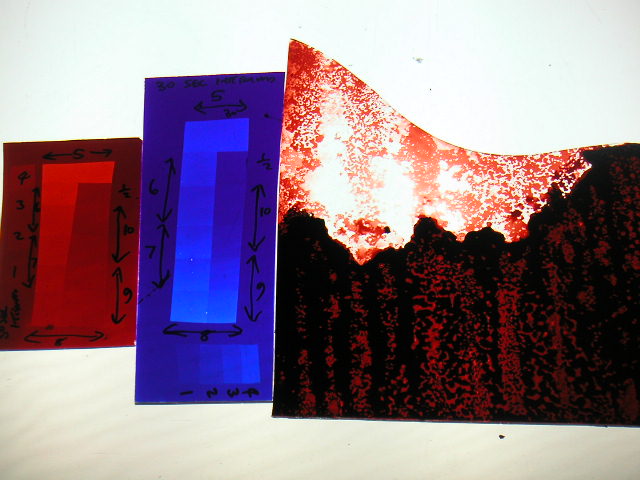
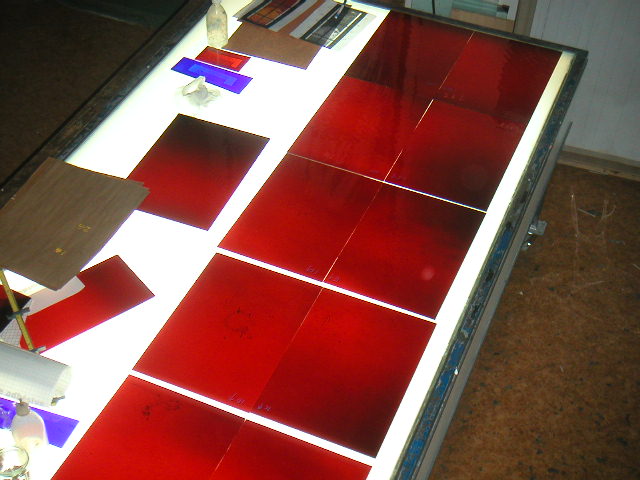
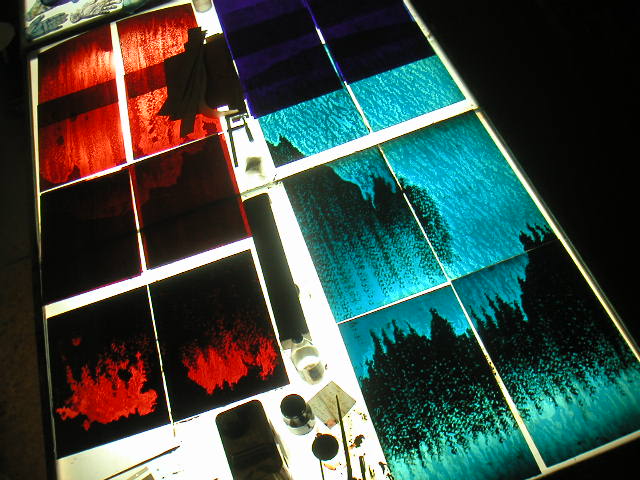
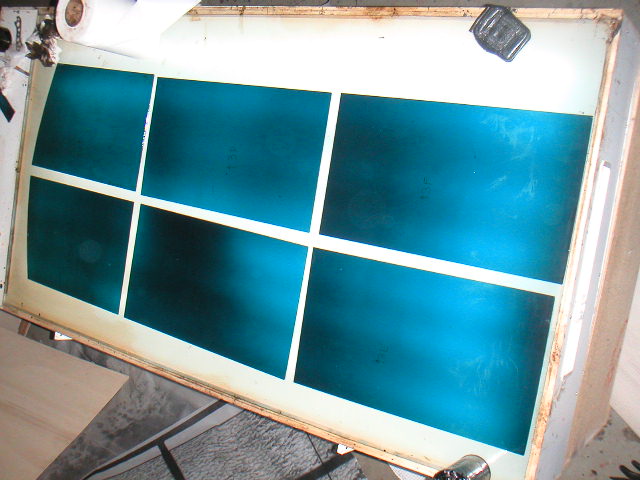
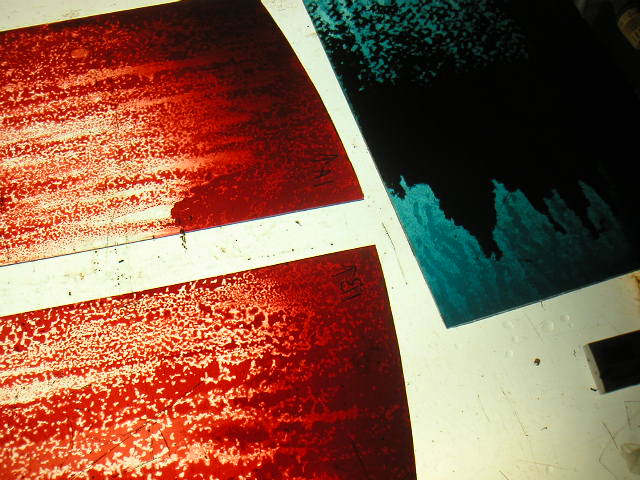
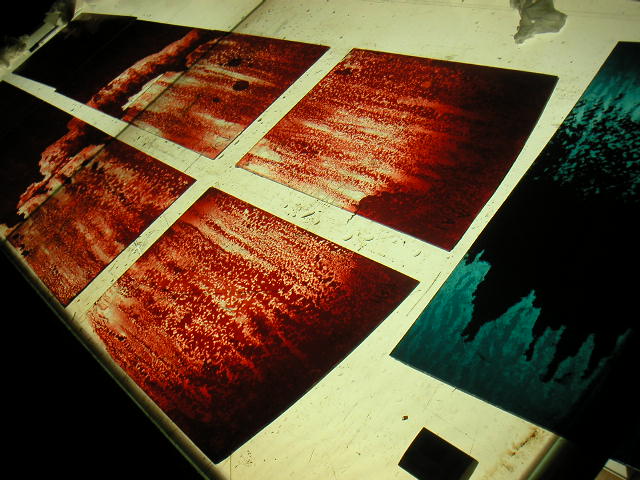
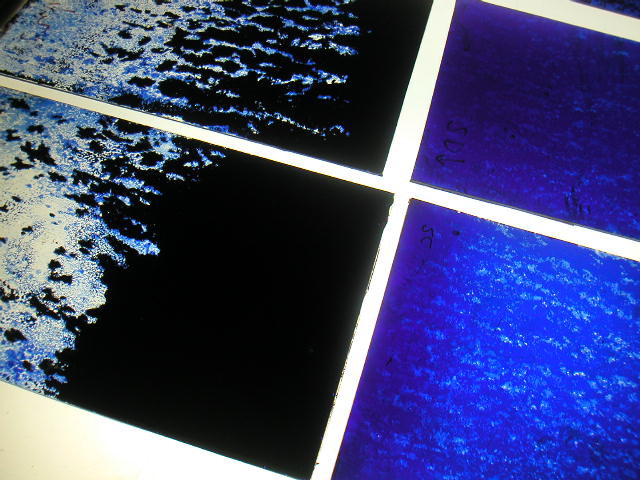
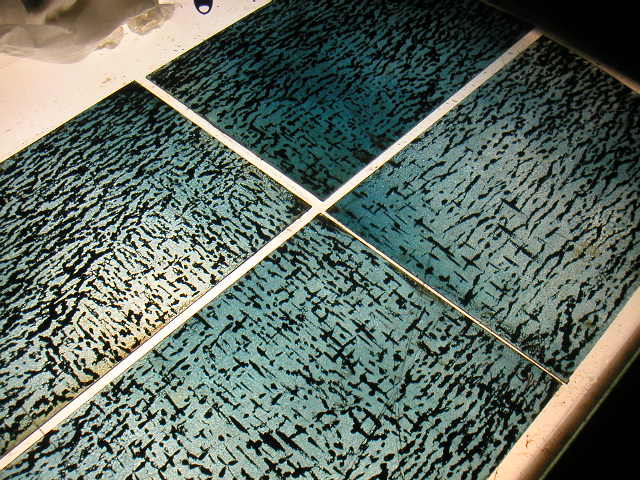
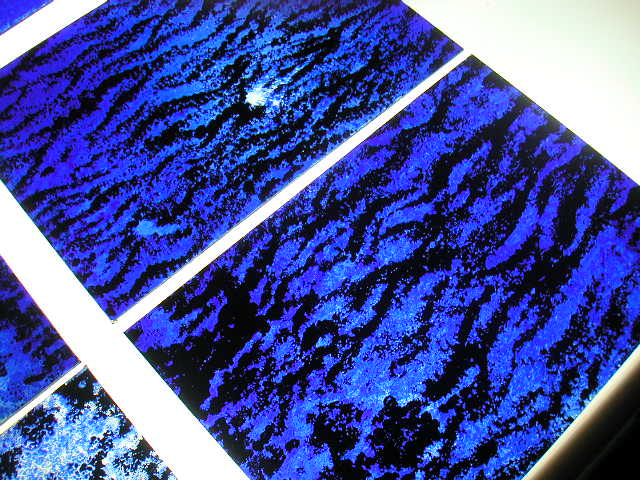
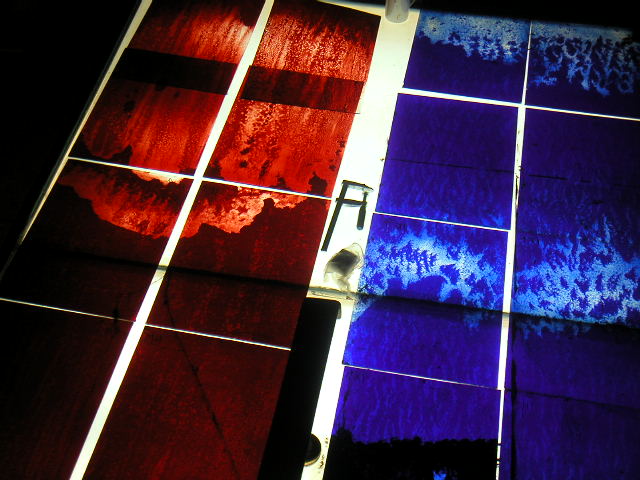
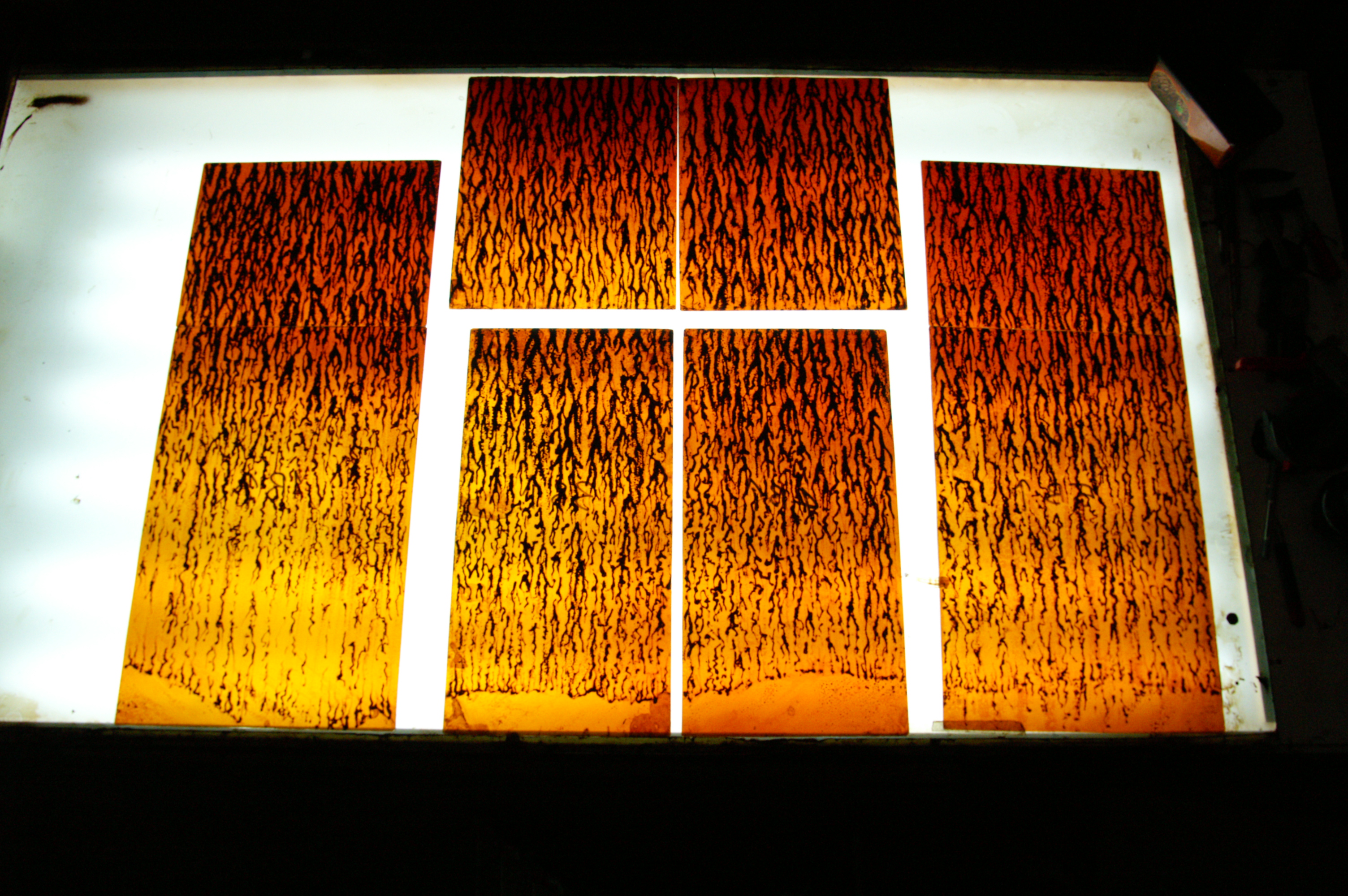
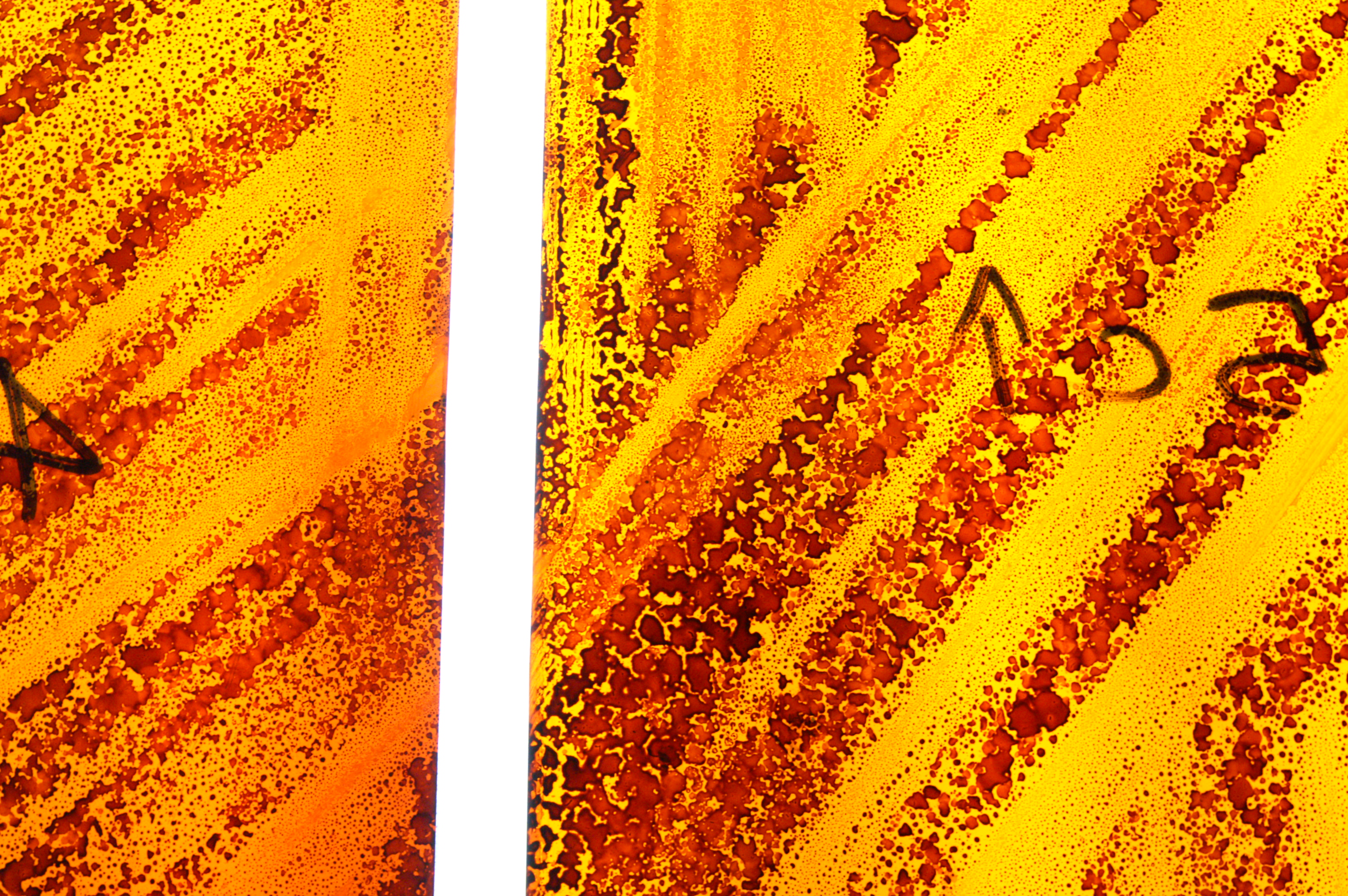
The etching process — testing the glass - important stage of making
Four Weeks of Experimentation
I experimented for approximately four weeks, trying various methods of applying acid resists to the glass surface, until I found the qualities I was looking for. The method I developed gave these windows a completely original quality that has never been replicated.
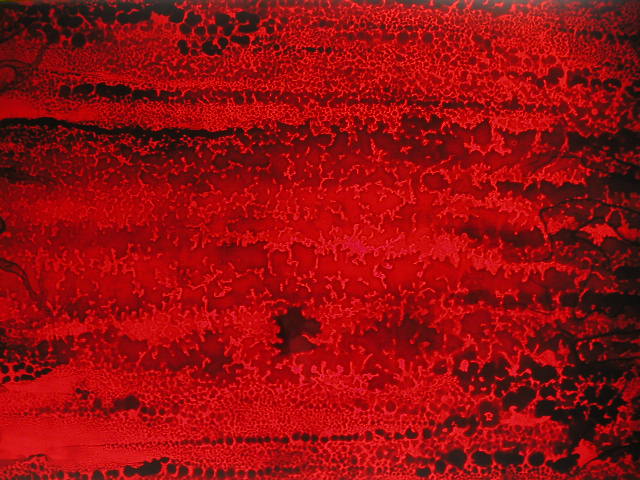
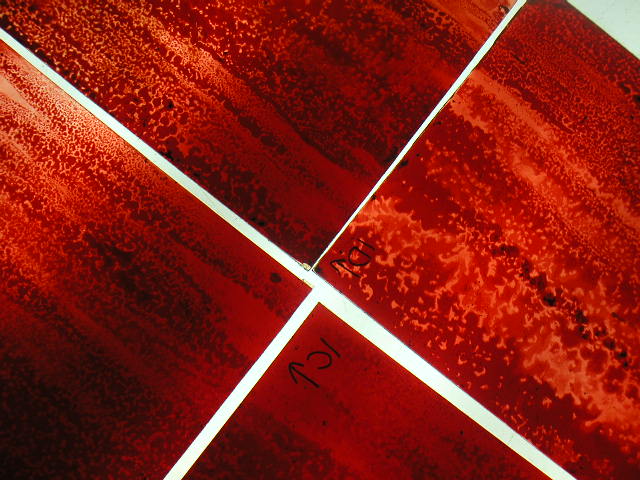
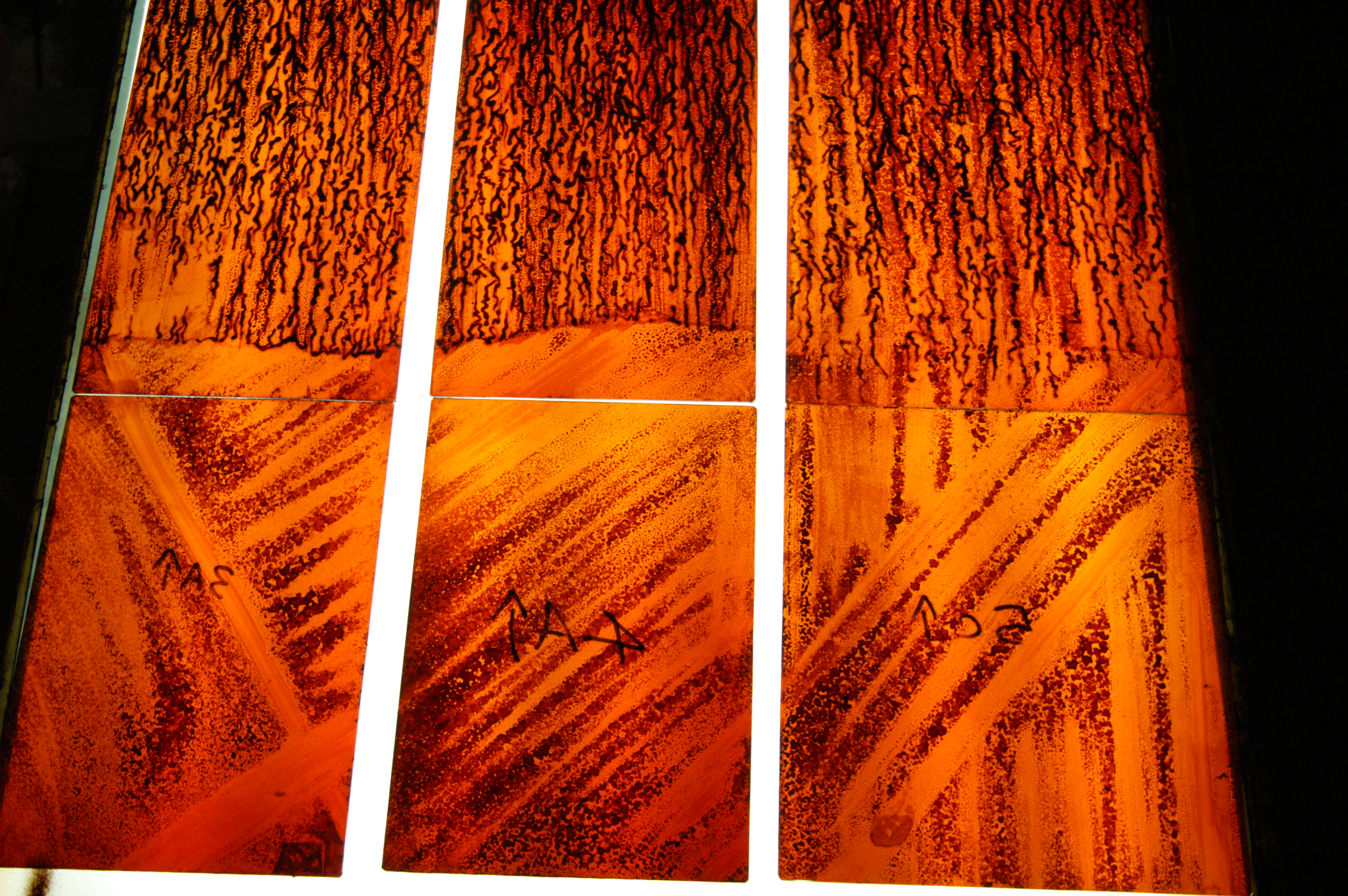
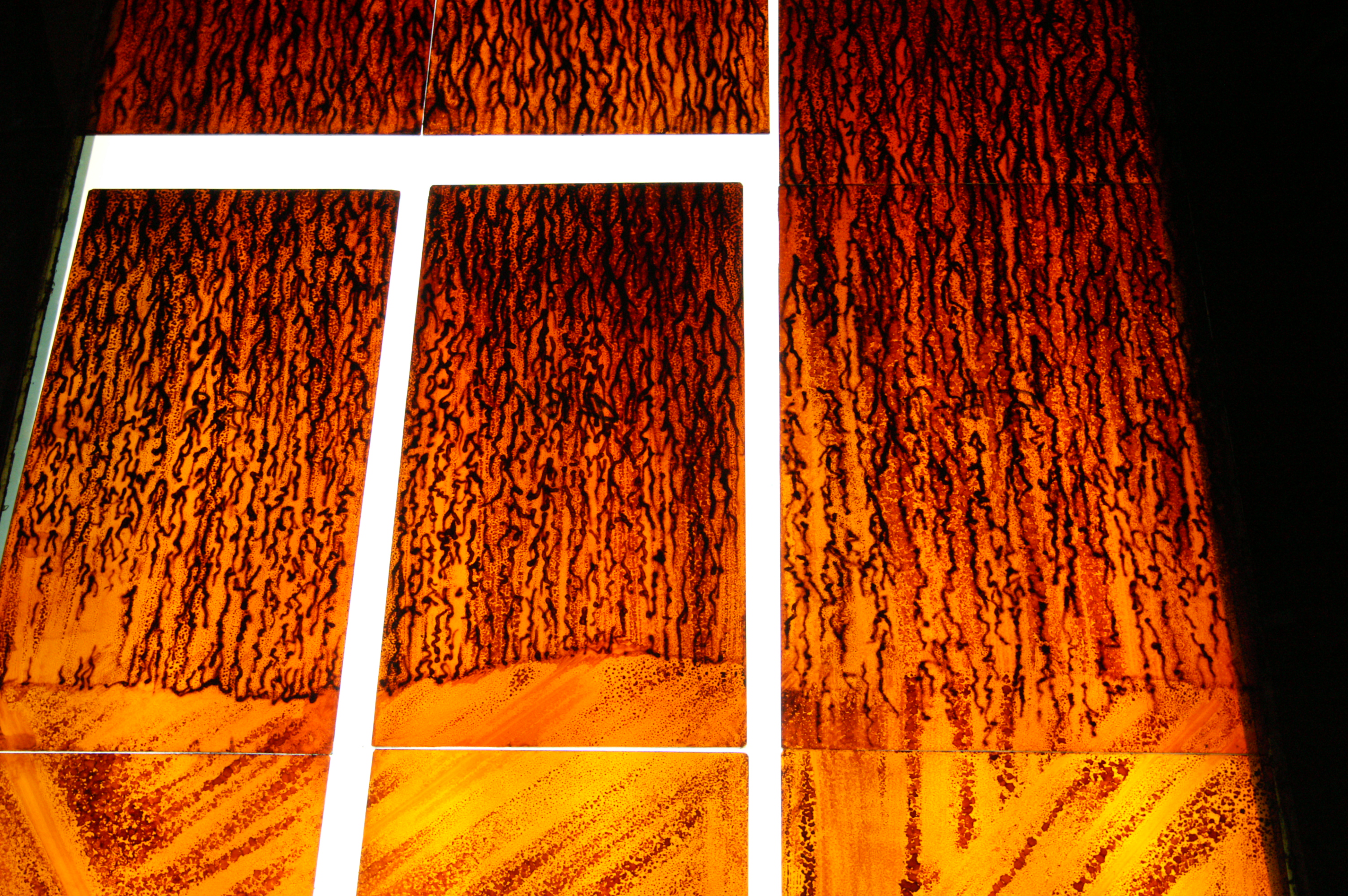
The surface of each panel was extensively and repeatedly etched — multiple applications of acid, each building on the last, the image emerging through accumulation rather than through a single predetermined process. Between etchings, the glass was washed and the loose resist removed, then the cycle was repeated. At a chosen moment, the acid resist was reapplied and the process resumed.
There is no paint and no enamel anywhere in these windows. The entire image — colour, tone, texture, depth — is created solely through the etching process and, in three of the windows, silver staining. The colours of the finished glass are not applied to a surface. They are what remains of the glass after the acid has done its work.
This project was where the concept of controlled spontaneity was first fully realised — the balance between the artist's control over timing and colour, and the inherent unpredictability of the etching process itself. It was very stimulating working finally on an abstract project and I have since used what I learned here in many subsequent commissions.
Making Gallery
The Six Elements
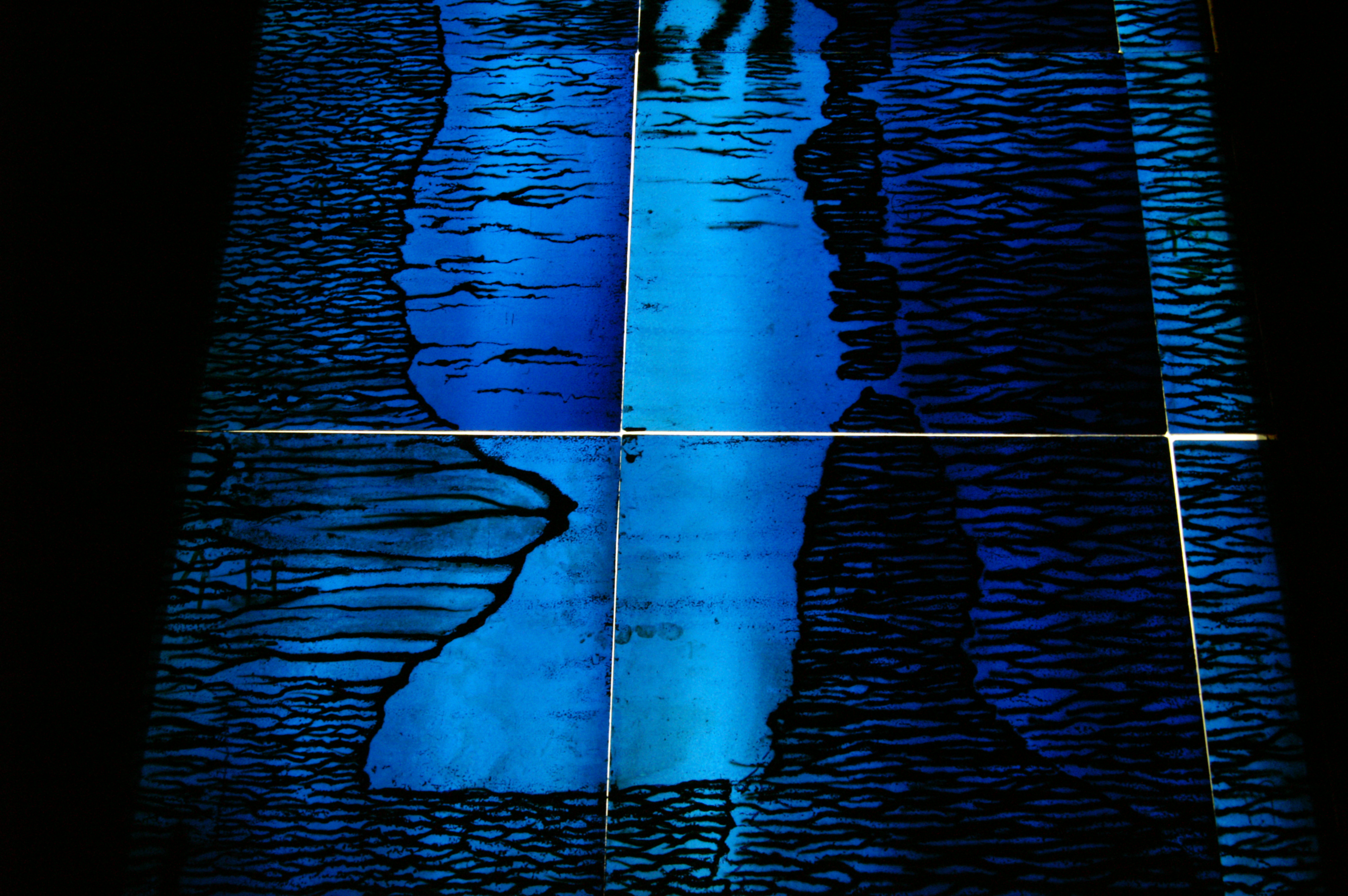
The commission for Domaine Mechtildshausen was made in two phases — 2003 and 2005. The first phase produced four windows on the theme of the fundamental elements. The second phase extended the programme with two further windows, a more nuanced reading that distinguishes between fire as combustion and sunshine as radiant warmth, and between water as fluid movement and ice as crystalline solid. Six windows in total, across two buildings, developed over two years.
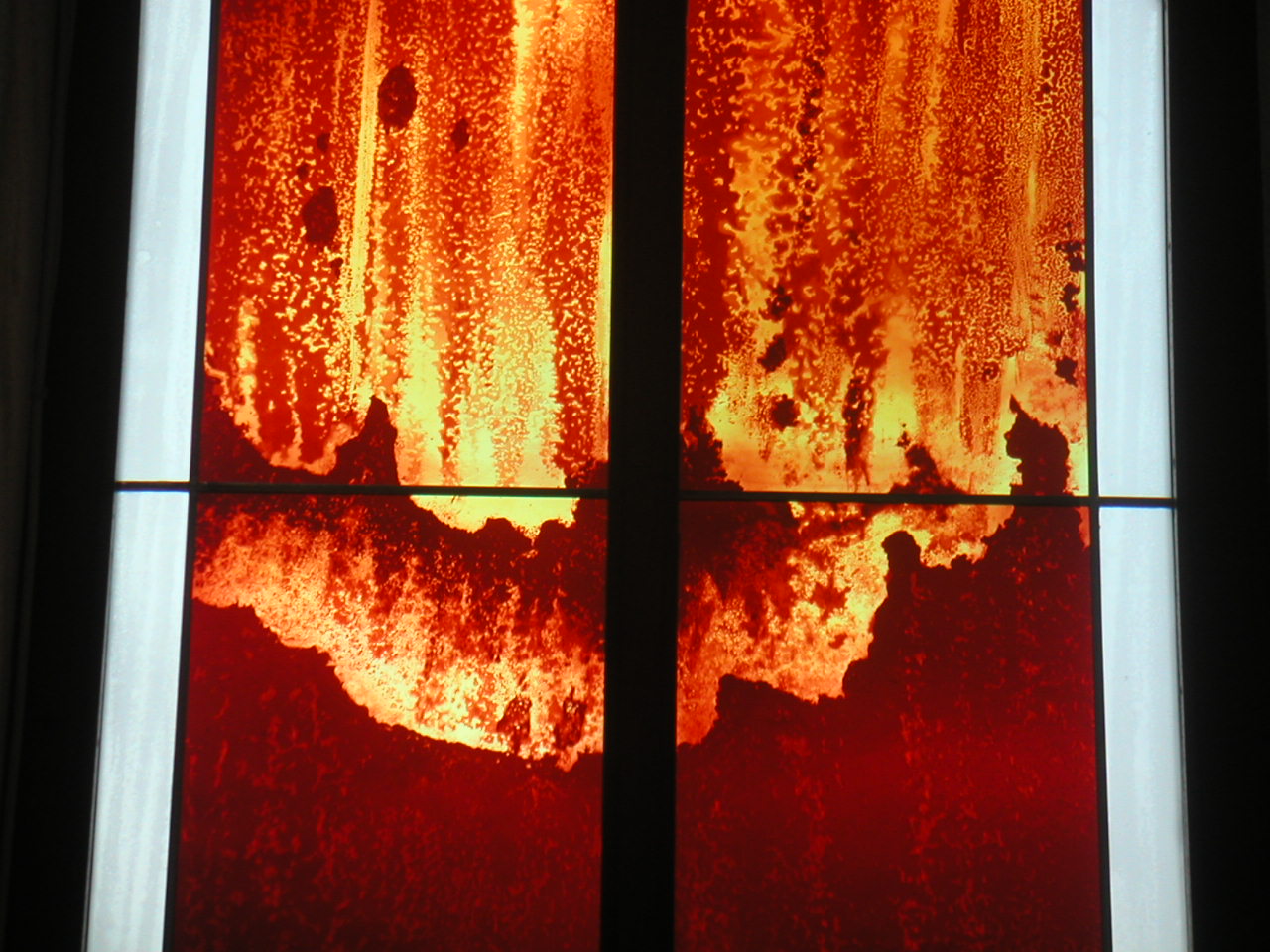
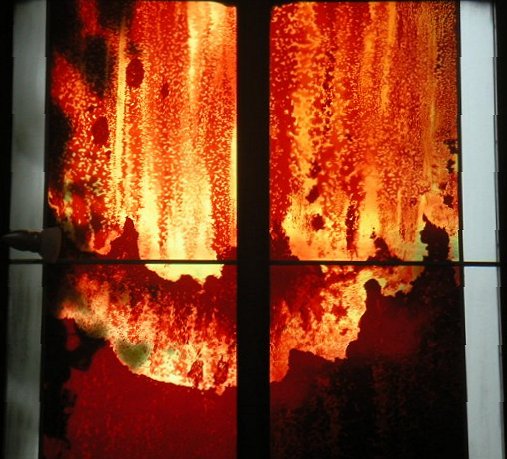
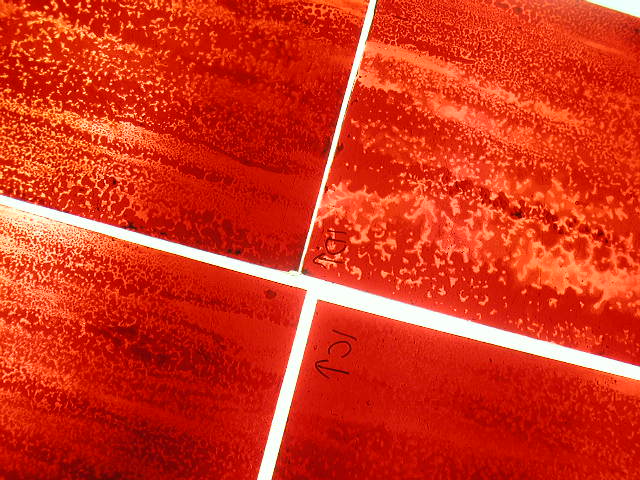
Fire — deep red flashed glass, Phase 1, 2003
Fire
Deep red flashed glass, extensively etched — the acid creating a surface that reads as volcanic, burning from deep red through orange to near-white at the most heavily worked areas. A bold diagonal form cuts across the panels — not drawn, not planned, but found in the material through the etching process. The resist shattering in ways that cannot be exactly predicted or repeated.
This is perhaps the most dramatic of the six windows — the colour and the form both working at full intensity, neither subordinate to the other. The geological weight of the element is present in the surface itself.
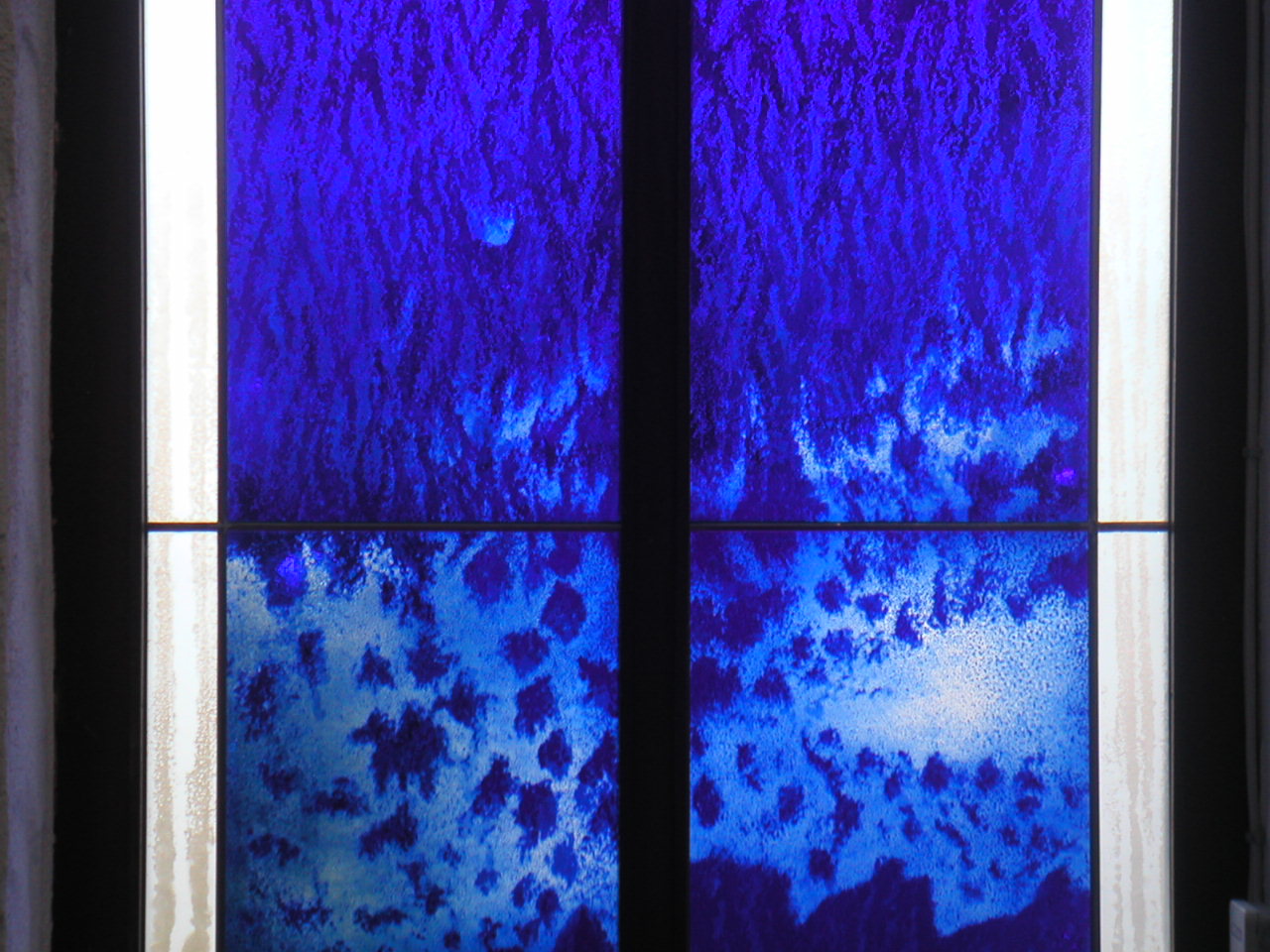
Water — deep cobalt blue flashed glass, Phase 1, 2003
Water
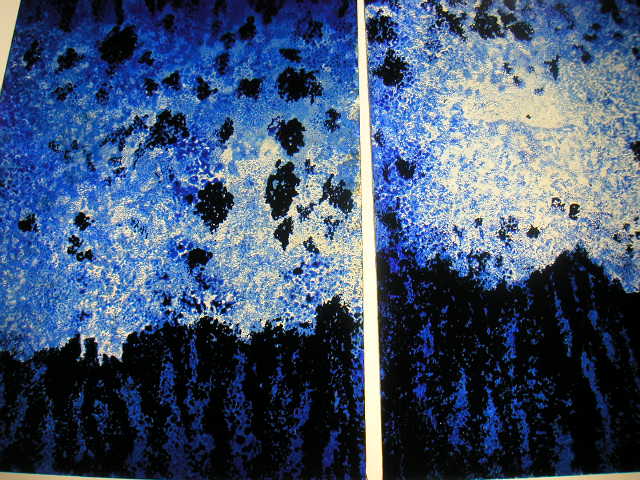
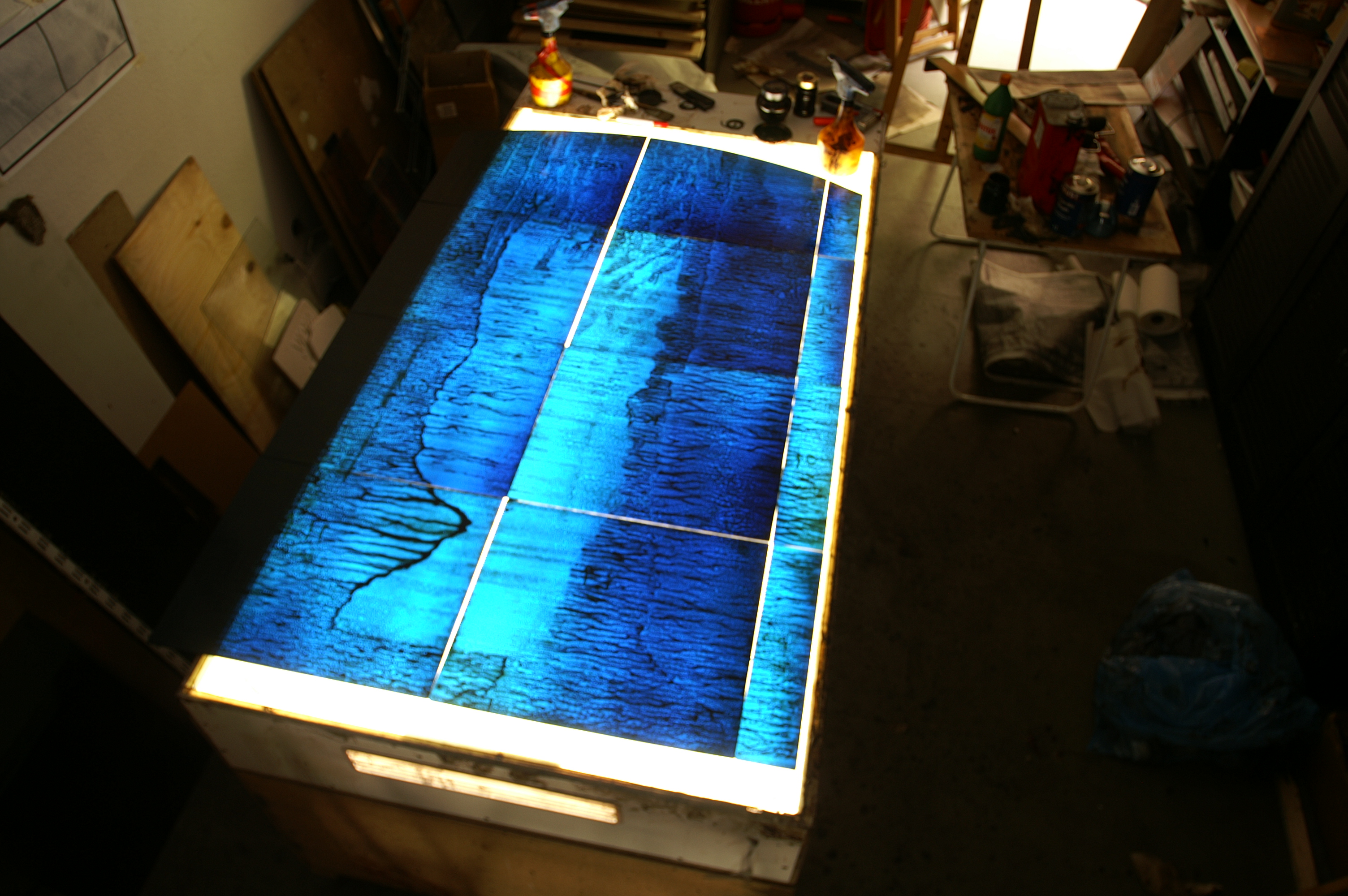
Deep cobalt blue flashed glass, etched to create atmospheric, cloudlike forms — colour dissolving from dense blue through pale turquoise toward white. The successive etchings build up a surface of extraordinary tonal complexity, the image reading differently at different times of day as the quality of the light behind it changes.
The etching has been used to suggest depth and movement rather than surface — the blue not a flat colour but a space that the eye enters, the pale forms within it reading as reflections, currents, or the play of light through deep water.
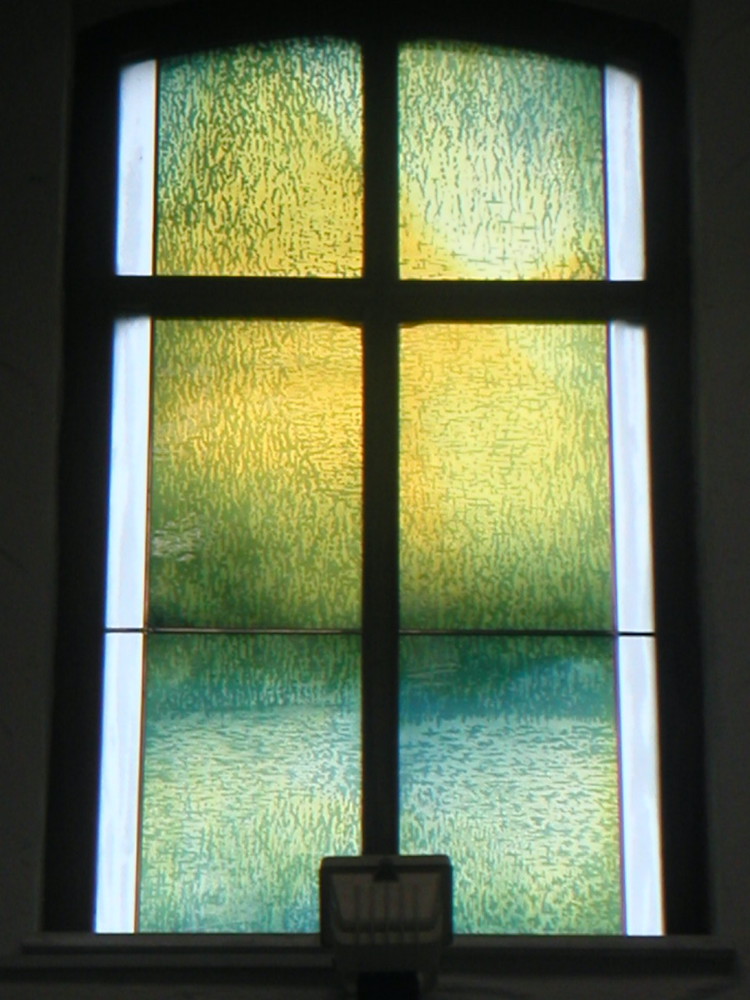
Air and Light — the most technically unusual of the six windows, Phase 1, 2003
Air and Light
The most technically unusual of the six windows — pale yellow and grey, with a quality of diffuse luminosity that the other windows do not have. The effect is achieved through a specific technical decision: the silver staining was applied to the back of the glass rather than the front.
Silver staining applied to the back produces a colour that seems to come from within the glass rather than sitting on its surface — softer, more diffuse, the yellow appearing to glow rather than to colour. Combined with acid etching on the front face, the light passes through two layers of worked glass simultaneously. The colour and the texture are on opposite faces of the same pane.
Air and light have no fixed surface. This window has none either.
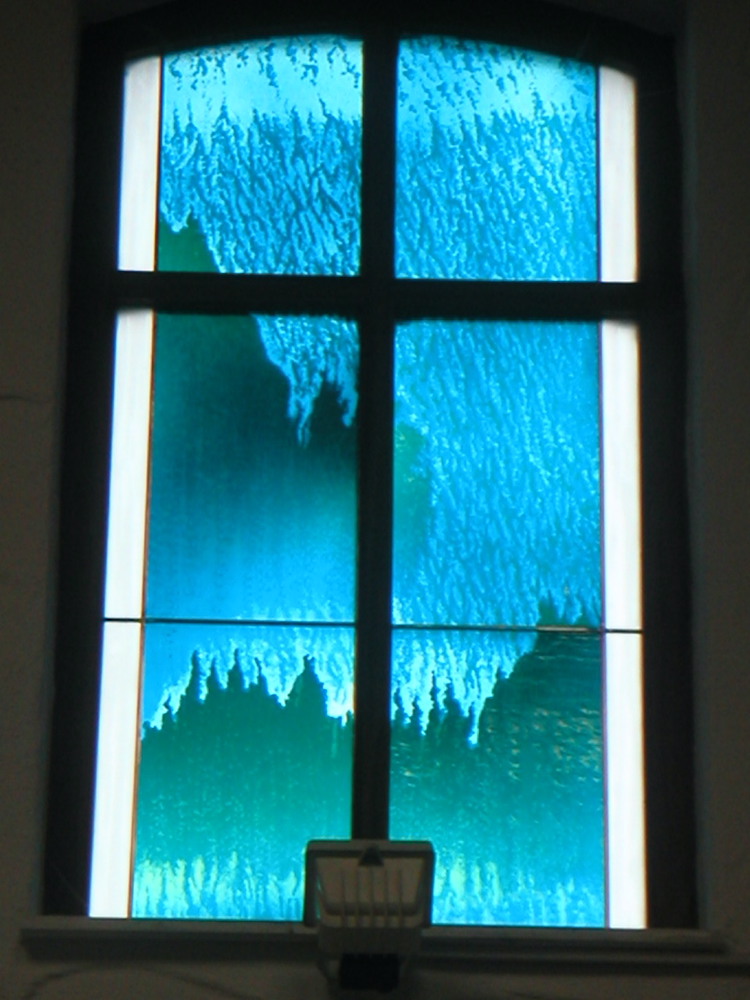
Growth — the living response to the elements, Phase 1, 2003
Growth
Yellow-green glass with warm light breaking through in a circular form — the sun rising through vegetation, or the cell of a plant seen under a microscope, or simply the colour of spring. Growth is not one of the classical four elements — it is what the elements make possible together. Water, fire, air, and earth combining to produce something living.
The choice to include Growth alongside Fire, Water, and Air reflects the organic philosophy of the Domaine itself — a place built around the fundamental products of the living earth. Growth belongs here in a way it would not belong everywhere.
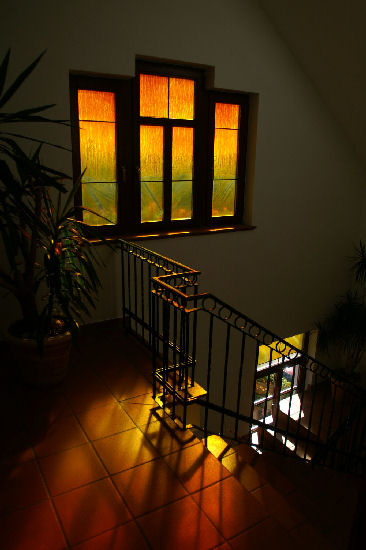
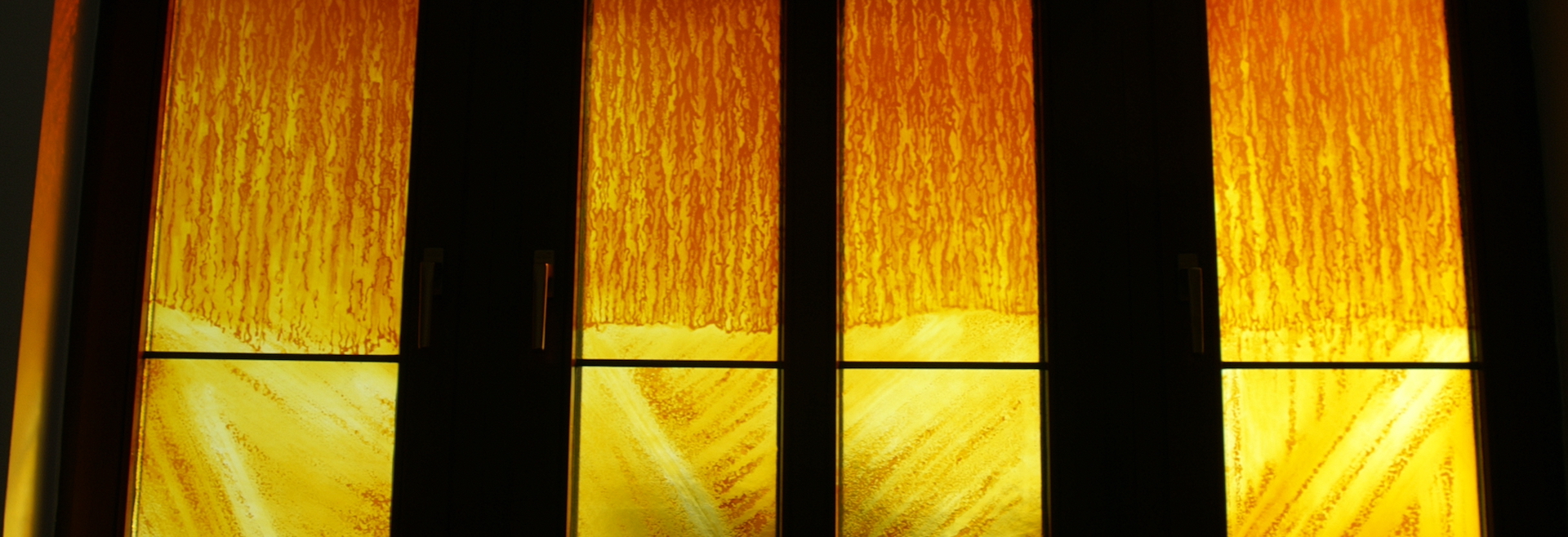
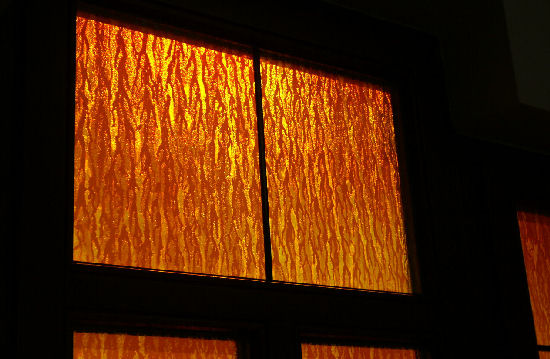
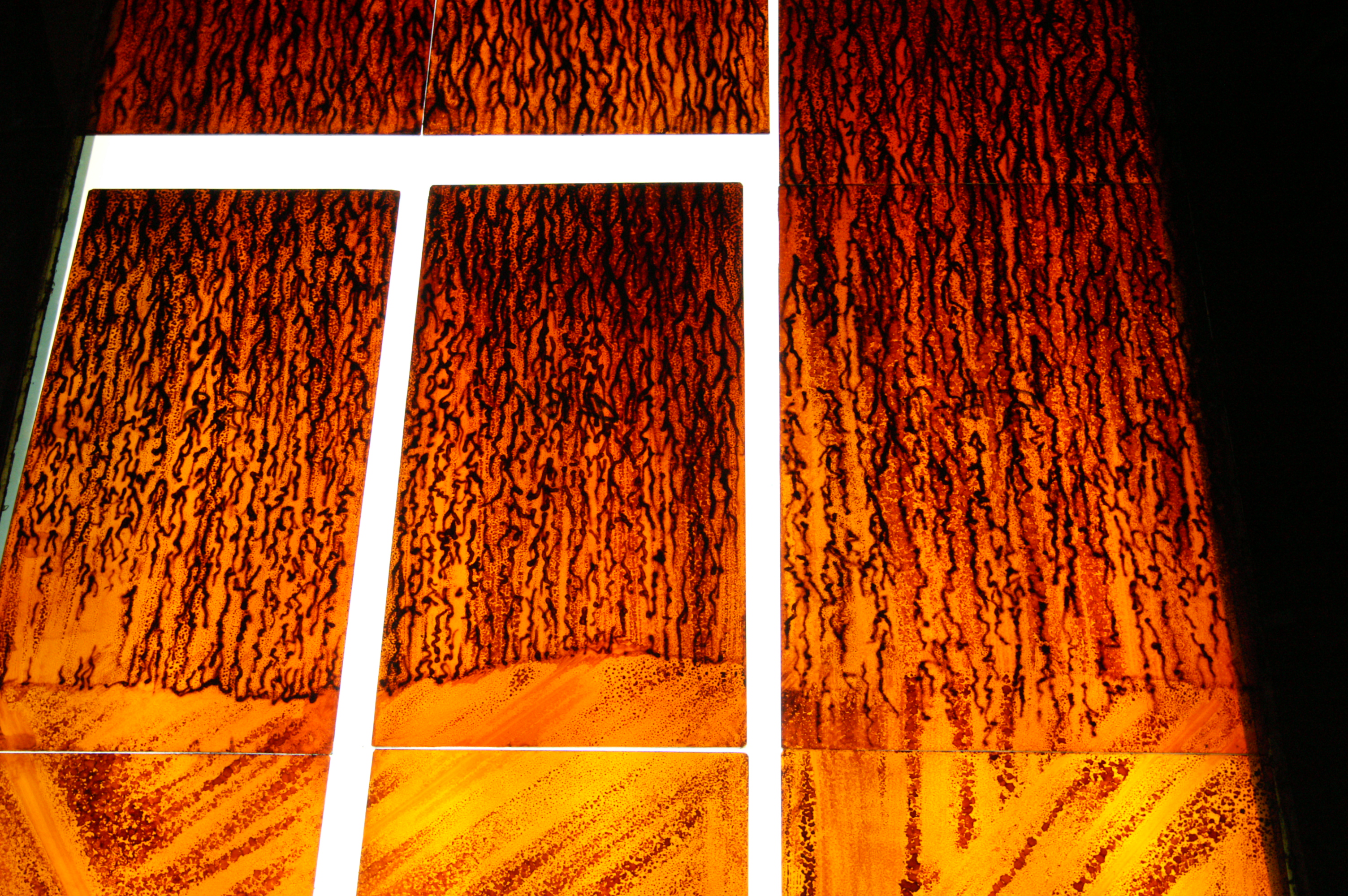
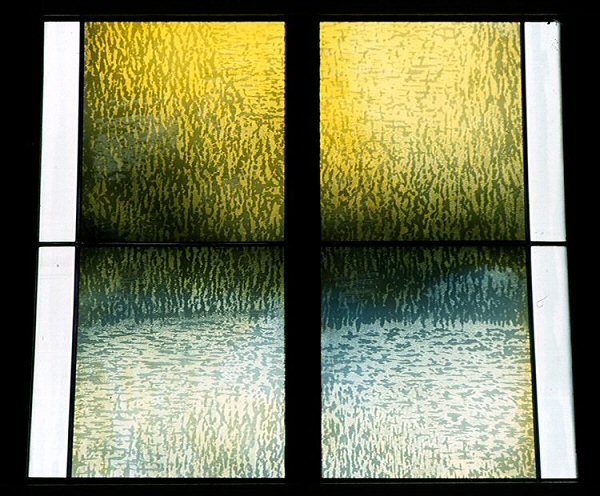
Sunshine — amber and gold flashed glass, photographed from outside at night, Phase 2, 2005
Sunshine
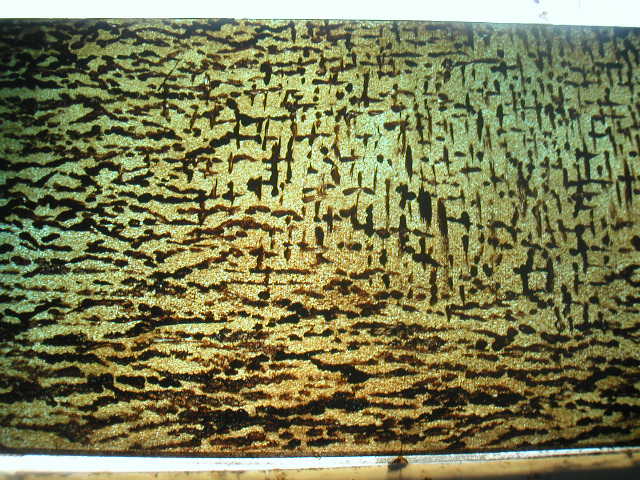
Amber and gold flashed glass, etched to reveal vertical striations of light falling through warm colour. Three of the six windows across both phases were worked with silver stain — Sunshine is one of them, the stain deepening the amber tones and introducing a range from pale gold through deep copper to rich orange-brown.
This is not fire. Fire is combustion, energy released, volatile and directional. Sunshine is radiant warmth — steady, falling, diffuse. The etched surface catches and distributes the light across its entire area, the vertical striations reading as rays falling from above.
Photographed from outside at night, the window glows incandescent — the building itself becoming a source of warmth in the dark, the amber light visible from the street as a signal of the organic warmth within.
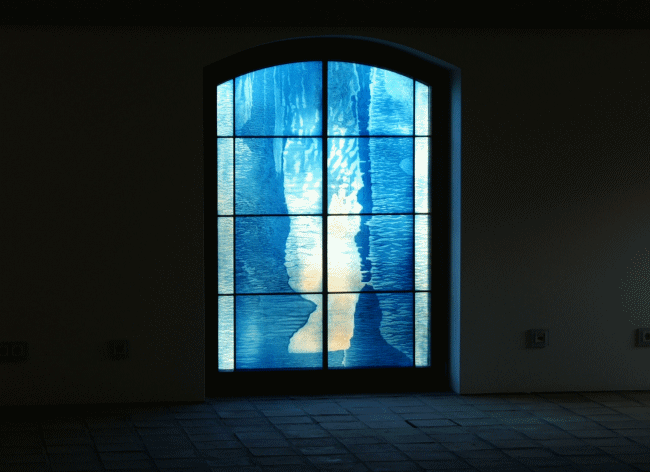
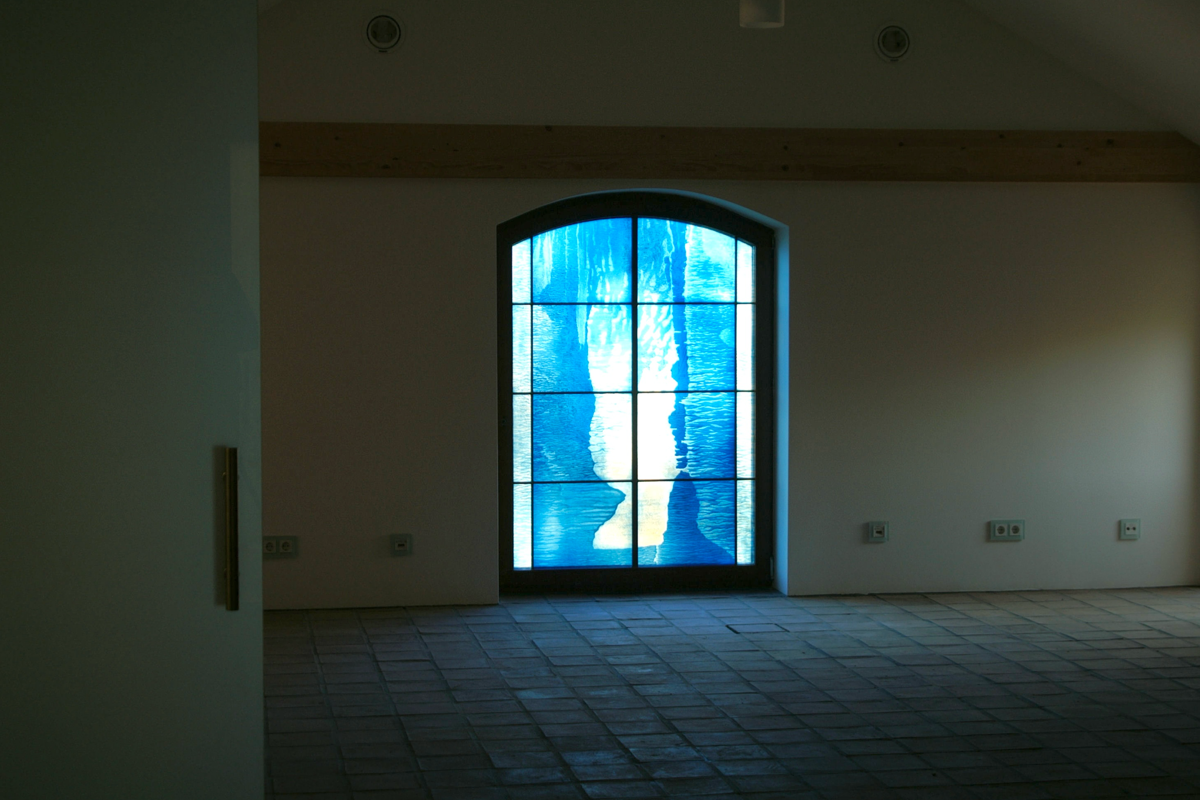
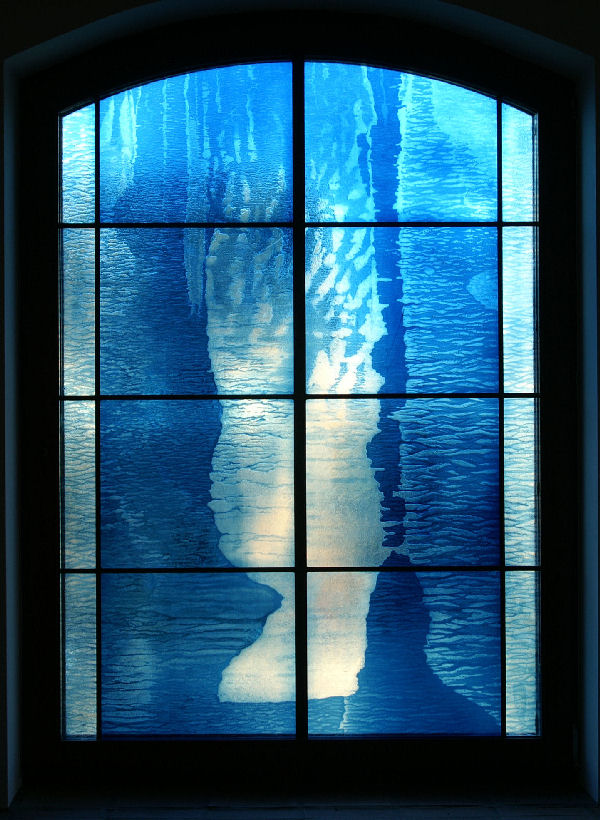
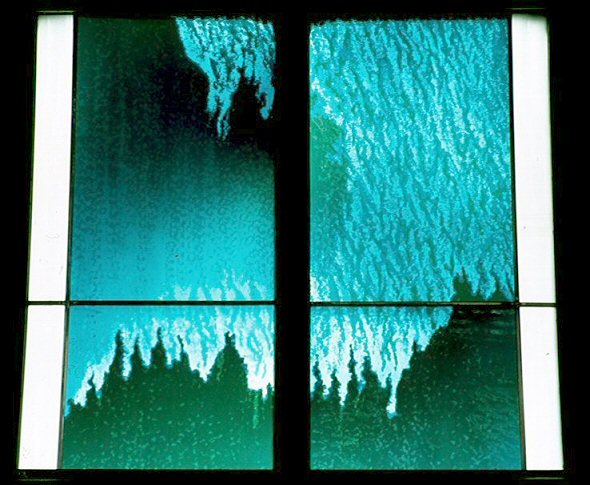
Ice — the large arched window, glacial columns standing in deep blue light, Phase 2, 2005
Ice
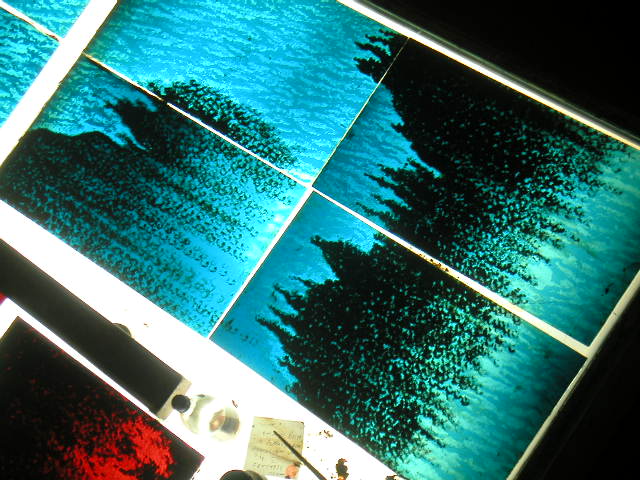
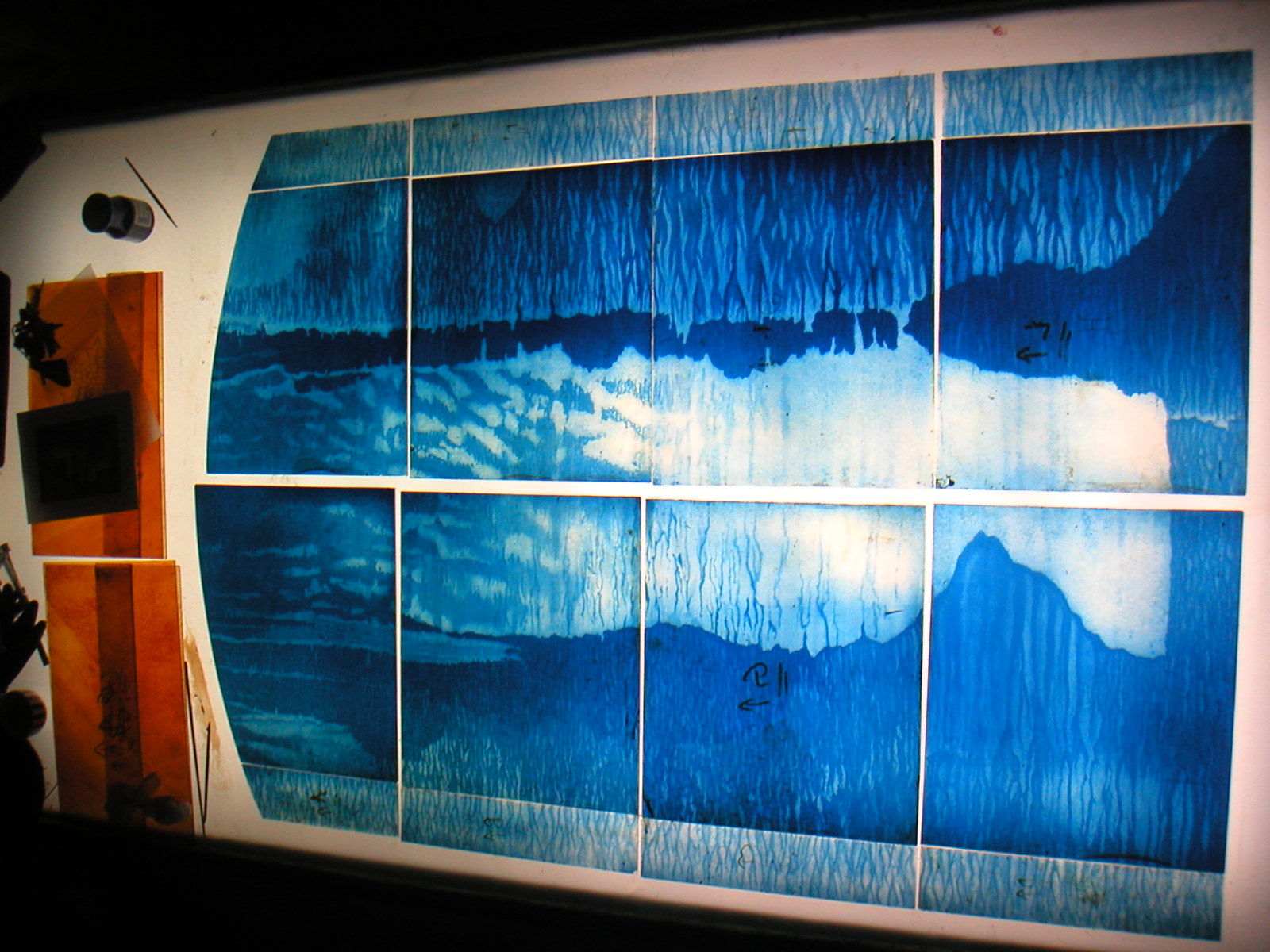
The largest window of the entire commission — a tall arched opening in turquoise and deep blue flashed glass, the acid etching creating two massive vertical presences that read as glacial columns or stalactites, warm light breaking through from behind as if from within the ice itself.
Ice is water in its crystalline state — solid, structured, architectural. Where the Water window of Phase 1 is atmospheric and cloudlike, this window is geological and monumental. The two vertical forms have a presence that makes the window read as a landscape rather than a surface — not something to look at but something to look into.
From across a darkened room it is a destination at the end of a sightline — the blue deepening as you approach, the warm light within it more mysterious the closer you stand. The Derix Glasstudios used to bring visitors to the Domaine specifically to stand before this window.
The Domaine
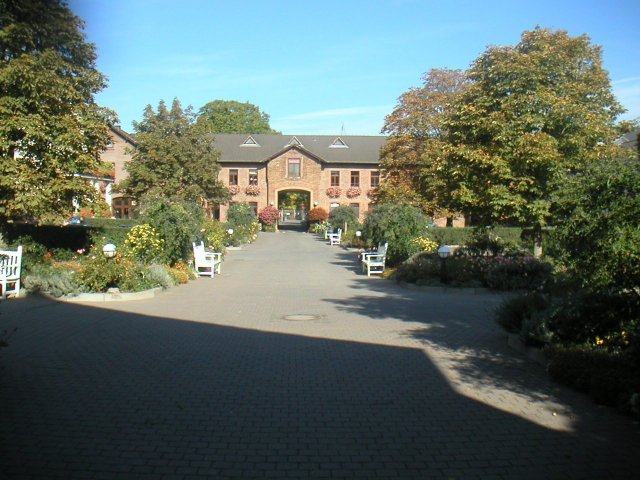
Domaine Mechtildshausen — the setting for the commission
An Unusual Setting
Domaine Mechtildshausen is not a church, not a corporate headquarters, and not a private house. It is a high-quality organic market, restaurant, café, and hotel — a place organised around the fundamental products of the earth: food grown from soil, watered by rain, ripened by sun. The theme of the Elements is not decorative in this context. It is conceptually embedded in what the place actually is and does.
The commission was recognised within the professional glass community as significant. The Derix Glasstudios in Taunusstein — where the windows were made — would bring visitors to the Domaine specifically to see them. That informal acknowledgement from one of Europe's most respected glass studios speaks to the originality of what was achieved here.
The Domaine is a publicly accessible location. Visitors to the market, restaurant, and hotel can see the windows in their architectural setting.
Location — Domaine Mechtildshausen, near Wiesbaden, Rheinland-Pfalz, Germany
Status — Permanent installation, publicly accessible
Fabrication — Derix Glasstudios, Taunusstein, Rheinland-Pfalz
Gallery
Questions and Answers
What is the theme of the windows?
The windows are based on the concept of the fundamental elements — fire, water, earth, and air — a framework found in many cultures as the primary constituents of reality. The theme was chosen as appropriate to the Domaine's holistic and organic philosophy: a place organised around the fundamental products of the earth, with food grown from soil, watered by rain, ripened by sun. The elements are not merely decorative in this context. They are conceptually embedded in what the Domaine is.
What technique was used to make the windows?
The windows are made entirely from acid etching and, in three of the four windows, silver staining. There is no paint and no enamel anywhere in the work. The image — colour, tone, texture, depth — is created solely through the etching process. The glass used is mouth-blown flashed antique glass — glass with a thin layer of colour bonded to a paler base — which can be etched away to reveal the lighter glass beneath, creating a range of tones from the full colour of the flashed layer to near-clear glass at the most heavily etched points.
What is controlled spontaneity?
Controlled spontaneity is the concept that emerged from the making of these windows — the balance between the artist's deliberate control over timing, colour, and process, and the inherent unpredictability of the material itself. The etching process cannot be entirely predetermined. The acid finds its own path. The resist breaks in ways that cannot be exactly repeated. The artist's role is to set the conditions — the colour of the glass, the strength of the acid, the duration of each etch, the moment at which the process is interrupted and resumed — and then to recognise and work with what the material produces. The result is a surface of complete originality that no drawn or painted technique could achieve.
How long did the making process take?
Approximately four weeks of experimentation preceded the actual making — developing the specific method of acid resist application that would give the required surface quality. The making of the windows themselves involved multiple etching cycles for each panel, the glass being placed in acid, washed, blasted with water to remove loose resist, and the cycle repeated, with the resist reapplied at chosen moments. The process is slow, cumulative, and cannot be rushed.
Why are these windows significant?
At the time of their making, windows produced entirely through acid etching — with no paint, no enamel, no leading in the traditional sense — were genuinely unusual in European architectural glass. The Derix Glasstudios in Taunusstein, one of Europe's most respected glass studios, recognised the significance of the work and would bring professional visitors to the Domaine specifically to see the windows. The concept of controlled spontaneity developed here subsequently informed everything that followed — including the surface treatment of the Glenmorangie Still House Window and the layering method of the Dalmore Still House Window.
Where can the windows be seen?
The windows are installed permanently at Domaine Mechtildshausen, near Wiesbaden, Rheinland-Pfalz, Germany. The Domaine is open to the public as an organic market, restaurant, café, and hotel. Visitors can see the windows in their architectural setting.