Lockerbie Memorial Window
Lesser Town Hall, Lockerbie, Scotland — Installed December 1991
On 21st December 1988 — the winter solstice, the shortest day of the year — Pan Am Flight 103 was destroyed by a bomb over the Scottish town of Lockerbie. 270 people were killed: passengers, crew, and residents of Lockerbie on the ground. The victims came from 21 nations.
Three years later, this window was installed in the Lesser Town Hall — in the very room that had been commandeered as a temporary morgue in the immediate aftermath of the disaster.

The Brief
The brief was formed from interviews with local people about what the memorial should contain. The defining instruction came from local councillor David Wilson:
"People wanted a memorial, not a reminder."
Any direct reference to the events of 1988 was ruled out. No religious symbolism. No depiction of the disaster. No reference to the aircraft, the explosion, or the deaths. No reference to how many victims came from each country. Within that constraint — one of the most restrictive I have worked to — the only area that could safely be explored was the flags of the nations of the people killed.
"Due to the nature of the subject and the event it commemorates, this was a very difficult work to make."
The Concept
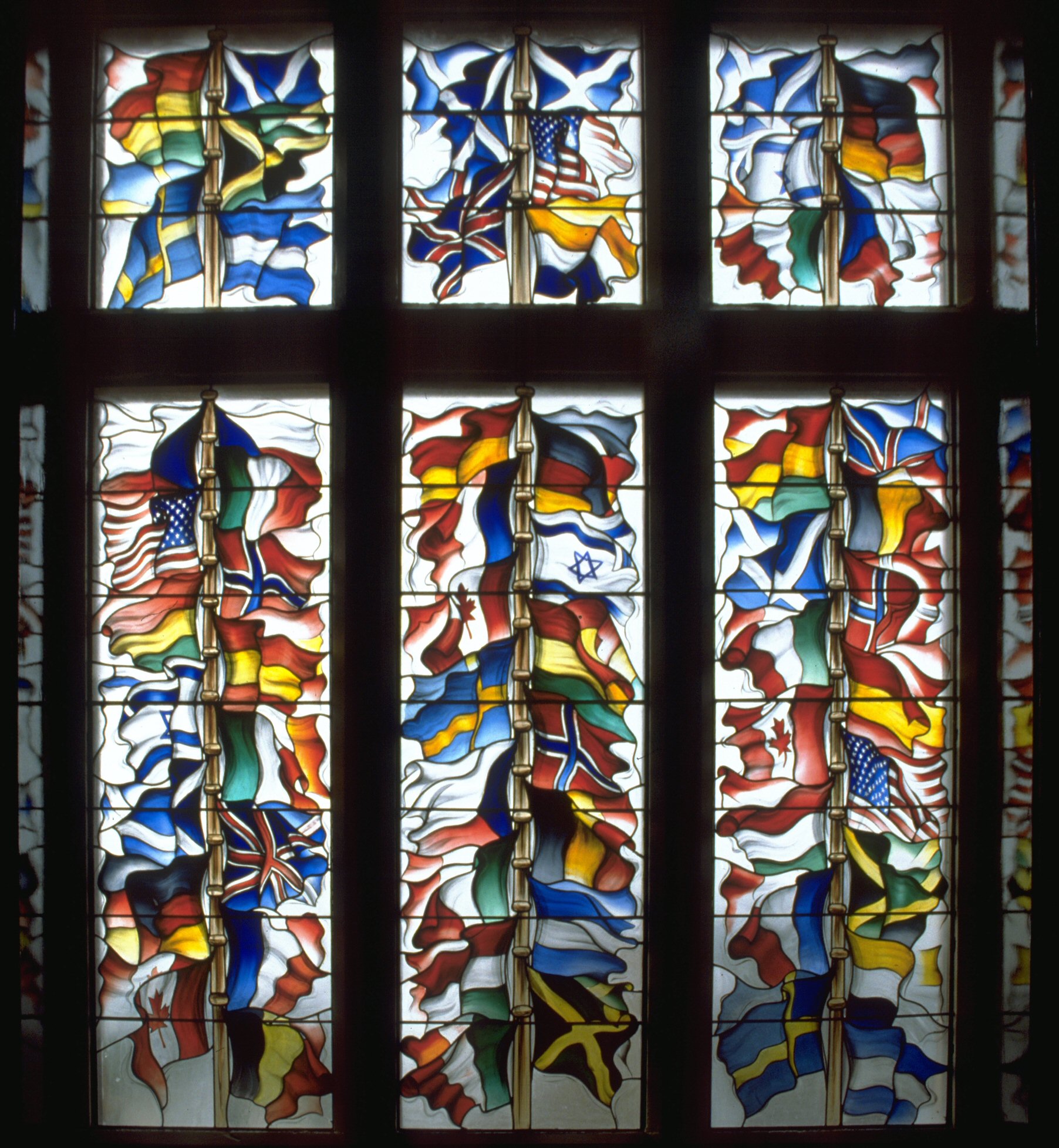
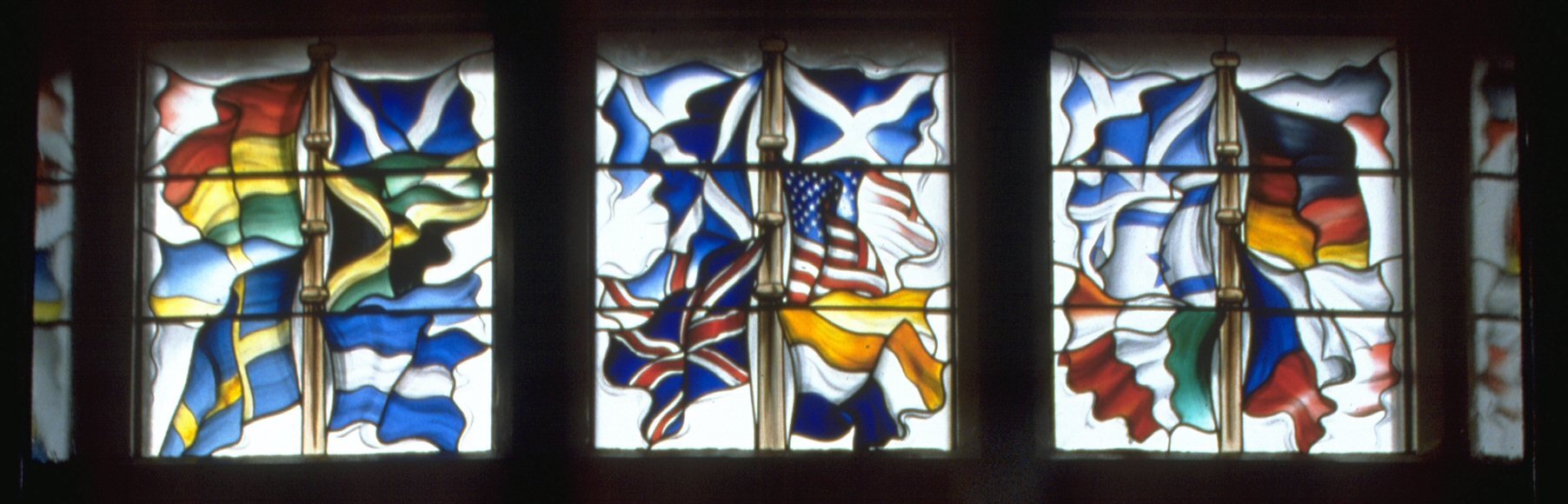
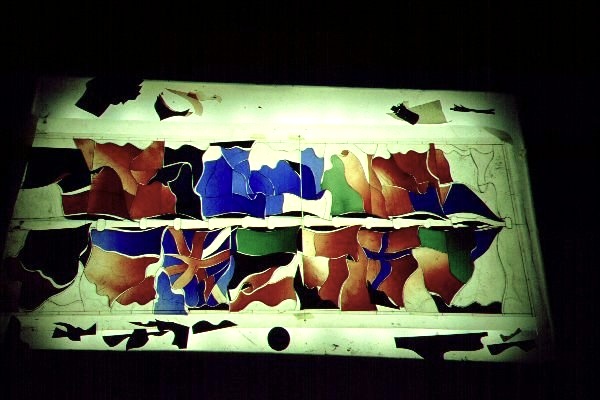
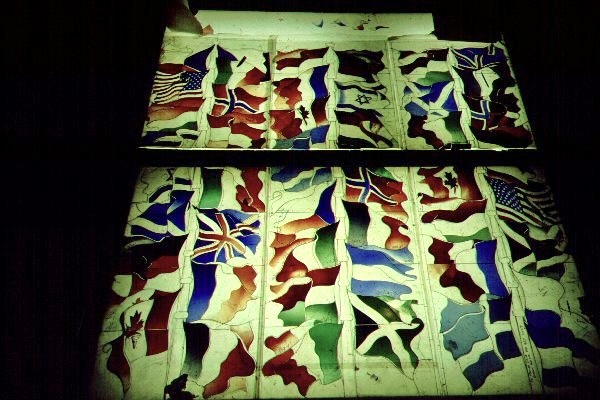
The window depicts the national flags of every person killed in the disaster, spread across six panels. The St Andrew's Cross — the Saltire — stands for the people of Lockerbie killed on the ground, so that the disaster is remembered as a local tragedy as much as an international one.
The flags are scattered rather than ordered, and that randomness is deliberate: who was on that flight was not chosen, and the scattered, overlapping arrangement enacts the randomness of who was lost. No flag is larger than another. No count of victims per nation is given. All nations equal; all flags the same size.
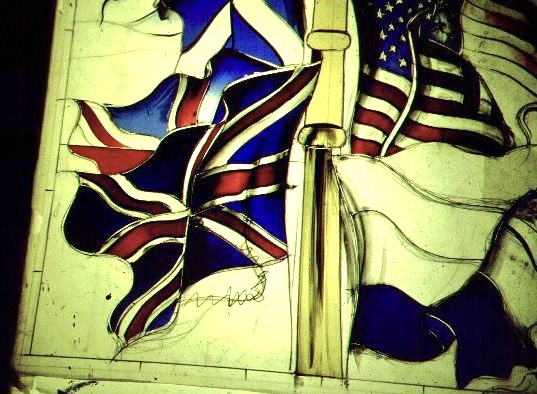
The flags are not flat heraldic symbols. They billow, overlap, and twist around shared flagpoles — rendered in amber-gold silver stain — that run vertically through the composition, caught in the same wind, inseparable yet distinct. The clear glass ground is the sky itself; light passing through the window is the air the flags fly in. It is a memorial made, literally, of light and air — the two qualities a flag possesses that no other symbol shares.
The six panels sit in two registers. The three smaller upper panels hold a more formal arrangement, the Saltire prominent at the centre. The three larger lower panels are where the real movement lives — flags cascading across the vertical divisions, the leading itself becoming a kind of horizon between earth and sky. The American flag, the largest single national group among the victims, sits alongside the Italian tricolour and, quietly, the Israeli Star of David — twenty-one nations, all present, none counted.
The Room
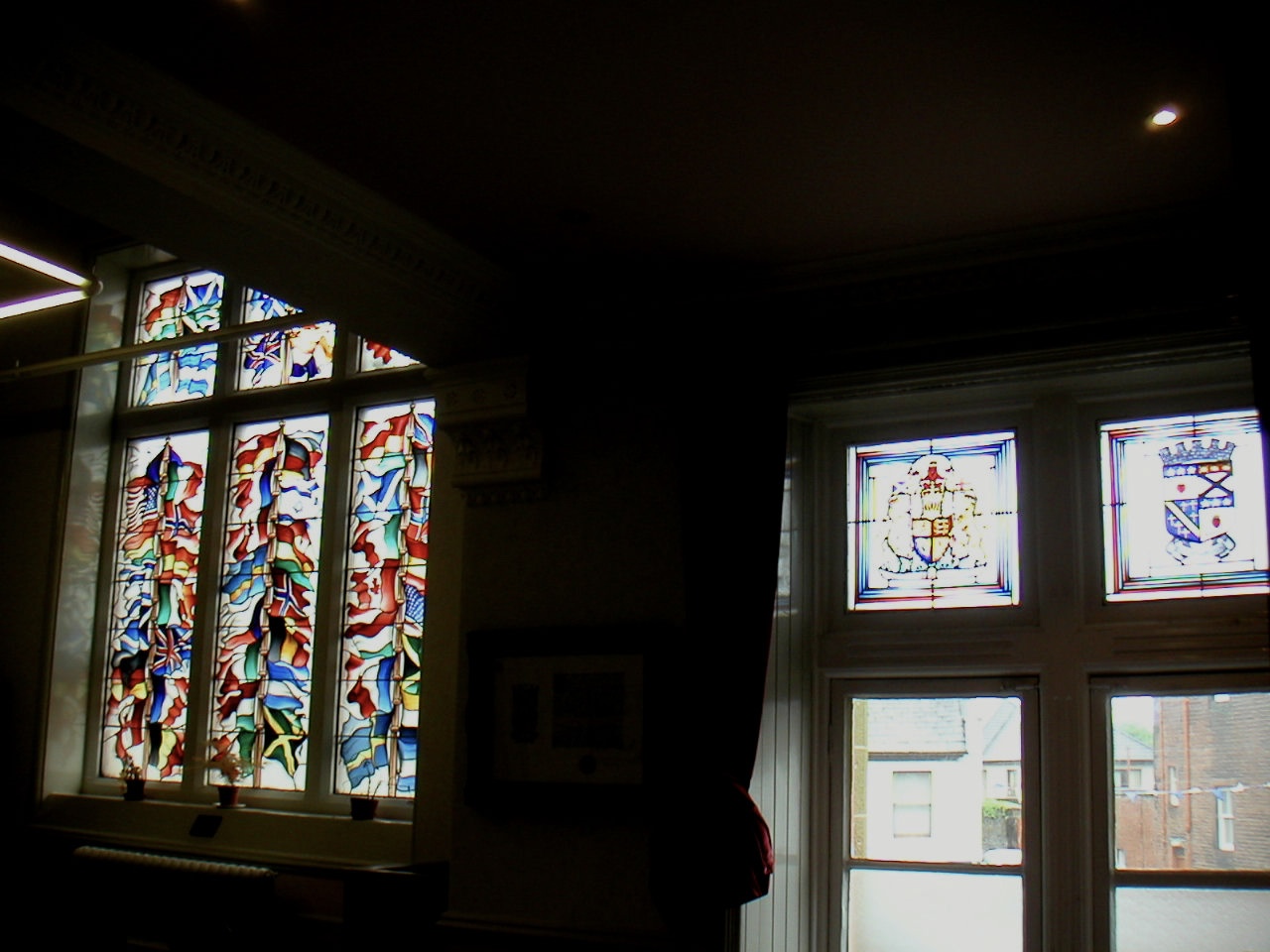
The window stands in the room first used as a temporary morgue in the hours after the disaster. That is not incidental — it is the defining context for the whole work. The space that once held the dead now holds their memorial. The flags fly where the bodies once lay. The glass transforms the room's history without erasing it.
Press Coverage
The window was covered by The Sunday Times in December 1991, in a piece by Robert Dawson Scott titled "Artistic Homage to Jet Tragedy," and featured on BBC Radio 4's Kaleidoscope. The article placed the window within a wider outpouring of creative response to the disaster from Scotland's artistic community — poetry, painting, and Karen Wimhurst's choral work "Requiem for Lockerbie," first performed at the Edinburgh Festival.
"It is the substantial body of new work that impresses: several lengthy poems, a large-scale piece of music, a significant exhibition of paintings and, most recently, a stained glass memorial which was installed last week in Lockerbie Town Hall, in the very room which was first commandeered as a temporary morgue."
"Clark emphasizes that the window is therefore not his personal statement. He feels, nevertheless, that the national flags of the victims, arranged randomly in the narrow confines of each window frame, are a telling image of the random arrangement of the people in the aircraft."
The article also noted the disaster's uneasy timing: it fell on the winter solstice, the day when, in pre-Christian tradition, fires were lit to call back the sun. A poem inscribed in runic script on a 7th-century stone a few miles south of Lockerbie describes a burning cross descending from the sky — not so different, the article observed, from a burning aeroplane.
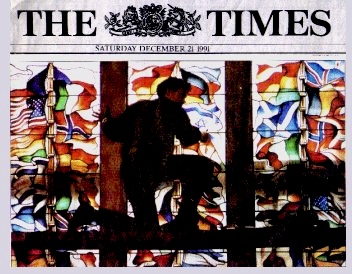
The Times, Saturday 21 December 1991 — the window during installation
Also in the Room
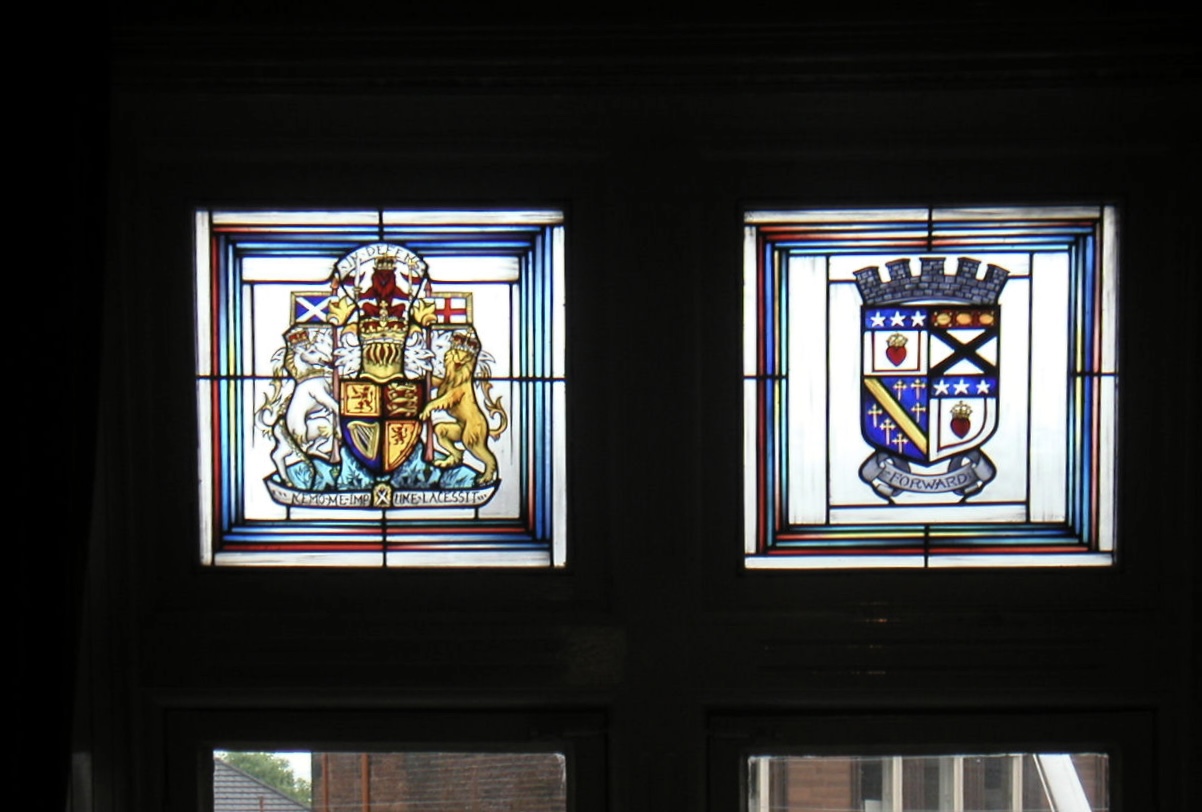
Some time after the memorial window was completed, I was asked to make two further windows for the same room — a separate commission, heraldic rather than memorial in character. One is the Royal Coat of Arms of Scotland, with its supporting lion and unicorn beneath the Scottish and English flags, bearing the motto Nemo me impune lacessit. The other is a civic coat of arms carrying the motto "Forward."
Technique
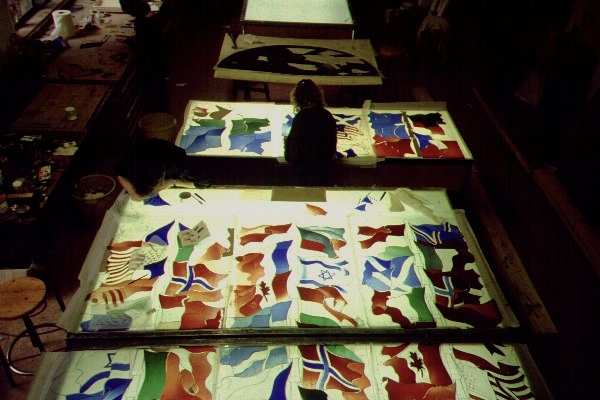
Mouth-blown flashed glass throughout. The heraldic precision the flags demanded — the stars of the American flag, the Nordic crosses, the Star of David, the Union Jack — called for exceptional accuracy in traditional glass painting, fired at 600°C to permanence. Silver staining was used for the gold and amber tones across the various flags, and for the flagpoles themselves, giving them a warmth and physical presence against the movement around them. All panels were leaded using traditional techniques.
Lockerbie Memorial Window — Lesser Town Hall, Lockerbie, Scotland
Dimensions — 3 windows at 2290 × 815mm, 3 windows at 920 × 815mm
Commissioned by — Lockerbie Town Council
Technique — Mouth-blown flashed glass, acid etching, traditional glass painting, silver staining, leading
Installed — December 1991
Making the Window, 1991
Questions and Answers
Why flags, and nothing else?
The brief ruled out almost everything — no religious symbolism, no depiction of the disaster, no reference to the aircraft or the deaths, no count of victims by nation. Flags were the one area that could be explored safely, and within that narrow space I found the one true image: flags fly, they move, they are made of light and air, and every nation could be represented equally without the window ever having to depict what happened.
Why are the flags arranged randomly rather than in order?
Who was on that flight was not chosen. The random, overlapping arrangement of the flags is a visual image of that randomness — the arbitrary way 270 people from 21 nations came to be together in one place on one night. It isn't decoration. It's the argument the whole window is making.
Why is the Saltire included alongside the national flags?
The disaster is remembered internationally as an aviation tragedy, but it was also a local one — Scottish people died on Scottish soil that night. Including the Saltire insists that Lockerbie's own dead are held within the memorial alongside everyone else, not set apart from it.
What is the significance of the window's location?
The Lesser Town Hall room where the window stands was the room first used as a temporary morgue in the hours after the disaster. The memorial occupies the same space that once held the dead — light and colour now filling a room that held something far darker in December 1988.
Can the window still be seen today?
Current accessibility to be confirmed.