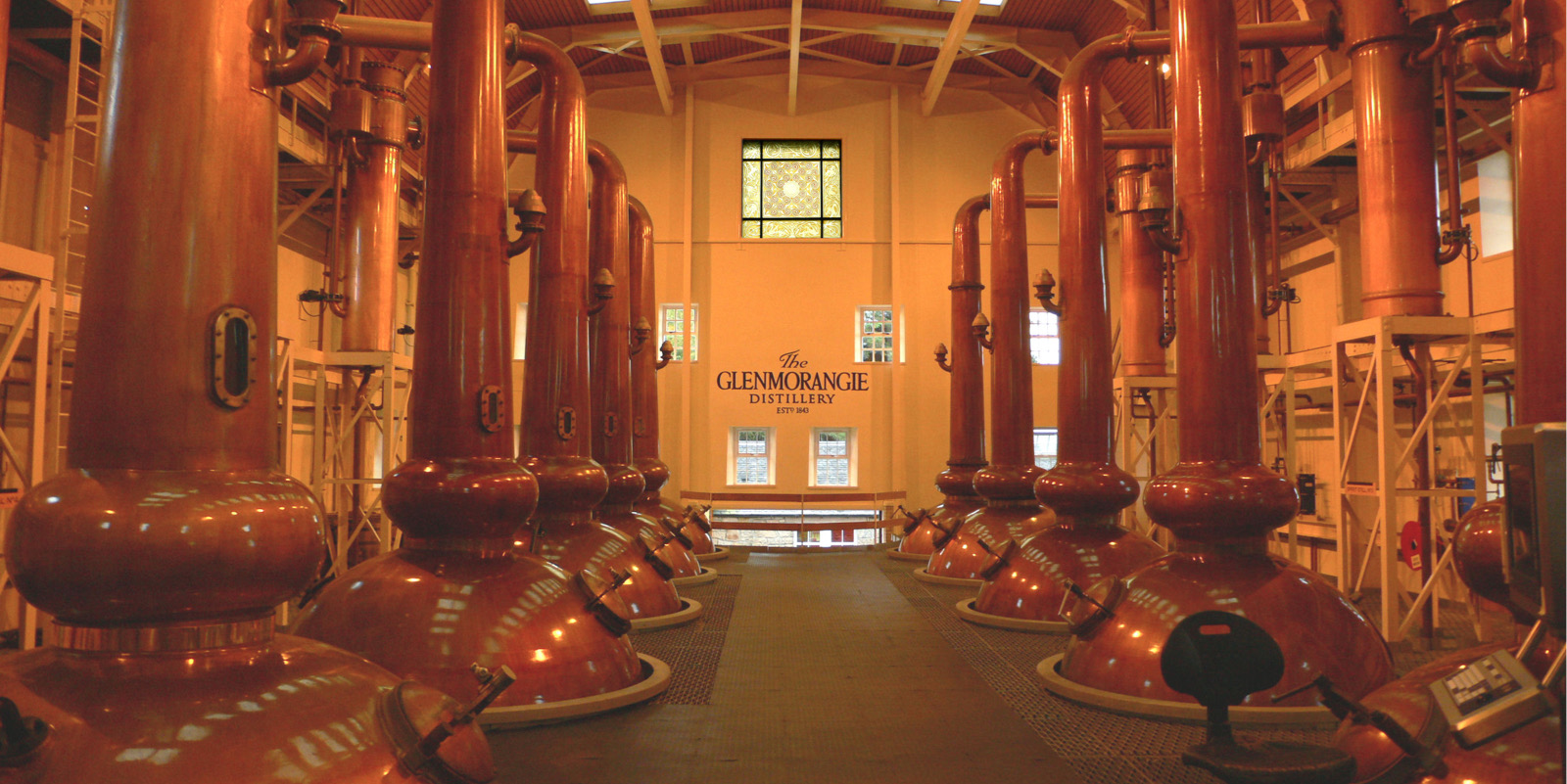
Glenmorangie Still House Window
Tain, Ross-shire, Scotland — Fused Bullseye glass relief
The Glenmorangie Still House Window was the project that opened up an entirely new direction in my practice. Commissioned through an invited competition, it set me the challenge of translating one of Scotland's great Pictish carved stones into fused glass relief — and in solving that challenge, led me to develop the Bullseye fusing technique that has underpinned my most ambitious work ever since.

The Brief
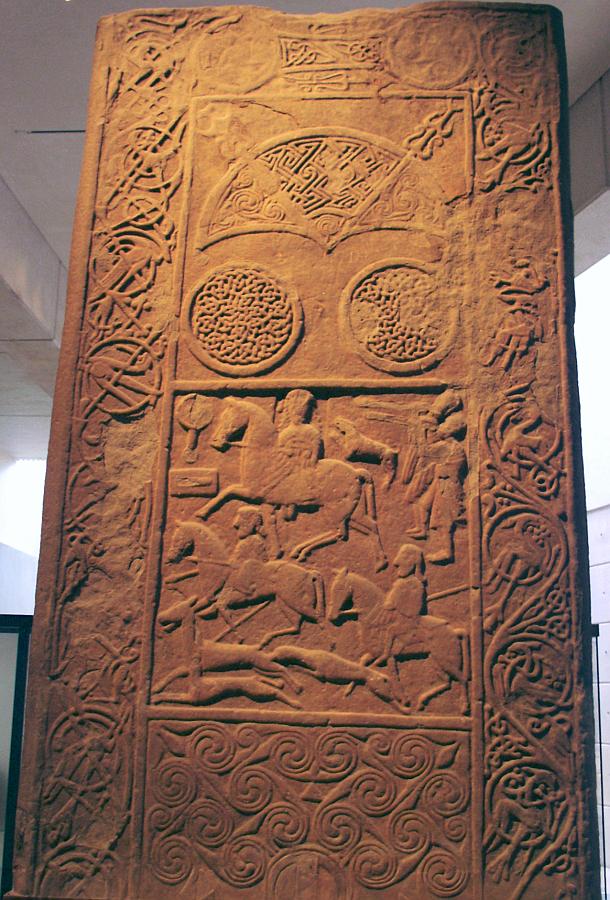
The Hilton of Cadboll stone — source of the Glenmorangie signet
The project began as an invited competition. Several artists working with glass were asked to present ideas for a new window to be located in the Still House at Glenmorangie Distillery in Tain, Ross-shire. The theme of the window was to be the signet used by Glenmorangie — a mark derived from one of Scotland's most remarkable surviving Pictish carved stones, the Hilton of Cadboll stone.
The still house at Glenmorangie is sometimes referred to internally as the Cathedral — a term coined by the marketing team at LVMH, who have owned the brand since 2004. It is a fitting description: the room is tall, hushed, and dominated by the extraordinary height of the Glenmorangie stills, the tallest in Scotland. The idea of placing a significant window in this space was therefore not merely decorative — it was architectural, even theological, in its ambition.
The Stone
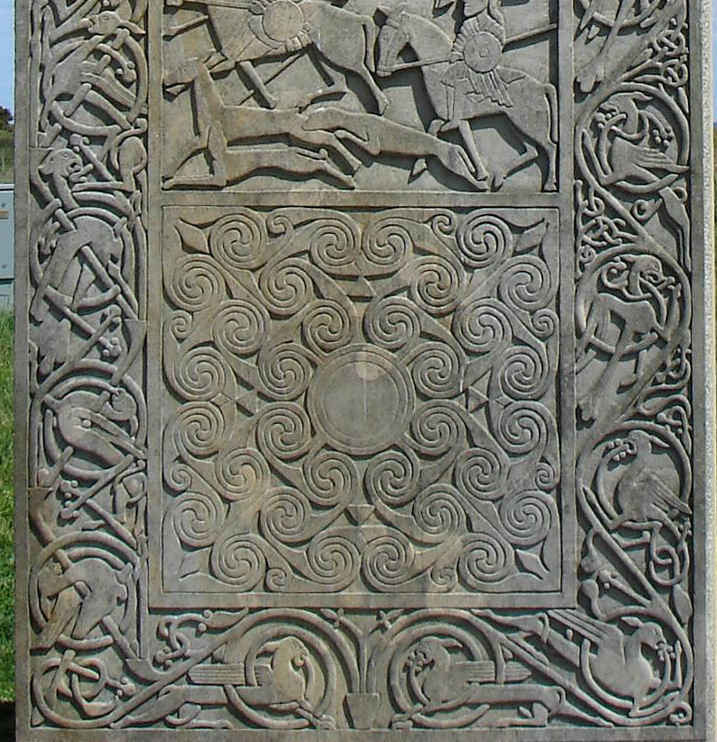
Barry Grove's complete interpretation of the stone, installed at the distillery site in Tain
The Hilton of Cadboll stone is one of the finest examples of Pictish relief carving in existence. The original stone — or most of it — is held in the Museum of Scotland in Edinburgh. At the distillery site in Tain, the sculptor Barry Grove had created a complete interpretation of the stone, resolving the missing sections with careful scholarship. I met Barry on location during a visit to the distillery arranged early in the project. His version is astonishing.
Since Barry made his interpretation, the base section of the original stone had been excavated and was now visible for the first time. I visited the Museum of Scotland and photographed the original stone directly, working from it as much as possible — just as Barry had done. The newly uncovered base section gave me fresh primary material for the border design: I used the spacings and the quality of drawing found in this section to redesign the side borders of the window, incorporating detail that postdated Barry's version.
Barry very generously allowed me to use his solution for the top section of the stone, of which he said he was fairly certain his reading was correct.
The Concept
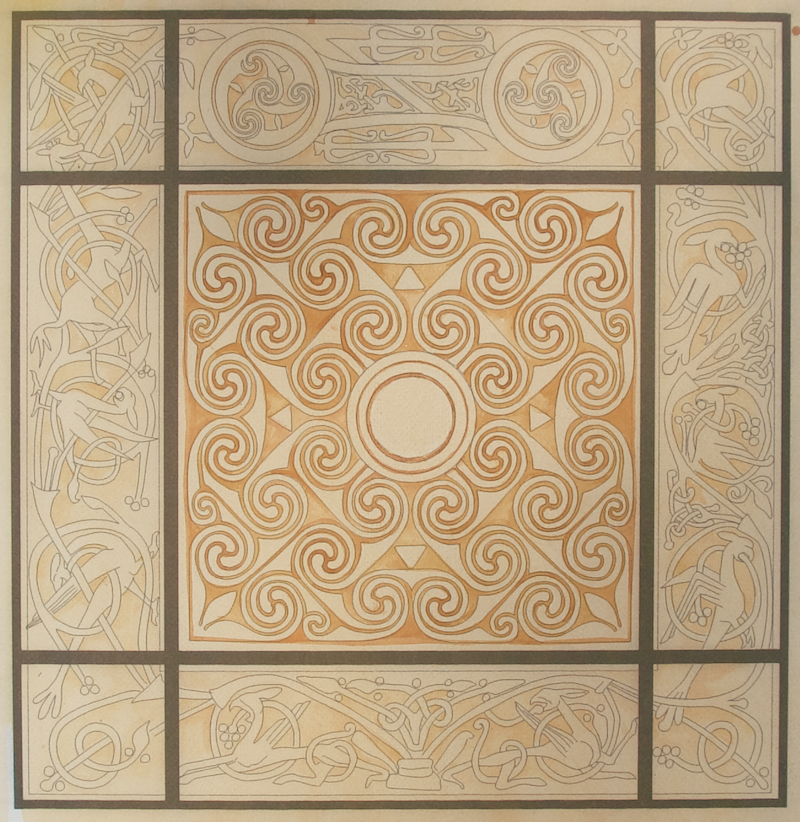
The revised design showing how colour at the centre would dominate, with the borders playing a supporting visual role
Rather than simply reproducing the signet image, I decided to use the signet as the central element and extend the design by incorporating the border that surrounds it on all three sides of the original stone — bringing the top border of the stone down to become the top border of the window. The stone is a relief sculpture: it seemed entirely appropriate that the window should be one too. I explored other artistic and technical possibilities but the relief solution was the strongest.
The initial concept was to make the panel in clear float glass. When slumped — melted onto a form — float glass takes on a wonderful silvery, almost liquid quality. This concept was accepted, but with a proviso: could I make something happen with whisky colours?
So began a period of experimentation.
Finding the Technique
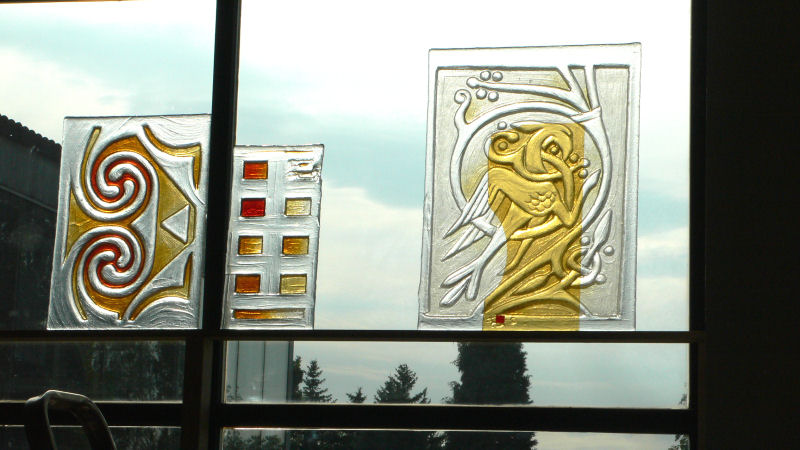
Early frit samples — the project was formally awarded only after these were accepted
There are not many ways to colour glass. You can begin with coloured glass and work with it directly. You can etch away colour with acid. You can paint enamels onto the surface. In my judgement, none of these methods were appropriate for this project — the surface quality they would produce was wrong for a relief sculpture of this scale and ambition.
A third method was to fuse glasses together — melting them into a unified surface. This is what I chose. Not all glasses are compatible with each other: you can fuse incompatible glasses, but they will crack and break apart on cooling as they contract at different rates. I therefore decided to use Bullseye glass, an American glass manufactured specifically for fusing, in which every colour within the range is compatible with every other.
I experimented extensively and presented the resulting samples to Glenmorangie. The project was formally awarded only after these samples were made and accepted.
The Full-Scale Drawing
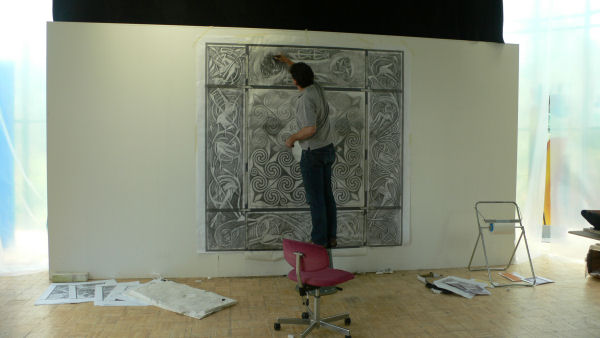
The full-scale drawing — the working document from which all tracings and forms were made
I had worked the entire design as a computer graphic, and at small scale it resolved perfectly. When I enlarged it to full size, I realised immediately that a full-scale drawing had to be made by hand. The proportions, the weight of the carved lines, the relationship between the spiral forms and the border — none of this could be finally resolved on a screen.
The full-scale drawing became the working document from which everything else followed: tracings were made from it, and from those tracings the forms were cut.
Making the Forms
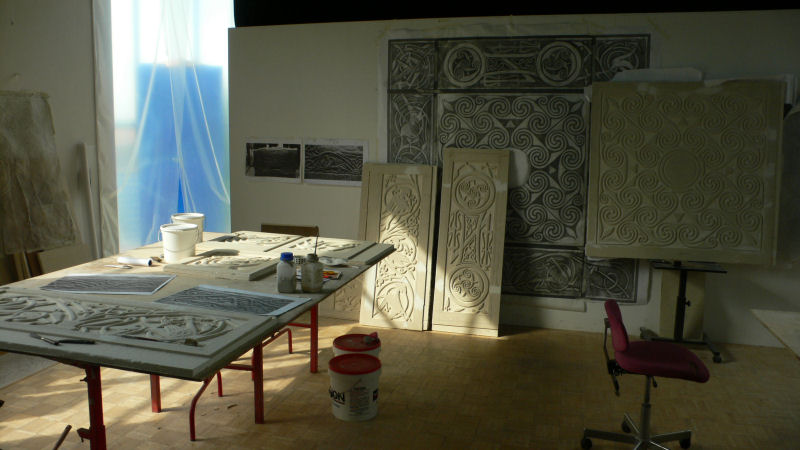
The forms in progress — all nine made simultaneously, each brought to the same level of finish before moving to the next stage
The most important phase of making this work was preparing the forms onto which the glass would be cast. The window is made in nine sections, with the largest panel measuring 1.35 metres, almost square. These forms are not merely supports — they are, in effect, the artwork itself. Every line, every depth, every transition between the raised spirals and the flat ground had to be resolved in the form before a single piece of glass was placed.
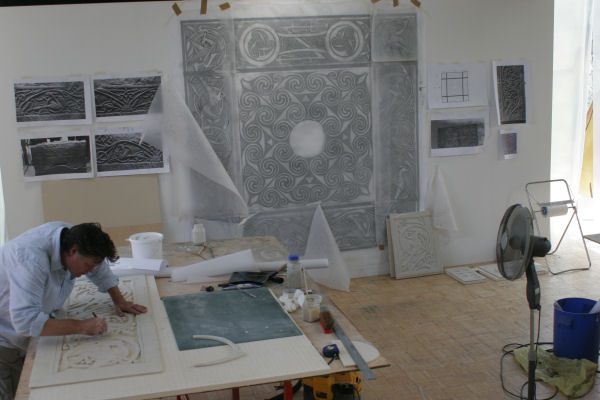
I made all the forms simultaneously, bringing each one to the same level of finish before moving to the next stage. The material was a carbon fibre board — chosen because it must withstand firing temperatures above 800°C without degrading or contaminating the glass. Throughout this phase, I was running continuous samples alongside the main work, testing and refining the technique, identifying and solving problems as they arose.
The large centre panel — the Pictish spiral fully resolved in the form, amber glass already beginning to take on the colour of the finished work
Drawings and photographs from the original Hilton of Cadboll stone were kept on the studio wall throughout — the source material always present, always available for reference. Working at this scale, the relationship between the carved original and the glass interpretation has to be felt as much as calculated.
These forms were made at the Derix Studio in Taunusstein, Germany, where I have worked for many years — the same studio in which the Dalmore Still House Window was later fabricated.
Making the Texture
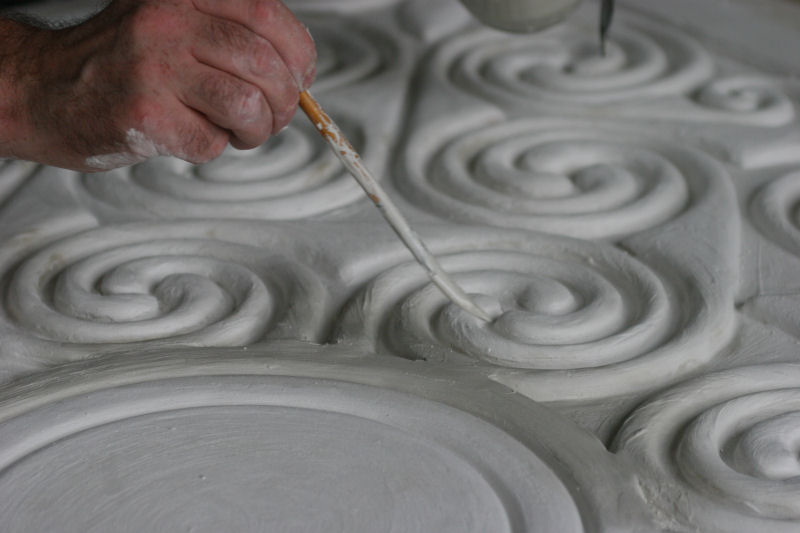
the matting was not left smooth, I developed a painted on method to create directional texture.
To give the glass life and sparkle, I painted all of the moulds to build up some structure giving a richer surface to the glass after fusing. This was a very important art of the process. Basically the moulds were the sculptures. I made these in the days before I had learned hoe to cast moulds, otherwise I would certainly have cast this piece. As it was, each mould was unique and got destroyed in the firing. Later, I learned how to cast using a mould I made from a border section. That transformed my work completely and was the method we used in the Kericho Project.
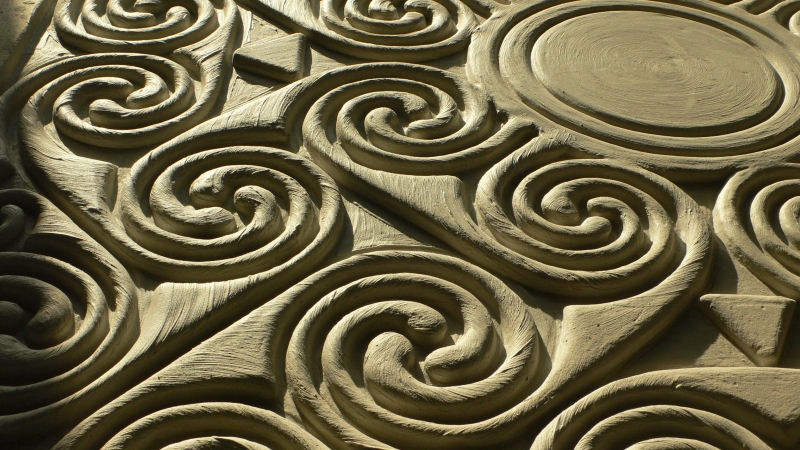
Detail of the large centre panel — the texture painting is still wet in this image.
I learned the method of casting from the wonderful Michael Bullen in the Northlands Studio, sadly now closed down.
The few weeks I spent there gave me an insight into casting and also developing my use of Bullseye Glass which occupies me to this day.
In this image you can see the painted structure on the mould. The glass was fused directly on top of these prepared moulds. If something had happened and the firing failed, the mould would have been destroyed and I would have had to begin again. I only had once accident when I was moving a mould but was able to save it.
Preparing the Glass
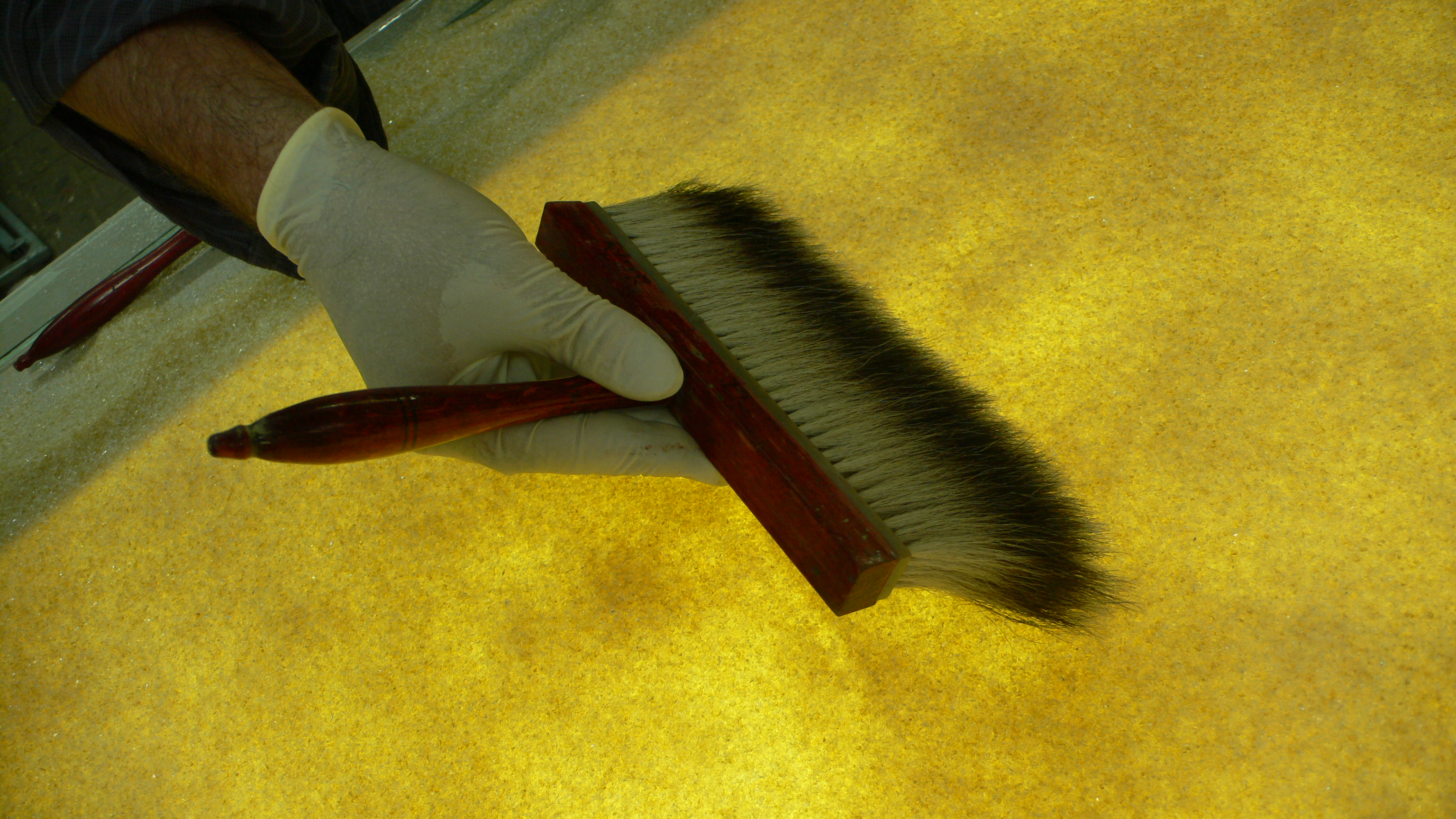
The base glass being prepared — a layer of amber frit spread evenly across the 12mm fused sheet
The base glass had first to be prepared. I used two layers of clear 6mm glass fused together, giving a sheet of 12mm — thick enough to allow the material to melt and flow down into the deeper areas of the relief form during firing.
To achieve the whisky colours, a layer of frit — crushed Bullseye glass in amber and gold tones — was spread evenly across the surface of this base sheet and melted into it. This coloured base layer was prepared in advance of the final firing, while the forms were still being completed. I also painted a structural layer onto the relief surface of the forms themselves, adding further definition to the image.
The Firing
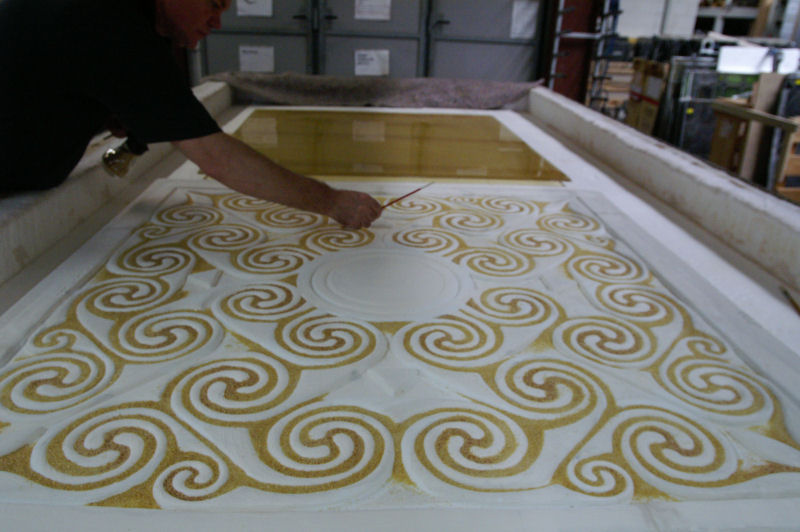
The forms loaded in the kiln — frit applied, ready for firing
Once the forms were completed they had to dry out fully before being fired. After firing, the carbon fibre forms become considerably more fragile — sensitive to any impact or vibration. I finished preparing them inside the kiln itself rather than risk moving them. With the forms in place, the prepared glass sheets were positioned on top — the coloured frit layer facing down into the relief.
The firing and cooling cycle took around eighteen hours. The kilns must remain closed and undisturbed until the glass has returned almost to ambient temperature.
These were nervous hours. If something goes wrong at this stage — a crack, a failure of the form, an error in the temperature curve — it is back to the beginning. Each panel is unique: the carbon fibre form is completely destroyed in the firing process. The result can never be exactly replicated.
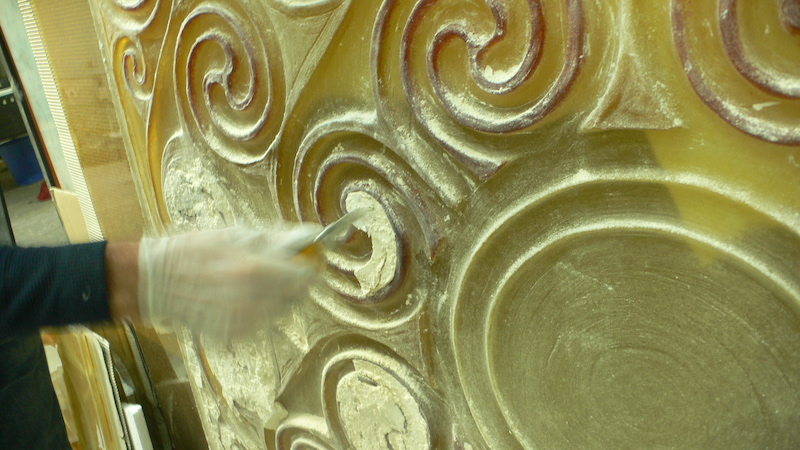
After firing and removal from the kiln — the form destroyed, the glass permanently resolved
The final stage, after removal from the kiln and clearing away the remnants of the form, is simply to wash the glass.
What remains is irreversible. The amber and gold of the whisky colours are now part of the glass itself — not painted on, not applied to the surface, but fused into its structure. The Pictish spirals stand in real physical relief, each one unique, each one permanent.
Installation
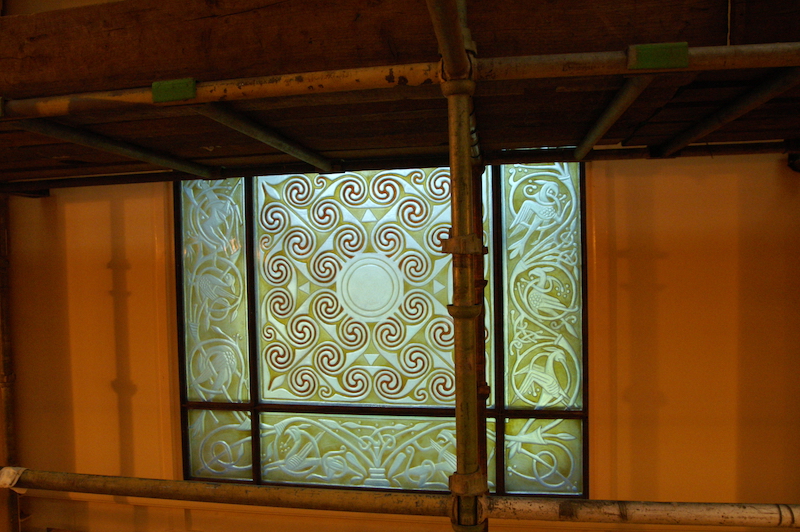
Installation in the still house — a long drive from Germany to Tain, and then a long climb up the scaffolding
The window was fabricated at the Derix Studio in Taunusstein, Germany. Installation meant a long drive from Germany to Tain in Ross-shire — and then a long climb up the scaffolding before the centre panel settled into its frame. That panel weighs approximately 170 kilograms.
I had designed the frame and arranged its manufacture, making the nine panels to fit it precisely. Once on the scaffolding, the panels settled into place one by one.
The Finished Work
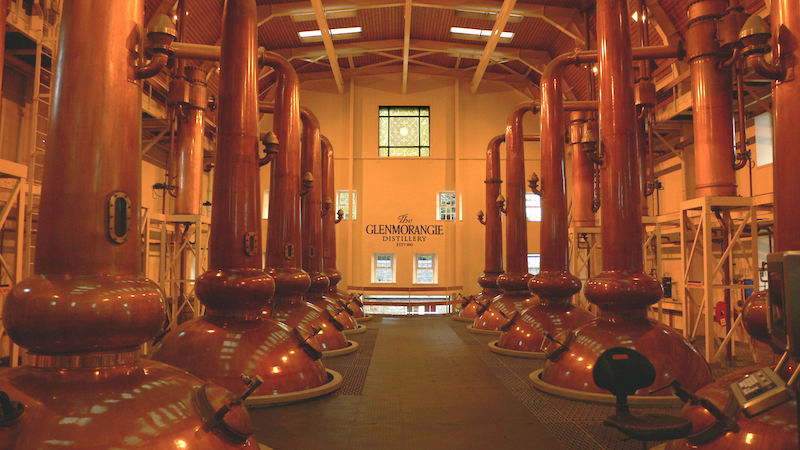
The finished window in the still house — the Cathedral, as Glenmorangie's own team named it
The still house at Glenmorangie — the Cathedral, as its own marketing team named it — now has its window. The Pictish spiral, drawn from a stone carved over a thousand years ago on the Ross-shire coast, resolved through Barry Grove's scholarly interpretation and my own research in the Museum of Scotland, is now permanently present in this room in fused amber glass relief.
As much as anything made of glass can be, this is a permanent work. It will not fade or change, and should remain part of this building for as long as whisky is made there.
This was a unique and very special project. I am grateful to everyone at Glenmorangie who had the vision to commission it, and who gave me the freedom to develop a completely new approach to working with glass — an approach that has informed everything I have made since.
I last saw this work in 2025, it still looks wonderful, it is still a delight to have made it.
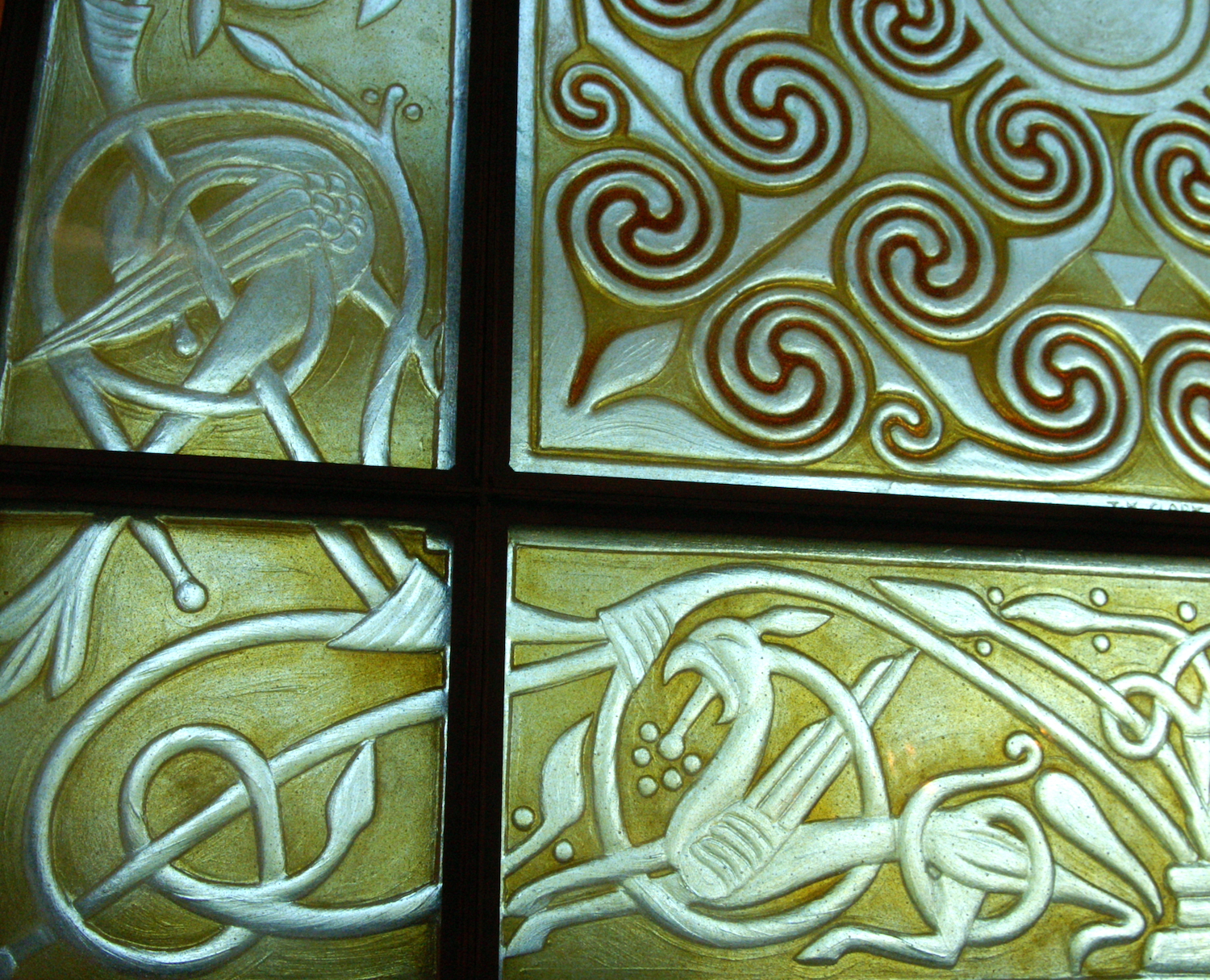
Detail of the spiral pattern and some of the border — amber and carnelian fused into the glass, showing beautifully the relief sculpture.